
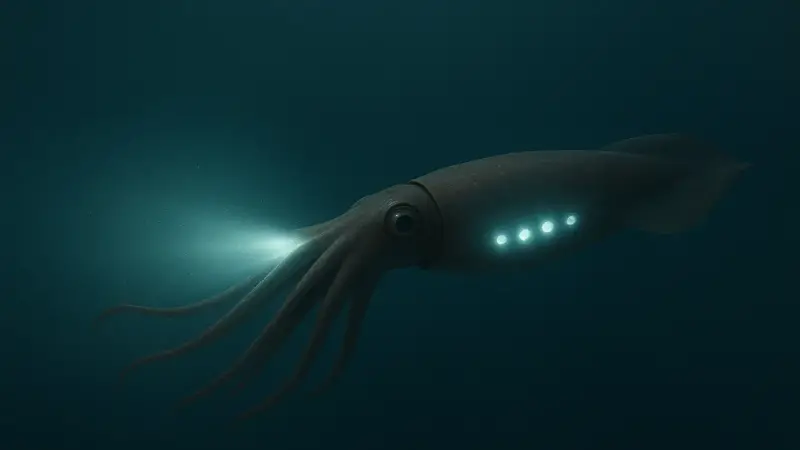
Why would a squid glow unevenly?
If you’ve ever looked up from underwater footage of the deep sea, one thing jumps out fast: down there, light mostly comes from living bodies. This isn’t one single place or one single species, either. Variations show up across the open ocean, from the Gulf of Mexico to the Monterey Canyon off California and the waters around Japan. Some deep-sea squid don’t flash symmetrically. They’ll fire bioluminescence harder on one side than the other, and it can make them harder to pick out. The core trick is that the glow isn’t meant to “be seen.” It’s meant to erase an outline at exactly the moment a predator is trying to lock on.
The deep sea is lit from above, not around
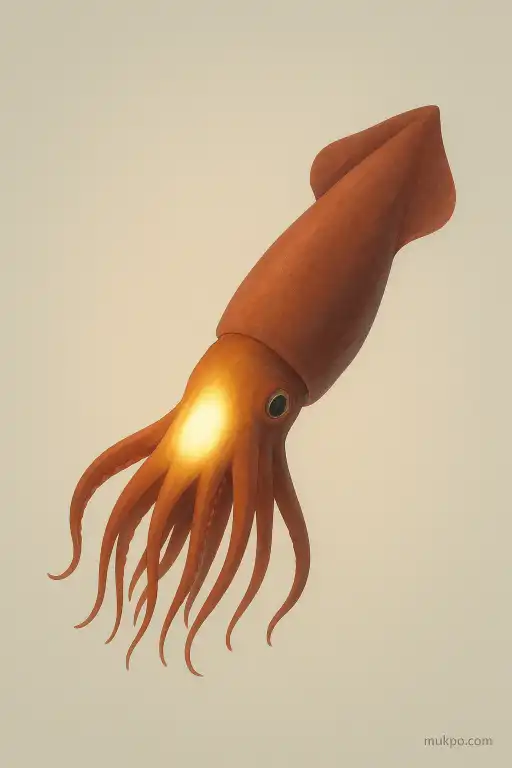
Most of the time, a predator below is looking up. Even at depth, there’s often a faint downwelling glow from the surface. That makes animals into silhouettes. A squid’s body blocks that dim light and becomes a clean shape. So the easiest way to vanish isn’t to match the darkness. It’s to match the background brightness coming from above. That’s why so many midwater animals use counterillumination: light on the underside, tuned to cancel the shadow.
The overlooked detail is that the background isn’t uniform. It changes with angle, waves, clouds, and depth. Even the squid’s own posture changes the shadow it casts. If a squid rolls slightly or turns at an angle, one side of its underside can look darker than the other from a predator’s point of view. A perfectly even glow can actually create a new cue: a bright “flat” patch that doesn’t fit the surrounding light field.
Lopsided light can cancel a lopsided shadow
Uneven flashing makes sense when the squid isn’t level. If it’s banking, twisting, or jetting away, the silhouette isn’t a neat oval. It becomes skewed. By biasing light output to one side, the squid can reduce contrast where the shadow is strongest and avoid over-brightening the side that already blends in. From below, that can make the body edge “disappear” for a beat, which is often all it needs to break a pursuit.
This also fits how many deep-sea squid carry their light organs. Photophores aren’t always arranged in perfect mirror-image rows. Some species have clusters concentrated on the belly, arms, or around the eyes, and they can vary by species and life stage. Control can be local, too. Instead of one central dimmer switch, different patches can brighten or dim independently, letting the animal correct for a changing viewing angle in real time.
Flashing isn’t just “camouflage” — it can be a timing weapon
A lot of people imagine continuous glow. But quick pulses matter. A flash can land right when a predator is about to strike, which is when the predator’s visual system is trying to confirm distance and shape. A sudden, uneven burst can interrupt that confirmation without turning the squid into a long-lasting beacon. If the squid then changes direction, the predator’s last reliable “track” points to the wrong place.
The lopsided part helps here because it can fake motion cues. Brightening on one side shifts the apparent center of the body for an instant. That can make the squid’s true position feel offset, especially if the predator is judging based on contrast edges. In the midwater, where there’s little reference structure, those tiny errors can be costly for the hunter.
It has to work against real predators with real eyes
The main audience for these flashes is likely fish and other visual hunters moving through the twilight zone and deeper. Many of them are tuned to detect silhouettes and small brightness differences, not color. Bioluminescence in the deep sea is usually blue-green for a reason: that wavelength travels farthest in seawater, and lots of eyes are most sensitive there. So the squid’s job isn’t to create a pretty signal. It’s to match the exact brightness a predator expects from the background, while the squid is turning, accelerating, and changing depth.
One situational example is a squid rising or falling through a thin layer where brightness changes quickly with depth. If it’s climbing while angled, the upper side of its underside may be closer to the faint surface glow than the lower side. That asymmetry can be visible to a predator below. A lopsided flash can “patch” the mismatch for a moment, and then the squid is already somewhere else.

Related reads
- How bristlecone pines archive millennia of drought in rings and resin
- How Joshua Norton declared himself Emperor on 1859 San Francisco streets
- An elevator that skips floors if you say a secret word
- Why unfinished tasks cling to your mind
- The town statue that mysteriously appears wearing a different hat every morning
- A phone line that delivers hold music recorded during the 1970s