
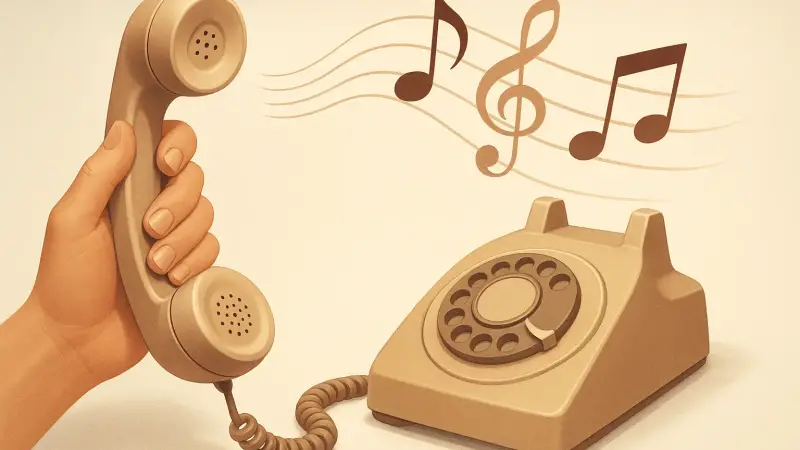
A number you call just to be put on hold
Most people only hear hold music while they’re trying to reach a human. But there are phone lines you can dial on purpose that do the opposite: they answer, then keep you waiting, looping old recordings as if the call never quite “connects.” It isn’t one single place or one famous line. Versions have shown up in different countries over the years, including the United States and the United Kingdom, and the exact number tends to change or disappear. The basic mechanism stays the same. A recorded program starts playing immediately, and it’s curated to sound like a specific era. Sometimes that era is the 1970s, complete with the soft synths and thin, telephone-bandwidth audio that makes it feel even older.
Where that 1970s sound actually comes from

Hold music from the 1970s often isn’t “a song” in the way people assume. A lot of it was made as production music: short, reusable cues recorded by studios and sold on libraries. Companies would license tracks and drop them into systems without crediting an artist on the line. That’s part of why the same melody can pop up in unrelated places. It wasn’t rare for one piece to end up on thousands of systems over decades, especially once tapes got duplicated and reused.
There’s also a technical reason it feels so time-stamped. Telephone audio cuts off most bass and most sparkle. It’s narrowband, designed for speech. A 1970s cue that already leaned on midrange instruments—electric piano, light strings, early synthesizer pads—survives that filter in a recognizable way. Modern music often collapses into mush under the same limits, but older arrangements can sound oddly “clean” through a handset.
How a “hold music line” is set up
A dedicated hold-music number is usually just a normal telephone endpoint connected to some kind of playback system. Historically that might have been a tape loop or a cartridge. Later it became a CD, and now it’s often a digital file. The phone line answers automatically, then routes the caller to that audio. If the goal is to mimic a real waiting experience, the recording might include occasional voice announcements, fake transfer clicks, or sudden volume jumps.
One detail people overlook is that “on hold” isn’t always the same as “listening to music.” Many business phone systems play music from a separate source, but the caller is still technically connected to a live system that’s managing the call state. A novelty line doesn’t have to manage any of that. It can simply play a recording down the line from start to finish. That simplicity is why these numbers can exist at all, and also why they’re easy to shut off once they attract attention.
Why anyone would keep it running
Sometimes it’s a side effect. A business might publish a support number, and the support queue quietly becomes famous for its music. People start calling just to hear it, and the company either tolerates it or replaces the audio. Other times it’s intentional. A telecom hobbyist, an art project, a radio producer, or a museum exhibit might set up a line as a small public portal to a sound archive. The public doesn’t need an app. The phone network is the interface.
There’s also a practical motivation: phone audio is a controlled environment. Anyone, anywhere, can dial in and hear roughly the same thing. That makes it a strange kind of broadcast channel that still works during internet outages. If the recording is from the 1970s, the limitations become part of the authenticity. Even the faint hiss and the hard edges on loud notes can be a deliberate choice, because it matches what callers used to hear on real corporate systems.
What callers tend to notice (and what they miss)
The first thing people notice is the mood. 1970s hold music tends to be cheerful but restrained, built to be ignored without being annoying. The second thing is repetition. If the line is using a short loop—especially an older tape-derived loop—the seam can be obvious. You might hear a tiny dip, a click, or a slightly different noise floor right where the audio joins itself again. That “seam” is often the most honest clue about the source format.
What people miss is how much of the sound is created by the network itself. Compression, echo cancellers, and level control can pump the volume in a way the original recording never had. A quiet intro can get boosted until the hiss becomes loud. Then the system clamps down when the melody swells. That can make a clean studio track from decades ago feel like a fragile artifact, even if the original master was perfectly crisp.

Related reads
- The word at the edge of your tongue: why retrieval slips away
- Salt chemistry in Enceladus plumes and what it reveals about hidden oceans
- Why the word you need vanishes in the middle of a sentence
- The mirror in a thrift shop that reflects rooms nobody recognizes
- How seagrass meadows bury carbon and reshape coastlines
- The Antarctic brine pocket where microbes breathe metal instead of oxygen