
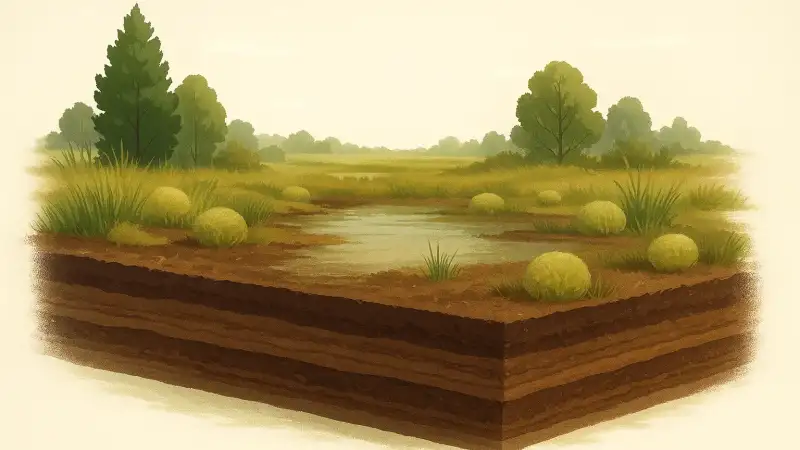
A simple question: how can a swamp keep a record?
If you cut a plug of peat out of a bog, it can look like plain brown compost. But inside it is a timeline. That isn’t one famous place, either. Researchers pull these cores from sites like the Flow Country in Scotland, raised bogs in Ireland, and peatlands across Finland. Layer by layer, the peat holds onto pollen grains that drifted in from the surrounding landscape. The core mechanism is simple. Pollen lands on a wet surface, gets buried, and then sits in conditions that slow decay to a crawl.
The part people often miss is that the bog isn’t just storing “old stuff.” It is actively making a sealed archive. The surface keeps accumulating plant material, and yesterday’s pollen is pushed down into colder, darker, more oxygen-starved layers.
Peat builds up in layers that stay in order
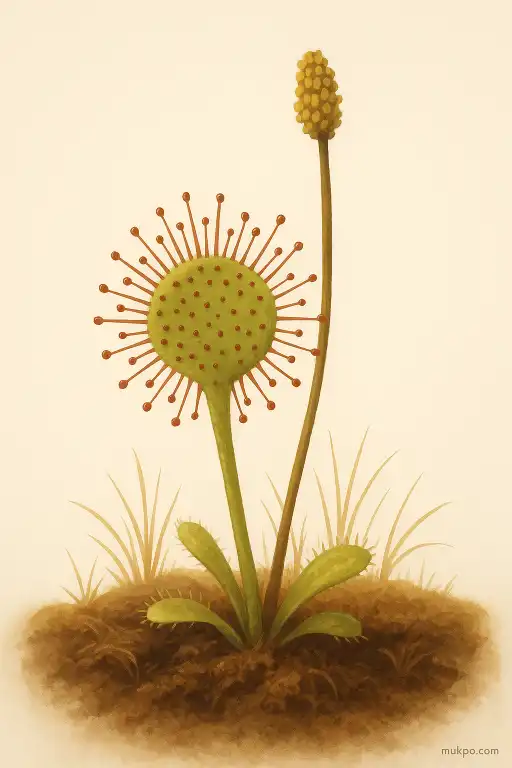
Peat forms when plant material is produced faster than it breaks down. In many bogs that’s dominated by Sphagnum moss, which grows at the top while older material is compressed underneath. That slow, steady build-up matters for pollen. It creates a stack of thin layers that tend to remain in sequence, so deeper usually means older.
It isn’t perfectly neat everywhere. Burrowing animals, root growth, and cracking during drought can disturb layers in spots. But compared with many soils, a bog often behaves like a filing system. Each season’s pollen rain is more likely to end up as a distinct smear in the next layer down instead of being churned and mixed for decades.
Low oxygen and acidity protect pollen’s tough outer coat
Pollen survives because it is built for survival and because bog chemistry helps. The outer wall of a pollen grain is made of sporopollenin, a very decay-resistant material. In a bog, that armor is helped by waterlogged conditions that limit oxygen. Without much oxygen, many microbes and small soil animals that would normally chew up organic debris can’t do their usual work.
Bogs also tend to be acidic, especially those dominated by Sphagnum. Acidity slows decomposition further and reduces biological activity. That combination—waterlogging plus acidity—doesn’t preserve everything equally. Soft plant tissues can still break down. But pollen’s outer wall often persists, which is why it becomes such a reliable signal when other traces vanish.
The bog surface acts like a pollen trap
Pollen is constantly drifting through the air, and bogs are open, exposed landscapes. That makes them good collectors. Grains fall directly onto wet moss, into pools, and onto saturated peat. Once a grain is damp, it is more likely to stick rather than blow away again. The next growth of moss and the next wash of organic debris can cover it quickly.
A specific detail that gets overlooked is how uneven pollen production is between plants. Pine can release huge amounts of lightweight pollen that travels far, while many insect-pollinated plants contribute far less to the airborne mix. So a peat core doesn’t record “what was growing” in a simple one-to-one way. It records what was growing nearby, what was producing pollen heavily that year, and what the wind could deliver to that bog’s surface.
Those grains become a dated record of changing landscapes
When scientists extract a peat core, they can slice it into depths, process each slice, and count pollen types under a microscope. Because peat accumulates over time, those counts can be linked to a sequence of changes: more tree pollen during forest expansion, more grass and heather pollen during open-land phases, or sudden shifts that may line up with drainage, burning, or farming around the bog. The exact timing varies by site and needs independent dating, often using radiocarbon from the peat itself.
Even within one bog, different spots can tell slightly different stories. A core taken near a pool edge may trap pollen differently than one from a drier hummock. That is why studies often compare multiple cores from the same peatland and look for patterns that repeat, rather than treating a single narrow column of peat as the whole history.
Related reads
- Why some rocks end up glazed with natural mineral polish
- The Alaskan town where night stretches for 65 days and residents throw sunrise parties
- Why catchy songs loop in your mind without warning
- The Taos hum that only some residents can hear
- How nocturnal moths navigate moonlit landscapes
- Why time seems to slow down during a sudden scare