
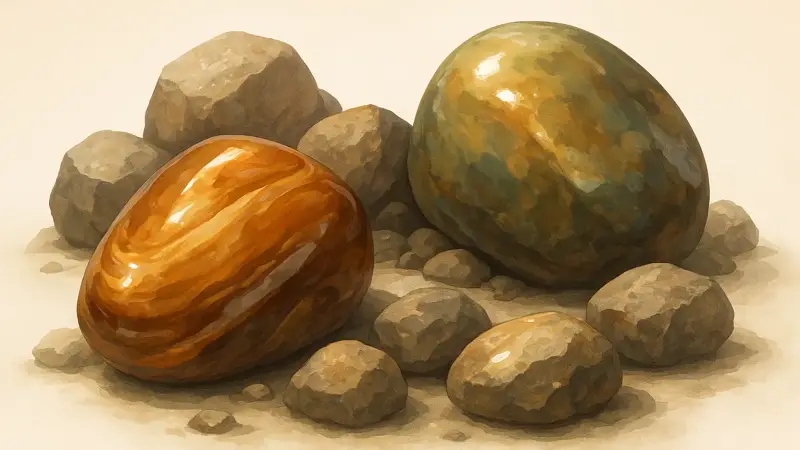
That odd shine on an ordinary rock
Pick up a stone from a dry wash and sometimes it looks like it has been waxed. Not wet. Not painted. Just oddly glossy. This isn’t one single place or event. It shows up in different ways in the Mojave Desert in the U.S., on wind-scoured surfaces in the Atacama Desert in Chile, and on wave-tumbled pebbles along the coast of Cornwall in England. The core mechanism is simple: a hard surface gets microscopically smoothed, then its outermost skin gets “sealed” or coated by very thin mineral films. Light stops scattering as much, so the rock starts to read as polished.
Polish without people: abrasion does the smoothing
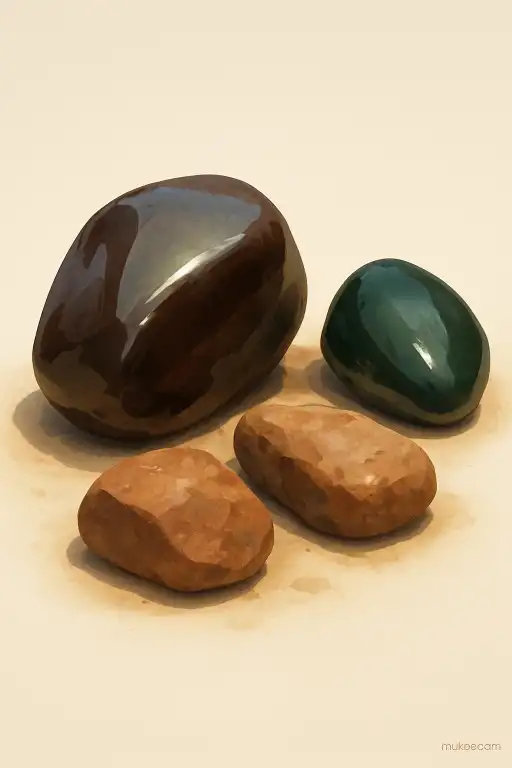
Natural polish starts with abrasion. Water moves sand and grit. Wind does too. Even slow motion counts, because it’s the number of tiny impacts that matters. Over time, sharp corners get knocked down and the surface texture changes from jagged to gently rounded at a microscopic scale. When a surface gets that kind of fine smoothing, it reflects more light in a consistent direction, which looks like a glaze.
One overlooked detail is that it doesn’t take a river-sized current. A seasonal wash that runs hard for a few hours a year can do a lot, because the sand load is high and the impacts are fast. The same stone can be dull on the sheltered side and glossy on the side that faced the grit stream, simply because one face took the abrasion and the other didn’t.
Thin mineral skins: varnish, silica, and iron films
Smoothing alone can make a rock look brighter, but a true “glazed” look often includes a coating. In deserts, a well-known one is rock varnish: an extremely thin, dark film rich in manganese and iron oxides, mixed with clay minerals. It can be glossy even when it’s only microns thick. It tends to develop on stable surfaces that stay exposed for a long time, because the coating builds slowly from dust and tiny amounts of moisture.
In other settings, the film is different. Silica can precipitate out of water and leave a very thin, hard, glassy skin. Iron-bearing water can leave an iron-oxide sheen that’s more amber or reddish. The exact recipe varies with local chemistry, and it isn’t always clear from appearance alone which film is doing the work without lab tests. But the effect is similar: once pores and microcracks get partly filled, light scattering drops and the surface reads as “polished.”
Why some rocks shine and others stay dull
Rock type matters. Fine-grained rocks like chert, quartzite, and some basalts can take a high natural polish because their minerals are hard and the texture is tight. Softer or more porous rocks lose material too quickly or keep a rough microtexture, so they stay matte. Even within one rock, different minerals wear at different rates. A surface with quartz grains cemented in a softer matrix can polish in patches, then pit where the softer parts weather out.
Exposure matters just as much as composition. A rock that is constantly moved gets abraded but may never hold onto a stable coating. A rock that is stable might slowly build varnish or silica skin, but only if it isn’t being freshly scratched. That’s why polished-looking stones often come from environments that alternate between movement and rest: a beach that tumbles pebbles, then leaves them to dry; or a desert pavement where stones sit for long periods but still get sandblasted.
Small conditions that control the final look
Moisture cycles are a quiet control knob. In very arid places, dew can matter more than rain because it arrives frequently and evaporates slowly enough to move ions across the surface. That can help mineral films grow in a thin, even way. Dust supply matters too, because dust brings clays and metals that become part of varnish-like coatings. A clean, frequently washed surface might stay bright but not develop that dark, glossy skin.
Angle and shelter can decide everything. A face tilted upward can collect more dust and moisture, and it can end up darker and shinier than a downward-facing side that gets scoured clean. Tiny hollows often stay dull because grit can’t reach them to smooth them, and coatings grow unevenly in sheltered pits. That’s why “glaze” often shows up as a skin on ridges and flats first, while the protected microtextures keep their rough, light-eating look.

Related reads
- The Alaskan town where night stretches for 65 days and residents throw sunrise parties
- Why catchy songs loop in your mind without warning
- The Taos hum that only some residents can hear
- How nocturnal moths navigate moonlit landscapes
- Why time seems to slow down during a sudden scare
- How lichens mine rock faces with living acids