
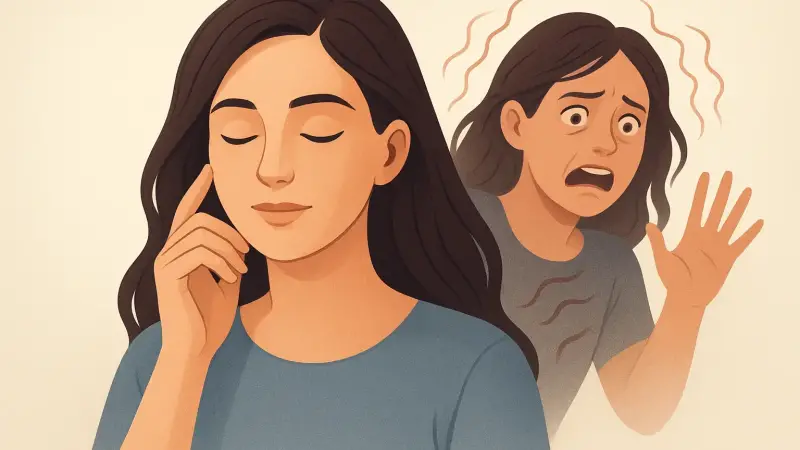
That weird moment when acting calm changes the feeling
It isn’t one single event or place. You can see it in a packed New York subway car, in a hospital waiting room in London, or at a Tokyo train platform when the loudspeaker suddenly announces a delay. Someone looks like they’re fine. Their shoulders drop a little. Their face stays neutral. And a minute later the panic doesn’t fully disappear, but it often loosens its grip. The core mechanism is surprisingly plain: the body reads signals from the outside in, not just the inside out. When the “calm” signals show up in posture, breathing, and voice, the alarm system sometimes dials down because the evidence looks less like danger.
The body treats calm behavior as data
Panic is not only a thought. It is a whole-body state: heart rate up, muscles braced, attention narrowed, and a fast scanning for threat. One reason pretending calm can help is that the nervous system uses feedback from muscle tension, breath rhythm, and facial expression as part of its ongoing threat calculation. If the jaw is clenched, the breath is high in the chest, and the eyes are wide, the body gets one kind of “report.” If the face softens and the breath becomes slower, it gets another.
A small overlooked detail is the throat. When people are panicking, the larynx and surrounding muscles often tighten without them noticing. That changes the voice: higher, thinner, more strained. Even if the words are normal, the tone can keep the body in an “urgent” mode. When someone keeps their voice low and steady—almost like they’re reading a grocery list—it can nudge that throat tension down, which then feeds back into the feeling.
“Pretend” calm is often just interrupting the spiral
A panic spiral is self-reinforcing. A sensation shows up (a skipped beat, dizziness, heat in the face). It gets interpreted as a sign of danger. That interpretation adds more adrenaline. Then the new sensations feel like proof that the first interpretation was correct. Calm-looking behavior can break the loop at a boring, mechanical point: it reduces some of the sensations that the mind keeps checking. Less chest heaving means less air hunger. Less muscle bracing means fewer tremors. The thoughts may still race, but they have fewer physical “updates” to latch onto.
This is also why the timing can look odd from the outside. Someone may still be scared, but their body has fewer obvious panic markers. That mismatch can create a small window where the brain stops treating the moment as escalating. It’s not that the fear was fake. It’s that one part of the system stopped amplifying the other.
A concrete scene: the meeting that starts with a surprise question
Picture a work meeting where a person is asked a question they didn’t prepare for. Their stomach drops. They feel heat in their cheeks. They notice their heart pounding and assume everyone can tell. If they answer in a rushed voice, with quick shallow breaths between phrases, the body keeps interpreting the situation as a threat that is still unfolding. If they pause, keep their shoulders still, and speak at a normal pace, something specific changes: the exhale lengthens. That longer exhale tends to pull the heart rate down a notch. The feeling often follows a beat later.
The overlooked detail here is eye behavior. In panic, people often lock their gaze or flick it rapidly to scan reactions. Both patterns can increase the sense of danger because the brain reads them as vigilance. A steadier gaze—still alert, but not darting—can reduce that “I’m being hunted” sensation that sometimes sneaks into social panic, even when nothing objectively threatening is happening.
Why it soothes sometimes, and why it doesn’t always
This effect varies because panic has multiple drivers. If the main driver is physiological arousal and feedback—breath, tension, adrenaline—then changing outward behavior can change the inputs and lower the alarm. If the main driver is a specific belief (“I’m about to faint,” “I’m trapped,” “I’m going to be judged”), the body may stay activated even if the person looks composed. People can also get a rebound: they hold themselves rigidly “calm,” which is still tension, and the nervous system doesn’t read it as safety.
Context matters too. In places where someone feels watched—an airplane seat, a silent exam room, a crowded elevator—acting calm can reduce social fallout while the body slowly settles. In other settings, masking can add pressure, because the person is monitoring their performance on top of the panic itself. That extra self-monitoring is easy to miss. It can keep attention pinned to the body, which is the same attention pattern panic feeds on.
Related reads
- Why compliments can feel uncomfortable to receive
- How emotional moods spread through a group without a word being said
- How bombardier beetles fire boiling chemicals as defense
- Earworms explained: why a fragment of a song repeats in your head
- A cave where bats abruptly changed their songs and left scientists baffled
- How Jupiter keeps its Great Red Spot from fading