
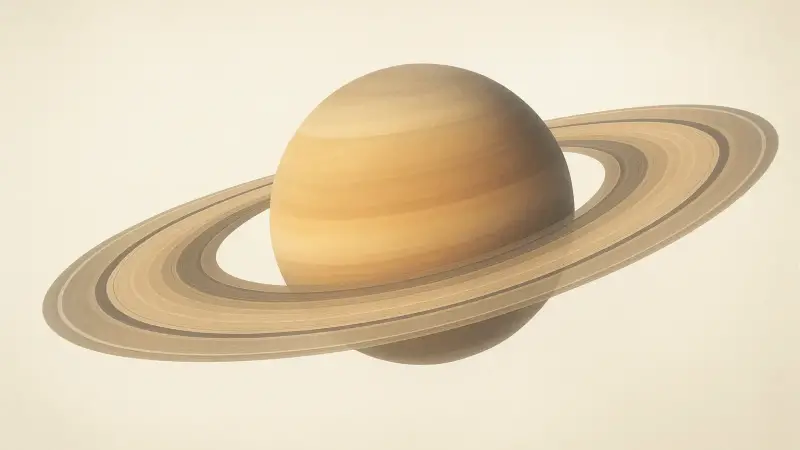
Every so often, Saturn does something that feels like a trick. The planet looks normal, but the famous rings seem to fade until they’re almost gone. Then, a few years later, they’re back. This isn’t one single event tied to one place. It’s a repeating geometry problem that plays out everywhere we observe Saturn, whether that’s from NASA’s Hubble Space Telescope, from big observatories on Earth, or from backyard telescopes that catch Saturn as a tiny oval. The core mechanism is simple: the rings are extremely thin, and our viewpoint shifts as Saturn moves around the Sun.
Saturn’s rings are wide but shockingly thin
Saturn’s ring system spans an enormous distance across space, but its thickness is small compared to its width. Think of a sheet that’s miles wide but only a bit tall. When you see it from above or below, it looks bold and bright. When you see it edge-on, there isn’t much “height” for sunlight to hit or for your eye to catch.
That thinness is the detail people usually overlook. The rings feel like a solid band in photos, so it’s easy to assume they would always be obvious. But the rings are mostly countless small particles and chunks of water ice spread out in a flat plane. If that plane lines up with your line of sight, the rings don’t have much surface area showing, so they dim dramatically.
The viewing angle changes as Saturn orbits
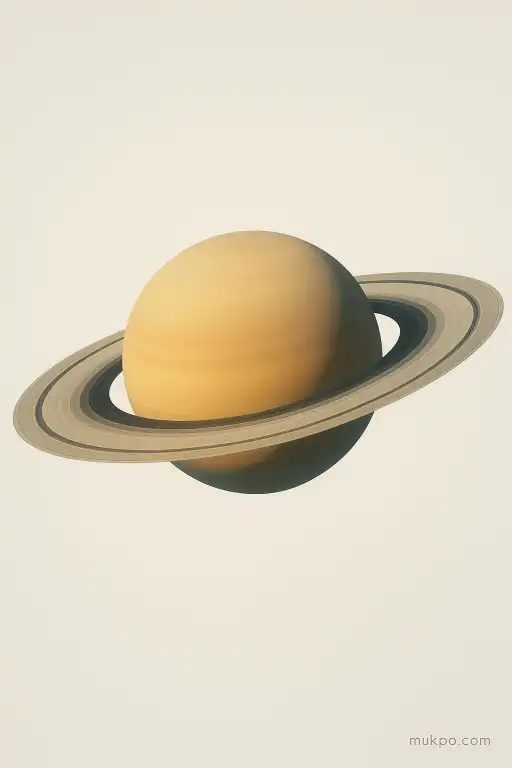
Saturn takes about 29.5 Earth years to orbit the Sun. Over that time, our angle to Saturn’s ring plane changes slowly. Sometimes we’re looking more “down” onto the rings. Sometimes we’re looking more “across” them. The ring plane itself stays tied to Saturn’s equator, but the Sun-Earth-Saturn geometry keeps shifting.
There are specific times when Saturn’s ring plane crosses the line between Earth and Saturn. Those are called ring plane crossings, and they’re when the rings can appear to vanish. Around those periods, the rings can also look lopsided: one side of the ring system can brighten before the other, because the tilt is changing and the lighting angle changes with it.
Light and shadow matter as much as tilt
Even when the rings are not perfectly edge-on, they can look weaker depending on how sunlight hits them. The rings shine mostly by reflected sunlight. When the Sun is positioned so that it lights the rings from a shallow angle, the brightness drops. The exact effect varies because the rings have different particle sizes and densities in different regions.
Shadows add another twist. As the seasons change on Saturn, the rings can cast shadows onto Saturn’s cloud tops, and Saturn can cast shadows onto the rings. Near edge-on views, those shadows can become thin and hard to notice, which makes the whole ring system seem to “disappear” faster than you’d expect. It’s not that the material is gone. It’s that the bright, easy-to-see parts stop presenting themselves to us.
What you see depends on the instrument and where you are
There’s a big difference between “invisible” and “hard to see.” Hubble can still pick out the ring line when conditions are right, because it isn’t fighting Earth’s atmosphere. From the ground, the rings can slip below what your eyes can separate from the glare of the planet, especially when Saturn is low in the sky and the view is softened by turbulence.
This is why two observers can report different impressions in the same month. A large telescope with good optics may show a hairline ring and a dark band where the ring plane cuts across the planet. A smaller telescope might show Saturn as a plain-looking globe with “something odd” at the edges. The rings didn’t change between those views. The resolving power did.
Edge-on moments reveal details you usually can’t notice
When the rings are close to edge-on, features that are normally lost in the rings’ brightness can become easier to pick out. Small moons that orbit near the ring plane can stand out more clearly against the darker background. The rings’ shadow on Saturn can also sharpen into a narrow line, which can make the planet look strangely “clean,” like it has been simplified.
One more overlooked detail is that Saturn’s rings aren’t a single uniform sheet. They’re divided into multiple rings and gaps. Near the edge-on geometry, that structure collapses into a single thin line from our perspective, so all that complexity gets compressed into almost nothing. Then the tilt increases again, and the same structure re-expands into the familiar bright bands.
Related reads
- When an entire harbor froze solid and the climate mechanics that caused it
- Why the walking palm appears to relocate and the root mechanics behind it
- The bakery oven that chimes at midnight with an impossible melody
- When uncontrollable laughter spread through Tanganyika schools in 1962
- How a Second Empire impresario tried to replace Parisian musicians with clockwork automatons
- How a vaudeville theater’s curtains seem to remember the names whispered into them