
A small thing that keeps stealing your eyes
You can be staring right at a phone screen and still snap your attention to a shadow that moves off to the side. This isn’t tied to one single place or event. It shows up everywhere, from driving on a highway in the United States to walking through a Tokyo station to watching a soccer match in Spain. The core mechanism is simple: the visual system treats motion in the periphery as a priority signal and pushes it forward before you’ve decided it matters. It’s fast, and it tends to feel automatic. Even when the moving thing is irrelevant, it gets processed like it might be urgent.
Peripheral vision is built for change, not detail
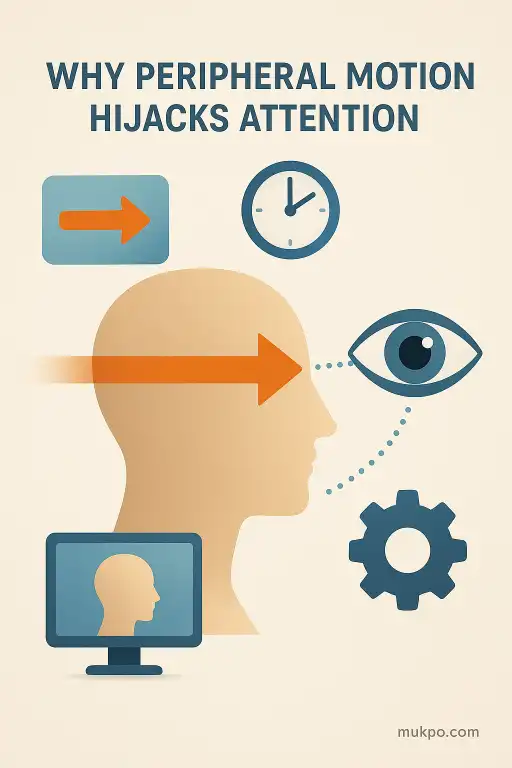
Peripheral vision is low on fine detail and high on sensitivity to change. The retina’s center (the fovea) is packed for sharp, high-resolution vision. The outer retina has different strengths. It’s better at detecting broad patterns, flicker, and motion. That means the edge of your vision is less suited for reading a sign but better suited for noticing that something is moving at all.
One overlooked detail is how much the brain is compensating for the periphery’s blur. You don’t usually experience the world as having a sharp “spotlight” in the center and fuzz everywhere else. The brain fills in stability. But motion is harder to “fill in” as constant, because motion is change. So movement breaks through the illusion of steadiness more easily than color or shape does.
The attention system treats motion like a possible threat
Attention isn’t only about choosing what you care about. It also has an interrupt function. Motion in the periphery is one of the strongest triggers for that interrupt. In everyday terms, it’s the difference between calmly scanning a scene and suddenly orienting toward something that might be approaching you. The brain is constantly estimating “what changed?” and “could that change matter?” before conscious thought catches up.
A concrete example: driving past a line of parked cars, you may be focused on the lane markings. A tiny outward movement in the corner of your eye—like a door beginning to open or a cyclist shifting position—can yank attention immediately. You often don’t register what it was until after you’ve already looked. The interrupt fires on motion first, and identification comes second.
Why it feels stronger than it “should”
Peripheral motion doesn’t just get detected. It competes well. One reason is timing. Motion signals travel through fast visual pathways that emphasize speed over detail, which helps the brain react quickly. Another reason is that peripheral motion is noisy. The system expects less certainty out there, so it leans toward “better safe than sorry.” A small movement can get amplified into “pay attention now,” because missing a real event is costlier than checking a false alarm.
The strength of the hijack also depends on context. If the main task is visually demanding—reading, threading a needle, tracking a ball—there’s less spare capacity to suppress distractions. Peripheral motion then wins more often, not because it’s more important, but because the brain is already running close to its limit. That’s why the same flicker in the corner of your eye can feel easy to ignore one moment and impossible the next.
Designers and environments lean on this effect
Modern environments are full of deliberate peripheral motion cues. Think of a notification badge that animates, an auto-playing video thumbnail, or a scrolling billboard beside a road. These elements work partly because the periphery is tuned to movement. They don’t need to be readable at a glance. They only need to create change that pulls the eyes, and then the fovea arrives to do the detailed work.
What’s easy to miss is that “motion” isn’t only an object moving across space. It can be a sudden contrast change, a flicker, or a pattern that shifts just enough to imply movement. Even a light reflection sliding across a glossy surface can trigger the same orienting response. The brain treats it as information about something changing in the world, and it keeps checking, because ignoring motion has always been a risky bet.