

That quick head-turn in a crowd
It isn’t one single place or event. You see it in lots of settings: a packed subway platform in New York, a football stadium in Manchester, or a busy street market in Tokyo. Someone’s eyes snap to the left, and before you know it, yours follow. Often you don’t even feel like you decided. That reflex comes from how the brain treats other people’s gaze as high-priority information. A glance can mean “there’s something important there,” and the cost of missing it can be higher than the cost of checking and finding nothing.
What’s easy to overlook is how fast it starts. People will shift their own attention based on another person’s eye direction even when the other person’s head barely moves, and even when there’s no obvious signal like pointing or speaking.
Gaze is a social signal your brain treats like a cue
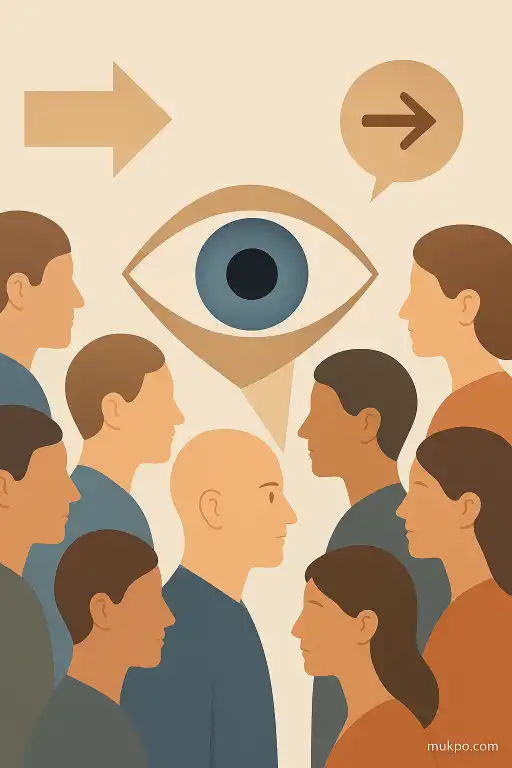
Humans are built to read faces quickly. Eye direction sits near the top of the list because it’s predictive. If somebody is looking at a sudden movement, a threat, a dropped object, or a person approaching, their gaze gives away where the action is before you can parse anything else. That’s why the reaction can feel “automatic.” It’s closer to orienting than to reasoning.
This is also why the effect shows up even when you don’t know the person you’re copying. You don’t need trust, status, or a relationship for the cue to be useful. In a crowd, most information is blocked by bodies and noise. Gaze is one of the few signals that can slip through without words.
Attention spreads because it’s cheaper than investigating alone
Looking where someone else is looking is a shortcut. Instead of scanning the whole scene, you borrow another person’s partial scan. If their attention was pulled by something real, you save time. If it was nothing, you lose only a fraction of a second. In dense crowds, that tradeoff is especially favorable because your own view is limited and constantly changing.
Once a few people do it, the signal gets amplified. More heads turn, and now there are multiple cues pointing the same way. At that point the “reason” can become circular: people aren’t just reacting to the original trigger anymore. They’re reacting to each other’s orientation.
Eyes and head don’t mean the same thing
There’s a detail people miss: the eyes can move without the head, and the head can move without the eyes. In a crowd, the difference matters. Eye-only shifts are subtle and often private. Head turns are big and public. So a head turn tends to recruit more followers because it’s visible in peripheral vision and can be detected from farther away.
That’s also why you sometimes glance in the “wrong” direction. If someone rotates their head while their eyes track something else, observers may follow the head, not the gaze. From a distance you’re often reading posture, not pupils. Your brain uses the most available cue, not the most accurate one.
Why it still happens when nothing is there
The reflex doesn’t require proof that there’s an object worth seeing. It’s triggered by the possibility that something matters. That’s why it persists during false alarms: a person looks up at a building façade, someone else follows, and soon a small cluster is staring at blank windows. The crowd isn’t “deciding” the windows are interesting. People are just responding to an attention cue that, under uncertainty, is hard to ignore.
Context changes the threshold. In places that feel risky or unpredictable—late-night transit stops, tightly packed festival entrances, unfamiliar neighborhoods—tiny cues can pull attention more strongly. In calm settings with clear sightlines, the same glance might barely register, because your own scan of the environment is already good enough.

Related reads
- Why comet tails shed sodium and how sunlight sculpts them
- The Christmas truce and the impromptu football match along the 1914 Western Front
- When a 1784 Paris commission exposed Mesmer’s animal magnetism as spectacle rather than science
- The island that vanished from maps and reappeared decades later
- How deep-sea worms cultivate sulfur bacteria on hydrothermal vents
- How the brain completes muffled conversations with confident fake words