
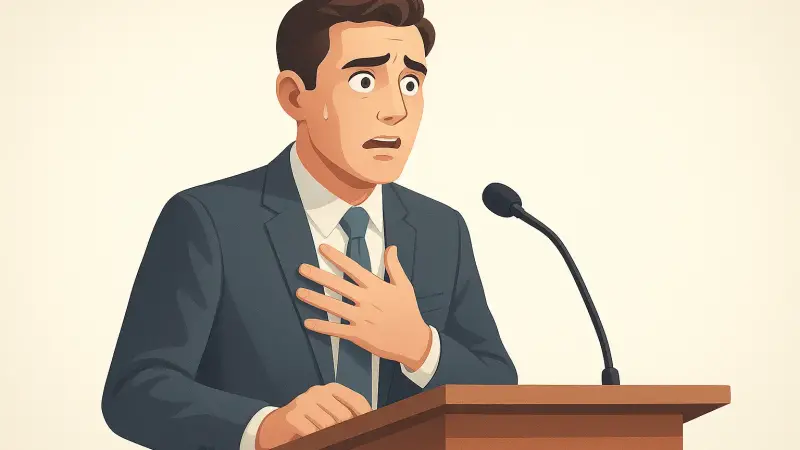
A familiar moment on a familiar stage
It doesn’t happen in one single place or one single kind of event. It shows up at a high school classroom podium, in a conference room in New York, or on a Zoom call where everyone’s faces sit in little rectangles. Someone stands up with notes they know well, and then their mind goes blank. The freeze isn’t a lack of knowledge. It’s a fast body-state change. The brain briefly shifts from “explain and connect” to “detect threat and avoid mistakes,” and speech is one of the first things to wobble.
There’s also a quiet contradiction built into it. Public speaking is socially normal and usually safe. But the body can treat it like a high-stakes situation anyway, because being watched and evaluated has mattered for survival and belonging for a long time.
Freeze is a real stress response, not just nerves
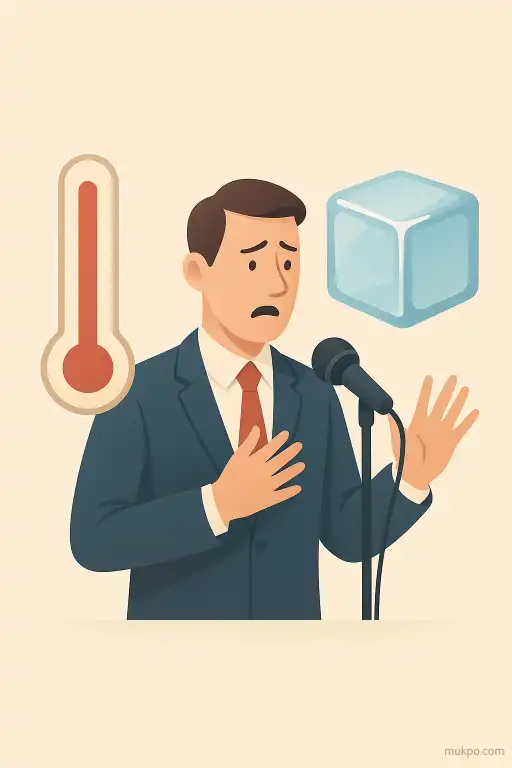
People talk about “fight or flight,” but freeze is part of the same family of responses. When the nervous system detects possible danger, it can push the body toward action, escape, or stillness. Freeze often shows up when the situation feels inescapable and performance-based. You can’t easily leave the room. You also can’t “win” by arguing. So the system chooses a temporary shutdown: reduced movement, narrowed attention, and less flexible thinking.
That shift changes how memory works in the moment. Under stress, the brain relies more on habit and less on working memory. That’s why a person can remember the content perfectly while practicing, then lose access to it as soon as the audience looks up. It isn’t that the information disappeared. Retrieval just got harder.
Speech is fragile when the body goes into alarm
Speaking is a surprisingly complex physical task. Breath, vocal cord tension, mouth movements, timing, and word selection all have to coordinate. When stress hormones rise, breathing often gets shallower and higher in the chest. The throat can tighten. The mouth can go dry. Those are small changes, but they can make speech feel like it’s stuck behind a gate.
A detail people usually overlook is that freezing can start one beat earlier than the obvious blank mind. It can begin as a tiny breath-hold right before the first sentence, especially when someone is waiting for a cue like “Whenever you’re ready.” That small pause can cascade. Less air leads to less steady voice. The voice wobble then becomes new evidence of danger, and the alarm state deepens.
The audience becomes a “prediction problem”
Public speaking adds uncertainty that private thinking doesn’t have. A speaker has to predict how others will react while also tracking their own words. The brain is constantly scanning for signals: a frown, a whisper, someone checking a phone, a blank stare. Most of these signals are ambiguous. Under stress, ambiguous signals are more likely to be interpreted negatively, because the system is trying to avoid social mistakes.
This is why the same person can speak fluidly in a one-on-one conversation, then freeze during introductions in a meeting. The content can be simpler in the meeting. The difference is the number of observers and the feeling of being “on record.” Even when nobody is hostile, the brain treats many eyes as a higher-cost environment for errors.
Why it can feel sudden and personal
The suddenness is part of the design. Threat detection systems are built to act quickly, before there’s time for careful reasoning. That speed is useful for physical danger. In a social performance setting, it can feel like betrayal. People often describe it as “my brain turned on me,” because the change is abrupt and doesn’t match their intentions.
It can also feel personal because the mind tries to explain the body’s alarm using the most available story: “I’m not good at this,” “They can tell I’m anxious,” “I’m going to mess up.” Those thoughts aren’t always the original cause. They’re often the brain’s attempt to justify a state it’s already in. The freeze happens first, then the meaning arrives to match it.
Related reads
- Why glacial flour turns alpine lakes brilliant turquoise
- Why ordinary coincidences feel like meaningful signs
- A village where fish rain down after storms
- The urge to check your phone when nothing new has arrived
- The fish that uses sand like a file to reshape its jaws
- Why imagined confrontations can feel physically exhausting