

The moment it slips, and the moment it returns
Someone asks for an actor’s name at lunch, and it’s right there but also nowhere. The conversation moves on. Then, hours later, it drops into mind while standing in line at Target or staring at a sink full of dishes. This isn’t one single famous incident or place. It’s a common pattern people report in New York, Seoul, or a quiet town where nothing else about the day is memorable. The basic mechanism is that the word was partly activated, but the brain couldn’t reach the exact sound-and-letter pattern on demand. Later, with the pressure gone, the same network gets nudged again and the answer clears.
Why it feels like it’s “on the tip of your tongue”
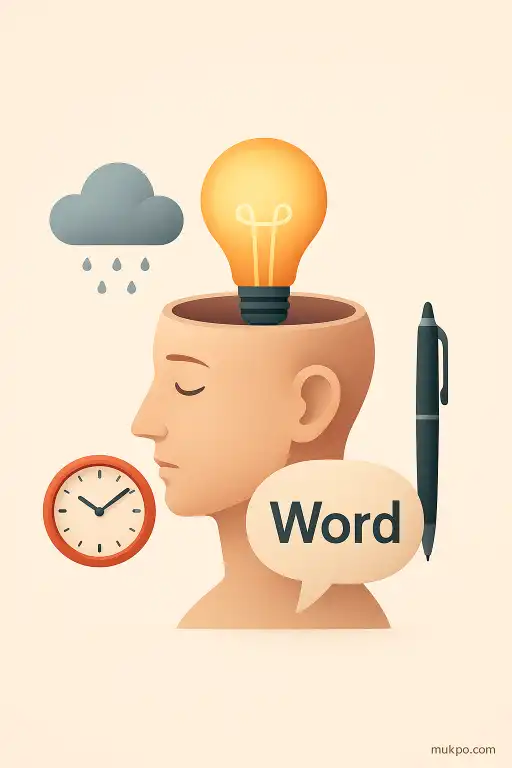
The stuck feeling has a name in psychology: the tip-of-the-tongue state. It tends to come with fragments. A first letter. The number of syllables. A similar word that is definitely wrong. That mix is a clue about where the snag is. Meaning is often available, but the specific phonology—how the word is built from sounds—fails to fully activate. People can even be confident they’d recognize it instantly if someone else said it, which fits the idea that recognition can work when recall can’t.
One overlooked detail is how often the brain supplies “blockers.” These are near-neighbors that share sound or category. If the missing name is “Hugh Jackman,” a mind might keep offering “Hugh Grant” or “Jack Black.” Those wrong answers aren’t random. They are strongly connected and easy to retrieve, so they keep winning the race. That repeated retrieval strengthens them in the moment, which can keep the correct word suppressed for longer than people expect.
What changes when you stop trying
The delayed pop-in often gets called “incubation.” The key shift is not magic memory suddenly switching on. It’s a change in constraints. Active searching tends to be narrow and repetitive. It circles the same partial cues and the same blockers. When attention moves to something else, the search pattern changes. The brain keeps processing lots of things in the background, and the word can be reached through a different route—an associated topic, a rhythm of speech, a visual reminder, or even a stray subtitle on a screen.
Relief and reduced self-monitoring matter too. Under social pressure, people monitor their speech more. They evaluate each candidate word as it appears. That can slow retrieval and increase interference. Later, alone, there’s no need to perform. A candidate word can surface without being immediately judged as “wrong, wrong, wrong,” which is part of why the arrival feels sudden and clean.
The brain’s filing system isn’t alphabetical
Words are stored through webs of meaning, sound, personal experience, and context, not like a dictionary. That’s why the environment can act like a key. If the missing word came up during a conversation about movies, a later glimpse of a streaming app icon or a poster might provide the right cue. Even small sensory details can matter. A particular jingle cadence, a familiar accent, or the sight of a red carpet photo can push activation toward the correct name instead of a competitor.
Another easy-to-miss detail is that “hours later” doesn’t mean the brain was silently repeating the problem the whole time. Memory networks can be primed. Once primed, they sit closer to the threshold. The next related cue can be tiny. People often don’t notice the cue because it doesn’t feel like a hint. It might be a single word in an unrelated email that shares a sound, like “grant,” which nudges “Grant” and then the mind hops to the “Hugh” pathway and corrects itself.
Why names and rare words are the worst for this
Proper names are famous for being hard to retrieve. They often carry less semantic content than common nouns. “Dentist” links to a whole cluster: teeth, drills, appointments, insurance, the smell of fluoride. A name like “Janelle” or “Hugh” can be attached to fewer built-in features unless a person has strong personal associations. With fewer routes in, the brain relies more on the exact sound pattern, which is the part most likely to stall.
Frequency matters too. Common words get practiced constantly, which strengthens their pathways. Rare words, new vocabulary, and less-familiar surnames have weaker connections and more competition from similar-sounding items. That’s why someone can explain a concept perfectly but blank on one specific label, then have it appear while folding laundry. The concept never left. The label just didn’t win access until the network got the right nudge.
Related reads
- How whale carcasses create island ecosystems on the seafloor
- The law that once listed house cats as livestock
- How background chatter quietly drains your focus
- Australia’s 1932 emu war where soldiers and machine guns were outmaneuvered by birds
- The town where the river runs backward once a year
- Why tiny awkward pauses make us assume the worst