
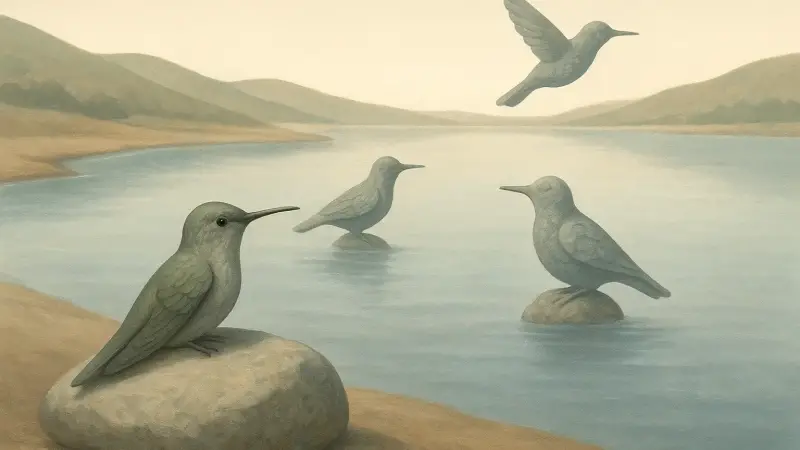
A lake that “petrifies” birds sounds impossible
If you’ve seen the photos from Lake Natron in northern Tanzania, you know why people talk about a lake that turns birds into stone. Dead flamingos and other birds appear stiff, chalky, and statue-like on the shoreline. The core mechanism isn’t magic. It’s chemistry plus drying. Lake Natron is highly alkaline, fed by mineral-rich hot springs and volcanic geology in the Rift Valley. When an animal dies in or near the water, the salts and minerals can coat the body. As it dries in the open air, that coating can harden and look like a crust of “stone.”
What Lake Natron is made of

Lake Natron is a soda lake. Its water chemistry is dominated by sodium carbonate and related salts that come from surrounding rocks and geothermal inputs. Because the lake sits in a hot, arid region, water evaporates faster than it is replaced for long stretches. That concentrates the dissolved minerals. The result can be extreme pH at times, along with high salinity. Conditions aren’t constant, though. The lake’s level and chemistry shift with rainfall and inflow, so the “petrifying” effect is more likely in some seasons and areas than others.
A detail people often overlook is that the shoreline isn’t one consistent surface. It can be a patchwork of mud, salt flats, shallow pools, and crusty mineral plates. That matters because the crust forms most readily where wet bodies or wet shorelines dry repeatedly. The hardening is a surface process. It can create a rigid shell even when the inside is not mineralized in the way a fossil is.
How a bird ends up looking like a statue
Birds don’t typically “turn to stone” while alive. What tends to happen is simpler. A bird dies from some other cause—exhaustion, injury, illness, or exposure—and ends up in the shallows or on the edge where water meets evaporating flats. The alkaline brine can irritate skin and eyes, but the bigger visual effect comes after death: mineral-rich water wets feathers and skin, then evaporates. Salts crystallize on the surface and between feathers. Over time, repeated wetting and drying can build a thicker crust that stiffens the body and locks it into a frozen-looking posture.
This is closer to encrustation than petrification. True petrification involves minerals replacing tissue over long periods, usually underground, which is how fossils form. At Lake Natron, the body is more like a naturally “salted” specimen. The rigid look is helped by feathers matted with crystals, and by the way a dried carcass holds shape when the joints and soft tissues dehydrate.
Why the lake still attracts so many birds
It sounds like a place nothing should touch, yet Lake Natron is famous for supporting large numbers of lesser flamingos. The same harsh chemistry that can crust a carcass also limits predators and competitors. Flamingos are adapted to alkaline lakes and can feed on microorganisms that thrive there. The lake’s remoteness and challenging conditions can make it a comparatively safer breeding ground than more hospitable wetlands that draw more predators and human disturbance.
That said, not every bird at Natron is a flamingo, and not every species is well-suited to the water. Individuals can still die from ordinary problems that happen anywhere—storms, disease, heat stress, or accidents. When those deaths occur in the wrong spot, the shoreline chemistry and sun do the rest, and the remains can persist long enough to be found and photographed.
What the photos don’t show
The most striking images usually show intact bodies placed on the salt flats, because they read clearly as “statues.” That can give the impression that the lake routinely produces perfect stone birds. In reality, many remains would be broken down by scavengers, weather, or shifting water levels before they ever become photographable. The crust can also be fragile. It can flake off, crack, or dissolve if conditions change and the shoreline floods again.
There’s also a timing problem that’s easy to miss. For a bird to look “turned to stone,” it needs enough exposure for evaporation to build a crust, but not so much time that the body completely collapses or disintegrates. That narrow window is part of why the phenomenon feels rare and dramatic. It’s not that the lake is a factory for stone animals. It’s that a very particular set of conditions sometimes lines up on a very mineral-rich shore.
Related reads
- Why peat bogs are such effective time capsules for pollen
- Why some rocks end up glazed with natural mineral polish
- The Alaskan town where night stretches for 65 days and residents throw sunrise parties
- Why catchy songs loop in your mind without warning
- The Taos hum that only some residents can hear
- How nocturnal moths navigate moonlit landscapes