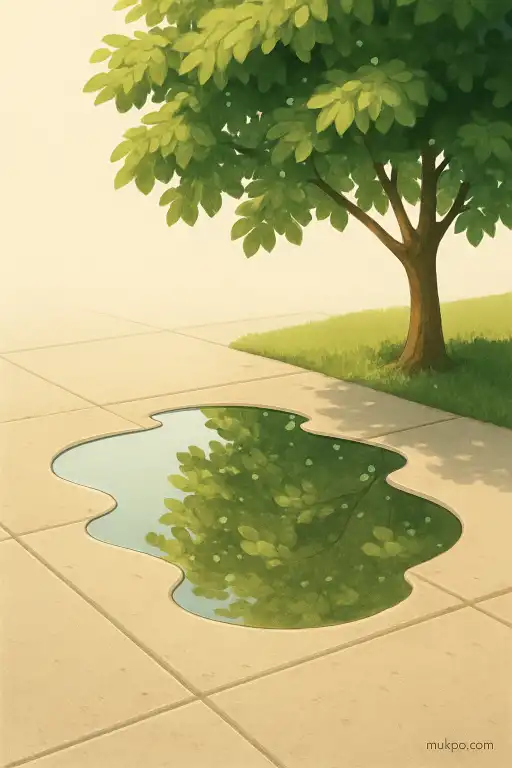
That odd dry patch under the branches
After a shower, it’s common to see a sidewalk still dotted with puddles, except for the strip that runs under a street tree. You can notice it on residential blocks in Seattle, along canals in Amsterdam, or on plane-tree-lined streets in Paris. It isn’t one single place or one special kind of pavement. The fast-disappearing water is mostly about airflow and heat at the ground. A tree canopy changes wind, shade, and humidity in a very local way. That can make a puddle under leaves evaporate differently than one in the open, even when the rain just stopped.
Trees change the wind at ankle height
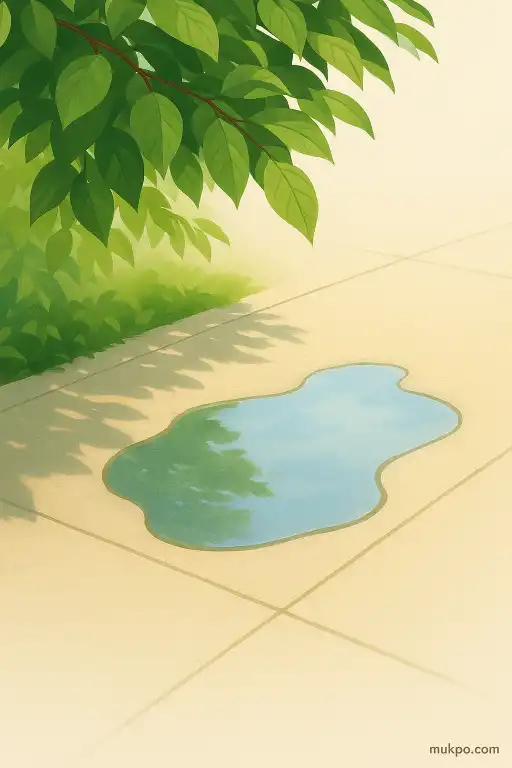
Evaporation speeds up when moist air at the surface gets replaced by drier air. Open pavement often has a thin, stubborn layer of still air right above it, especially when the broader wind is light. Under a leafy crown, wind doesn’t simply “stop.” It gets chopped up. Leaves and branches create small gusts and eddies that mix the air close to the ground. That mixing can strip away the humid layer sitting on top of a puddle and keep evaporation going.
A detail people usually overlook is height. A lot of the “wind” you feel at chest level isn’t what the puddle feels at 2 centimeters above the concrete. The canopy can reduce strong, steady wind overhead while still producing restless, swirling air lower down. Whether that happens depends on the tree’s shape, how dense the leaves are, and how the street is oriented, so the effect varies block to block.
The canopy also changes where the sun’s heat ends up
Shade seems like it should keep water around longer. Sometimes it does. But a sidewalk in the open can lose heat quickly to the sky after rain, especially when clouds break and the pavement “sees” a big, cold sky dome. Under a canopy, the ground sees more leaves and branches than open sky. That can reduce radiative cooling and keep the surface a bit warmer than the fully exposed pavement nearby.
Warmer pavement doesn’t need direct sunlight to help evaporation. If the concrete retains a little more warmth, the thin film of water in a shallow puddle can keep turning into vapor. This is one reason the difference can show up even on overcast days. How strong it is depends on cloud cover, the time of day, and how wet the canopy itself is.
Leaves steal water from the ground air
After rain, a tree isn’t just sitting there. Wet leaves dry. As they dry, air moving through the canopy can be pulled into a cycle of mixing and exchange. Later, when leaves are no longer dripping, they can also keep releasing water vapor through transpiration if it’s warm enough and the tree is active. That sounds like it would make the air more humid and slow evaporation, but it also drives airflow: warm, moist air tends to rise through the canopy, and drier air can be drawn in from the sides at sidewalk level.
So you can get a local “pump” effect. It’s small, and it’s not guaranteed. A dense canopy on a windless, humid day may trap moisture instead. But when the air is reasonably dry and there’s a little breeze, the moving, exchanging air under leaves can keep the puddle from sitting under a stagnant humid blanket.
Less puddle can form there in the first place
Sometimes the puddle isn’t vanishing faster. It simply started smaller. A leafy canopy intercepts rainfall. Some water never reaches the ground because it clings to leaves and evaporates later. Some arrives late as drips from leaf tips and branch ends. That changes the timing and the pattern of wet spots, which matters on sidewalks that are slightly sloped or uneven.
A concrete, situational example: on a block with a gentle crossfall toward the curb, the open sidewalk can get a broad sheet of water that flows, collects in shallow depressions, and becomes a puddle. Under the tree, the rain can arrive as scattered drops and small streams that miss those depressions or don’t last long enough to pool. Add in litter, bark bits, or fine dust under the tree that roughens the surface, and water can spread into a thinner film instead of beading up into a deeper puddle that hangs around.
Why it flips on some days
There are days when puddles under trees last longer. If the air is already humid, evaporation slows everywhere, and a canopy can keep the near-ground air even more moisture-rich. If the tree is very dense and blocks most turbulence, the air under it can go still. On cold days, shade can matter more than the radiative “blanket” effect, so the shaded pavement stays cooler and water lingers.
Street design can also overwhelm everything. A downspout splash zone, a low spot at a driveway seam, or a patch of smoother concrete can dominate where water sits. That’s why two puddles only a few meters apart can behave differently, even under the same branches.