
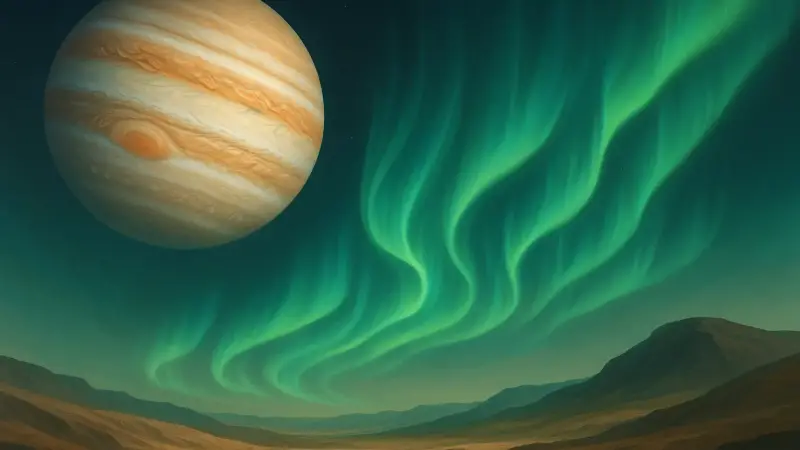
Why Jupiter’s auroras are a different kind of “northern lights”
It’s easy to assume auroras are always a solar-wind story, because that’s the familiar version from Earth. Jupiter doesn’t work that cleanly. There isn’t one single “aurora place” on Jupiter, and the details vary with time, but the big, famous examples include the bright main oval near each pole, the shifting polar emissions inside that oval, and a distinct footprint tied to Io’s orbit. NASA’s Juno spacecraft has watched these regions brighten and wrinkle as Jupiter’s magnetic environment gets disturbed. The core mechanism is still charged particles hitting the upper atmosphere and making it glow, but the way those particles get accelerated and guided is strongly shaped by Jupiter’s own magnetic storms.
The engine is Jupiter’s magnetosphere, not just the Sun
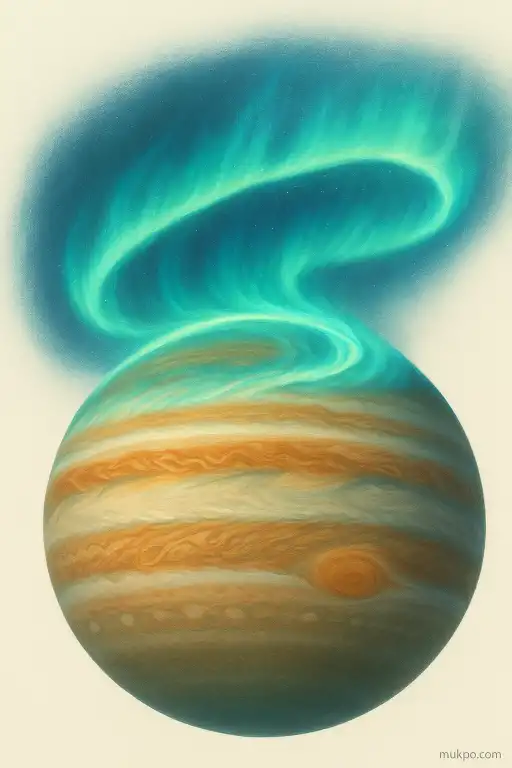
Jupiter’s magnetic field is huge and strong, and it spins with the planet. That spin matters. It drags magnetic field lines around like a rotating machine, and the magnetosphere tries to corotate with the planet. When that rotating system is stressed—by solar wind pressure changes or by internal mass loading—it can store energy and then release it in bursts. Those releases are what people mean by magnetic storms here: reorganizations of the magnetosphere that change electric fields, currents, and particle paths fast enough to change the auroras.
A specific detail that’s easy to overlook is that Jupiter’s auroral power supply is often internal. At Earth, the solar wind is the main driver. At Jupiter, the planet’s rotation provides a lot of the energy, and the solar wind often acts more like a trigger or a squeeze. When the solar wind compresses Jupiter’s magnetosphere, the whole system can respond abruptly, and the auroral brightness can jump.
What “magnetic storms” change: currents, acceleration, and where particles land
During stormy periods, the currents connecting the magnetosphere to the atmosphere can intensify or shift. Those currents run along magnetic field lines and are closely tied to auroral arcs. When they strengthen, they can set up electric fields that accelerate electrons downward into the atmosphere. The electrons collide with atmospheric gases and produce ultraviolet and infrared emissions that spacecraft can track, even when visible light is faint or hard to observe.
Storm-driven changes also move the “mapping” between space and the atmosphere. A given region out in the magnetosphere connects to a specific latitude and longitude near the poles. If the magnetosphere stretches, reconnects, or gets compressed, those connection points shift. That’s one reason Jupiter’s polar emissions can look messy compared to a clean ring. It’s not only a brightness change; it’s a change in where the particles are being guided to hit.
Io’s role: feeding the storm and leaving a visible track
Io is a constant complication. Its volcanoes supply huge amounts of material that becomes ionized and trapped in Jupiter’s magnetic field, forming a plasma torus around the planet. That extra plasma makes the magnetosphere heavier and harder to keep rotating at Jupiter’s pace. The resulting “slippage” sets up strong currents, which can help energize auroral regions even without a dramatic solar wind event.
There’s also a concrete, situational feature tied to this: the Io footprint. As Io moves through Jupiter’s magnetic environment, it acts like an electrical generator and sends disturbances along magnetic field lines into Jupiter’s atmosphere. The impact point can show up as a bright spot and trailing emissions. When magnetic storms alter the surrounding plasma and field configuration, that footprint’s brightness and shape can change, and the trail can look more or less continuous depending on conditions that aren’t always stable.
What observers actually see when storms sculpt the light
Jupiter’s main auroral oval tends to be the most persistent structure. It often marks where the corotating magnetosphere starts to break from perfect corotation and where strong currents close through the atmosphere. In stormier intervals, that oval can brighten and develop localized enhancements that drift with the planet’s rotation. Inside it, the polar region can erupt into patches and arcs that change quickly, sometimes on timescales closer to minutes than hours.
One more overlooked point is that different instruments tell different versions of the same event. Ultraviolet images track energetic electron precipitation well, while infrared emissions can emphasize heating and chemistry in the upper atmosphere. Juno has caught cases where the aurora brightens in one band more than another, implying that storms don’t only change how many particles arrive, but also their energies and the altitude where they dump that energy. That’s why the same magnetic disturbance can sculpt sharp arcs one time and broader, fuzzier glows another.
Related reads
- An island that stops traffic for migrating crabs
- How hydrothermal vents build lush communities without sunlight
- How we make snap moral judgments in a blink
- When the Great Stink halted Victorian Parliament
- The silent chemistry that paints autumn leaves in reds and golds
- What makes lightning behave differently over oceans and mountains