
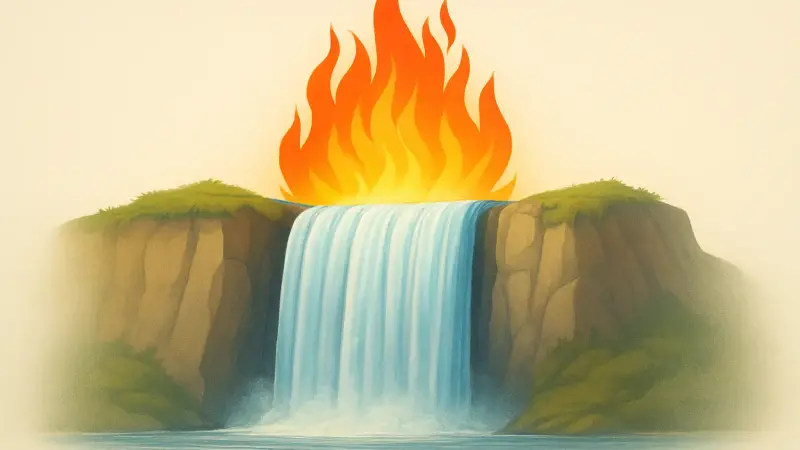
Seeing fire where water should win
Waterfalls usually look like the definition of “nothing can burn here.” So when people stand at Chestnut Ridge Park in Orchard Park, New York, and notice a small orange flame flickering behind the falling water, it feels like a mistake in the scene. The basic mechanism is simple, though. Fuel gas seeps out of cracks in the rock, collects in a little pocket, and someone has ignited it at some point. The waterfall keeps rushing down in front, while the flame sits back where the water doesn’t directly hit, protected by the shape of the rock and the airflow inside the recess.
Where the flame actually sits
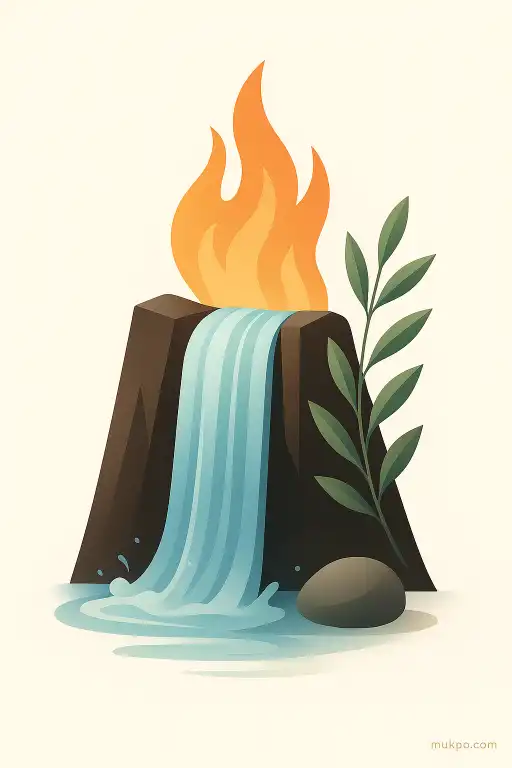
At Eternal Flame Falls, the fire isn’t “in” the water. It’s in a small grotto behind the curtain of falling water. That detail matters because the rock overhang creates a dry-enough zone and a steady path for air. If the flame were directly exposed to the falling sheet, it would sputter out immediately. Instead, the waterfall acts like a moving veil. You can see through it, but the flame is tucked into a pocket that the main flow skips past.
One overlooked detail is that the airflow can matter as much as the water. A waterfall can pull air along with it, and the little cave can “breathe” as wind shifts. That changes how the flame looks from minute to minute. Sometimes it’s steady. Sometimes it’s barely there. The size of the flame also depends on recent rain, because the water level changes the spray pattern and how wet the rock stays around the gas opening.
The gas is the real trick
The fuel is usually natural gas, mostly methane, leaking from underground. It moves upward through fractures in shale or other sedimentary rock. It doesn’t need a big reservoir. A slow seep is enough if the gas has a small sheltered space to collect and mix with oxygen. The seep can be steady or irregular. It can also change over time, because tiny shifts in groundwater, pressure, and sediment can open or pinch off pathways.
People often assume the flame must be volcanic or “from the Earth’s core.” That isn’t how these spots work. Western New York does not have active volcanism creating magma-heated vents at the surface. What it does have is gas-bearing rock layers and lots of fractures. The gas is a chemical fuel source, not a heat source by itself, and it needs ignition. The flame persists only because the seep continues to feed it.
Why the water doesn’t put it out
For a flame to go out, it needs to be cooled below its ignition point or deprived of oxygen or fuel. A waterfall mainly provides cooling water and turbulence, but it doesn’t automatically reach the flame. If the flame sits a few inches back in a recess, the falling water can pass in front like a curtain. Spray can still hit it, which is why these flames can be delicate. A small change in the flow can change whether the flame survives that day.
There’s also a geometry problem most people don’t think about. Water doesn’t fall as a perfect solid sheet. It breaks into strands and gaps. That creates brief “windows” of drier air behind it. If the rock pocket is shaped like a shallow bowl, it can stay comparatively sheltered even while everything around it is wet. The result looks impossible from a few feet away, but up close it’s more like a tiny campfire placed behind a wet beaded curtain.
Other places where fire and water overlap
This isn’t a one-off phenomenon, even if it’s rare to see it in such a neat, tourist-friendly setup. Natural gas seeps that can be lit show up in several regions. There are known “eternal flame” sites in the Chimaera area near Yanartaş in Turkey, where gas vents burn on a rocky hillside. There are also long-known burning gas features in Iraq at Baba Gurgur near Kirkuk, where petroleum and gas seepage has produced persistent flames. Those aren’t behind waterfalls, but they run on the same idea: a steady leak plus oxygen plus an ignition source.
The behind-a-waterfall version needs a specific combination of conditions: exposed rock layers that leak gas, a small protected cavity, and a waterfall that doesn’t flood the pocket directly. Change any one of those and the scene stops being photogenic. Sometimes the water wins. Sometimes the gas supply dips. Sometimes the pocket fills with debris. When it works, it looks like a rule of nature being broken, but it’s mostly a lucky arrangement of rock shape, airflow, and a very small flame in exactly the right place.
Related reads
- The habit of replaying past conversations
- Why kitchen lemons grow tiny roots when left in jars
- The town that heard a mysterious low hum no engineer could trace
- Why people stick to familiar routes even when a shortcut is obvious
- How sleep inertia turns you into a slow thinker after naps
- Storms that have actually dropped fish from the sky