
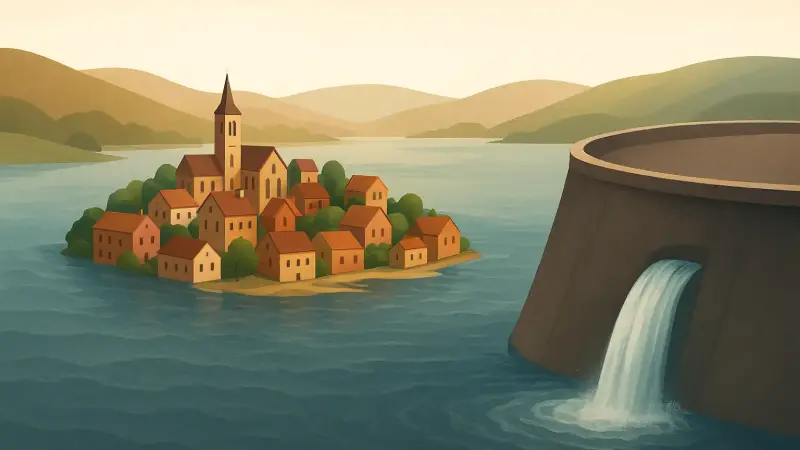
Reservoirs look stable from the shore. Then a dry year hits, and the shoreline pulls back so far that streets and stone walls start showing up. This isn’t one single place. It happens in different countries whenever a dammed lake drops below its usual level. Spain’s Aceredo reappeared in 2021 in the Lindoso reservoir on the border with Portugal. In the United States, parts of St. Thomas, Nevada show up when Lake Mead falls. And in Italy, the bell tower of Curon Venosta has been poking out of Lake Resia since 1950, but more of the old village becomes visible in unusually low water.
How a town ends up under a reservoir
Most of these places weren’t “lost” by accident. They were flooded on purpose to create storage for drinking water, irrigation, hydropower, or flood control. A dam goes up in a valley. The river backs up. Everything in the basin becomes lakebed.
What gets submerged depends on how the project was built and how people were relocated. Sometimes buildings were demolished before flooding, sometimes they were left standing, and sometimes only parts were removed. That difference is why one reservoir reveals neat stone foundations while another reveals rooflines, bridges, or a church wall with plaster still clinging to it.
Why it “resurfaces” at all

Reservoirs are managed like accounts that get deposits and withdrawals. Rain and snowmelt add water. Cities, farms, and power stations take it out. In droughts, there’s less coming in and the withdrawals don’t always drop at the same pace, so levels fall fast.
Operations matter as much as weather. A reservoir can be drawn down intentionally to make room for expected storms, to perform dam maintenance, or to meet downstream water obligations. That’s why a “sunken town” can appear even without a dramatic drought, and why the timing can vary from one year to the next.
What visitors actually see on the exposed lakebed
The first things that usually emerge are the high points: ridgelines that were once roads, the tops of staircases, and lines of old property walls. In Aceredo, low water revealed the layout of the village streets and the shells of stone houses. At Lake Mead, receding water has exposed bits of roads and infrastructure from before the reservoir filled, alongside later debris from decades of shoreline use.
A specific detail people overlook is how the “shoreline” can be misleading. Reservoirs leave bathtub rings and terraces that look like natural beaches, but they’re often just old waterlines and erosion steps created by repeated rise-and-fall cycles. Those steps affect what stays buried and what gets uncovered, because each pause in the water level can scour silt from one band and deposit it in another.
Why the ruins can be both well-preserved and fragile
Underwater doesn’t automatically mean protected. A reservoir is a rough environment: wave action, ice, and suspended grit can sandblast surfaces. When water drops, sun and wind dry out materials that have been waterlogged for years, which can crack plaster, warp wood, and loosen mortar.
There’s also chemistry at work. Low oxygen in deeper water can slow some kinds of decay, but alternating wet and dry conditions can speed others up. Metals can corrode rapidly when exposed to air after years underwater, and brick can crumble when salts crystallize as moisture evaporates.
What happens when the water comes back
Most of the time, the reappearance is temporary. The next wet season, or a change in reservoir releases, can cover everything again. That cycle can repeat for decades, which is why some places are remembered through occasional “returns” rather than through continuous visibility.
Even when the structures vanish under water again, the landscape doesn’t reset. Each exposure can change the site a little—footprints compacting mud, waves undercutting a wall, silt shifting into a doorway—so the next time the water falls, the town can look slightly different than it did before.

Related reads
- How octopus suckers taste to choose prey
- A waterfall with a natural flame burning behind it
- The habit of replaying past conversations
- Why kitchen lemons grow tiny roots when left in jars
- The town that heard a mysterious low hum no engineer could trace
- Why people stick to familiar routes even when a shortcut is obvious