
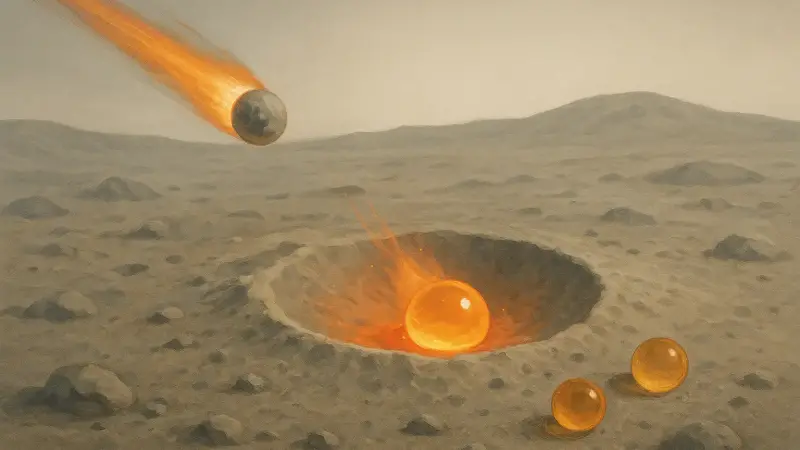
If you picture the Moon’s soil as dry dust, it’s easy to miss how much of it is actually tiny glass. The Apollo 11 and Apollo 17 samples brought back to Earth include countless bead-sized bits that look like they were melted and snapped into shape. There isn’t one single impact site responsible for them. They turn up across different regions, including the Mare Tranquillitatis landing area and the Taurus–Littrow Valley. The basic mechanism is simple: a micrometeorite hits at extreme speed, the surface flashes hot for a moment, and a small patch of rock and dust melts and then chills so fast it freezes into glass before it can crystallize.
What hits the Moon, and how fast it arrives
Micrometeorites are usually sand-grain sized or smaller. Many are bits of comet dust or fragments from asteroid collisions. On the Moon they tend to arrive at tens of kilometers per second, because there’s no thick atmosphere to slow them down. Earth gets hit by the same kind of material, but most of it burns up high overhead. On the Moon, the projectile reaches the ground still moving fast enough that the impact behaves less like a “chip” and more like a tiny explosion.
That speed matters more than the projectile’s size. Kinetic energy scales with velocity squared. So even a microscopic grain can dump enough energy into a pinpoint area to melt local material. The grain itself may vaporize, and some of it can mix into the melt. That mixing is one reason lunar glasses can carry traces of elements that don’t match the immediate surrounding grain-for-grain.
The instant melt: shock, heat, and a spray of droplets
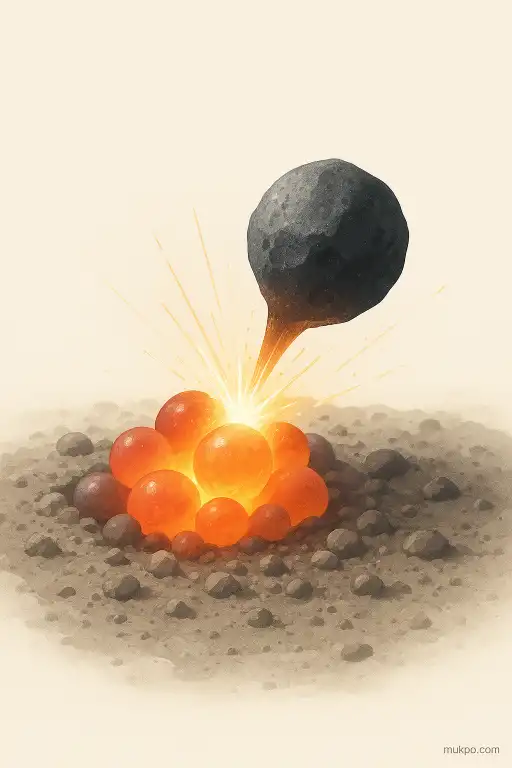
At the moment of impact, the target soil is shocked and compressed, then rebounds. Temperatures spike. Pressures jump. A shallow pit forms, and a jet of hot material gets thrown outward. Part of that ejecta is liquid or semi-liquid, and it doesn’t come off as one sheet. It comes off as droplets and strings that break apart.
A situational example helps: imagine a grain hitting fine regolith on a mare plain. The melted splash can be just a thin skin over unmelted dust, and it can still leave the crater only a millimeter or two across. Around that spot, droplets can fly out and cool while airborne. That’s how you end up with separate little spheres mixed back into the soil, not just glass fused in place.
Why the droplets become beads instead of jagged shards
A molten droplet naturally rounds up in flight because surface tension pulls it toward a sphere. The Moon’s near-vacuum changes the cooling story. There’s no air to convect heat away. Cooling is mostly by radiation and by contact when the droplet lands. Even so, the droplets are tiny, so they lose heat quickly. They can freeze into glass before crystals have time to organize.
One detail people overlook is how short the “liquid time” can be. For a very small droplet, the window between melt and solid can be fractions of a second to seconds, depending on composition and size. That short window locks in features like stretched bubbles, whorls, and uneven chemistry. Those textures are clues that the bead was once a flying droplet, not a chunk broken off a larger melt.
What ends up inside the glass
Lunar soil is already a mix: basalt fragments on the maria, more feldspar-rich material in highlands, and a steady rain of solar wind and micrometeorites everywhere. When a droplet forms, it can scoop up whatever is right there. That makes many beads chemically “local.” A mare bead tends to look basaltic. A highlands bead can look more anorthositic. Some glasses also trap a bit of vaporized material, which can change the final chemistry in subtle ways.
Vacuum also affects the volatiles. Elements that like to evaporate can be depleted because the hot melt has no surrounding pressure holding gases in. That’s why beads can show signs of volatile loss compared with their source grains. At the same time, some beads preserve tiny bubbles or voids, which can record gases present at the moment of quenching, including contributions from the impact vapor cloud or from material already implanted in the soil.
How the beads survive and accumulate in regolith
Once formed, beads don’t stay pristine. The same constant bombardment that created them keeps churning the upper layer of the Moon. Over long spans, gardening mixes beads downward and brings older material back up. Beads can get cracked, welded into larger clumps, or coated with thin rims produced by later impacts. Those coatings can make a bead look dull and dusty even though it’s still glass inside.
The result is that a scoop of lunar soil can contain a timeline in miniature. Fresh, glossy beads can sit next to older ones with pitted surfaces and adhered dust. The ages vary by location and by how recently a surface was disturbed by a larger impact, and it’s not always clear from appearance alone. That’s part of why Apollo-era samples are still studied: the beads are small, but they keep a very direct record of how often the Moon’s surface gets flash-melted by tiny, fast hits.
Related reads
- Why you freeze during public speaking
- Why glacial flour turns alpine lakes brilliant turquoise
- Why ordinary coincidences feel like meaningful signs
- A village where fish rain down after storms
- The urge to check your phone when nothing new has arrived
- The fish that uses sand like a file to reshape its jaws