
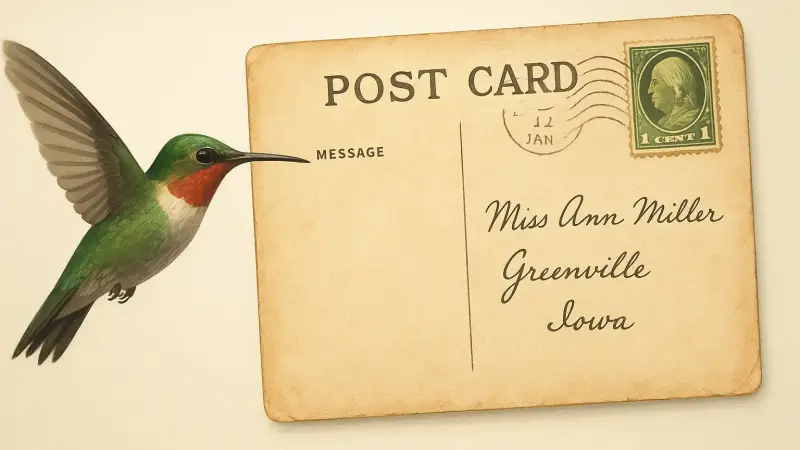
A letterbox surprise that doesn’t fit the calendar
People expect mail to be slow sometimes, but not “nearly a century” slow. Yet there are scattered reports of old postcards showing up long after they were written, with no clear single “famous town” behind it. The stories pop up in different places and different postal systems. For example, local news outlets in the UK have periodically covered very late postcards delivered by Royal Mail, and similar odd deliveries have been reported in parts of the US and Europe. The basic mechanism is usually mundane: something got misrouted or physically trapped, then re-entered the system when a building was renovated, a sorting center moved, or a forgotten sack was found.
The overlooked detail is the address itself. Old postcards often have incomplete addresses by today’s standards—no postal code, sometimes no house number, and handwriting that assumes a local postman knows the family. That makes “deliverable” a moving target that depends on who’s reading it, and when.
How something can vanish without being “lost”
Most extreme delays start as ordinary failure points. A postcard slips behind a sorting machine. A bundle falls into the gap between a shelf and a wall. A sack gets shoved into a corner during a rush period and later buried by newer supplies. It’s not always dramatic, and it doesn’t require a single catastrophic mistake. Postal systems move huge volumes, and tiny physical errors can persist for years if the item is literally out of sight.
Another route is “found paper” that wasn’t in the mail stream at all anymore. Postcards can end up inside furniture, books, or attic boxes and then get dropped into a mailbox decades later by someone who assumes they’re doing the right thing. In that case the late arrival isn’t a continuous journey. It’s more like a restart, with modern equipment and staff trying to interpret something written for a different world.
What changes over 80–100 years that affects delivery
Even if a postcard survives intact, the destination often doesn’t. Streets get renamed. Numbering schemes change. Villages are absorbed into cities. Postal codes are introduced or revised. Some countries have had major administrative reorganizations that change what “the right place” even means on paper. When an old card turns up, staff may have to decide whether to treat it like a collectible curiosity, return it to sender (often impossible), or attempt delivery based on whatever clues are still valid.
Names change too, and that’s a practical problem. A postcard might be addressed to “Miss Elsie Brown, near the church,” which could have been sufficient in 1920 and useless now. If it does get delivered, it may be because a current resident recognizes a family name, or because a clerk finds a match through local knowledge rather than any official database. That human layer still exists, but it’s uneven and depends on the specific route and the specific person handling the piece.
Why postcards are especially prone to strange outcomes
Postcards are exposed. They can be scuffed, stained, or partially torn while still remaining readable enough to try. Envelopes fail more cleanly; a letter that loses its contents can become undeliverable immediately. A postcard with a damaged edge might keep circulating because the key information—town name, a partial street, a surname—still shows through. That makes it more likely to be held aside, re-sorted, or placed in a “problem” tray that gets revisited later.
They also have fewer built-in corrections. If a postcard was written with the wrong town or a vague destination, there’s no return address on the back half the time, and no enclosure with more context. So the card’s fate depends heavily on small marks people rarely think about: a faint postmark that hints at origin, a stamp type that suggests an era, or a scribbled addition like “care of” that points to a business that may no longer exist.
What usually happens when one finally resurfaces
When an extremely old postcard is discovered in a facility or a recovered container, it often gets treated like any other item that lacks a clear path: it’s checked for a valid address, assessed for legibility, and then either forwarded, returned, or set aside. If the address still maps to a real location, it may simply be delivered with no ceremony. The recipient then becomes the first person to recognize how strange it is, because they can see the date and the message in plain view.
If the addressee is long gone, delivery can still happen in an indirect way. A card may be handed to the current occupant, or forwarded to a local historian, or end up back in a post office where staff ask around informally. Sometimes it becomes a small news story because it’s easy to photograph and easy to understand, and because the handwriting makes the time gap feel immediate in a way a “delayed parcel” never does.
Related reads
- How micrometeorite impacts forge glass beads in lunar soil
- Why you freeze during public speaking
- Why glacial flour turns alpine lakes brilliant turquoise
- Why ordinary coincidences feel like meaningful signs
- A village where fish rain down after storms
- The urge to check your phone when nothing new has arrived