
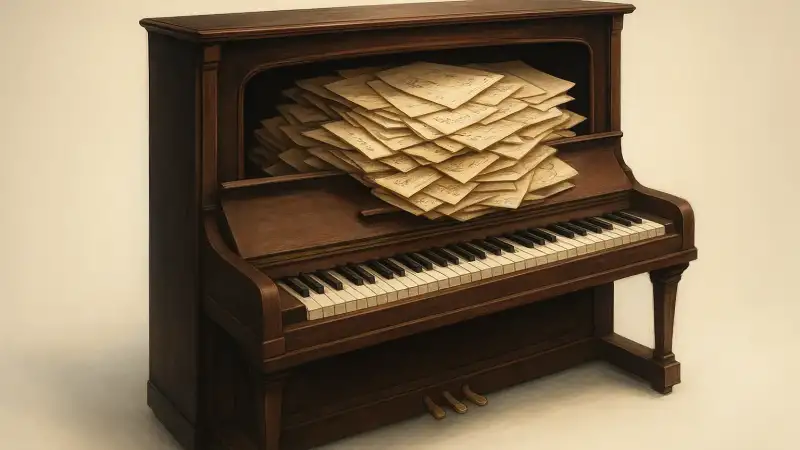
People move a piano and expect dust, maybe a few lost coins. Sometimes a whole paper trail falls out instead. This isn’t one single documented incident in one town, because most finds never get reported beyond family stories. But the pattern is real. Old uprights in places like New York tenements, London terraces, or rural homes in Scandinavia have all been found with notes and envelopes tucked behind panels. The mechanism is simple. A piano is big, heavy, and rarely opened by non-technicians. It can sit in one spot for decades. If someone hides letters inside it, they can stay there long after everyone forgets.
How letters end up inside a piano
Most pianos have more empty space than people realize. Uprights, especially, have a broad cavity behind the front board and below the action. That area is out of sight once the panels are back in place. It’s also close to where hands already go. People lift the lid to practice, to dust, or to stop a key from sticking. A letter can slip in without anyone meaning to hide it. Or it can be put there on purpose because it feels private but not suspicious.
The deliberate version tends to start as a short-term move. Someone needs to stash something quickly. They choose the nearest “safe” object that no visitor will open. A piano fits. It’s respectable. It belongs in shared rooms. And because it’s heavy, it doesn’t get searched the way drawers do. The hiding place can outlast the reason it was chosen.
Why a piano keeps a secret for so long
The biggest reason is maintenance. Many households don’t service a piano regularly, especially once it stops being played. Tuning happens from the outside. Basic cleaning is surface-only. The parts that would expose a stash are often handled only by a technician, and even then only if there’s a reason to remove boards. A silent, unused piano can go untouched for a generation.
There’s also the way pianos get inherited. They’re expensive to move, hard to sell, and emotionally loaded. Families keep them “for now,” even if no one plays. During downsizing or an estate cleanout, the piano becomes a problem object. It gets pushed to a wall, sent to a basement, or left with the house. That’s a long, quiet timeline for anything hidden inside.
What people find, and what that tells them
The contents vary wildly. Some finds are mundane: a child’s drawing, a grocery list, a program from a recital, a single postcard. Others are intimate. Unsent letters. Apologies. Notes that read like someone was trying to persuade themselves as much as another person. When the papers are dated at all, they can span multiple owners because the hiding place gets reused. That’s how a “century” happens. Not from one dramatic moment, but from accumulation and forgetting.
A concrete situation comes up during restoration. An upright is taken apart because keys are sticking or the action needs regulation. The front board comes off, and an envelope drops into the technician’s lap. It might be addressed. It might not. If it’s unsealed, it reads like a diary page. If it’s sealed, the finder has to decide whether it’s a piece of someone’s life that was meant to stay private. That tension is part of why these discoveries get remembered.
The overlooked detail: paper doesn’t age evenly in there
People imagine the inside of a piano as a dry vault. It isn’t. Temperature swings matter. Humidity rises and falls. Felt, wood, and glue all absorb moisture and release it. Paper tucked near the soundboard can warp or grow mold, while paper deeper in a corner stays crisp. One letter can look brand new next to another that’s stuck to itself. That uneven aging is a clue to where it was placed, and sometimes whether it fell in by accident or was pushed into a specific gap.
Another small, overlooked thing is abrasion. A piano vibrates. Even a rarely played one can be jostled by moving, by doors slamming, by footsteps, by changes in the building. An envelope resting against a metal bracket can wear through on one edge. Pencil can smudge from repeated tiny movements. If the piano is played, bass vibrations can slowly “walk” loose papers to a different spot, which is why items sometimes turn up far from the opening they likely entered through.
What happens after the discovery
Most of the time, the find stays within a small circle. A family reads, debates, and re-files the papers somewhere else. Occasionally, a restorer photographs the contents before returning them to the owner. If an address is clear and the letter seems harmless, some people try to trace descendants. If it’s personal or potentially damaging, it often gets put back into the envelope and left alone. There isn’t a standard practice, and reactions vary by culture and by the people holding the paper.
Sometimes the piano itself becomes the story. Not as a haunted object, but as a piece of furniture that quietly participated in domestic life. The letters don’t need to be historically famous to feel heavy. They’re time-stamped by handwriting, by paper type, by the way the ink has faded. And they’re found in a place that was already charged with memory, sitting in a room where people once listened and stopped talking.

Related reads
- What makes a chorus loop in your head long after the song ends
- Why years start to fly: the perception trick that shrinks long stretches
- The San Juan pig whose shooting nearly sparked a war between Britain and America in 1859
- A hoard of century old coins uncovered beneath a town square
- The Ottoman edict that closed coffeehouses and criminalized gossip
- How mental shortcuts steer snap judgments