
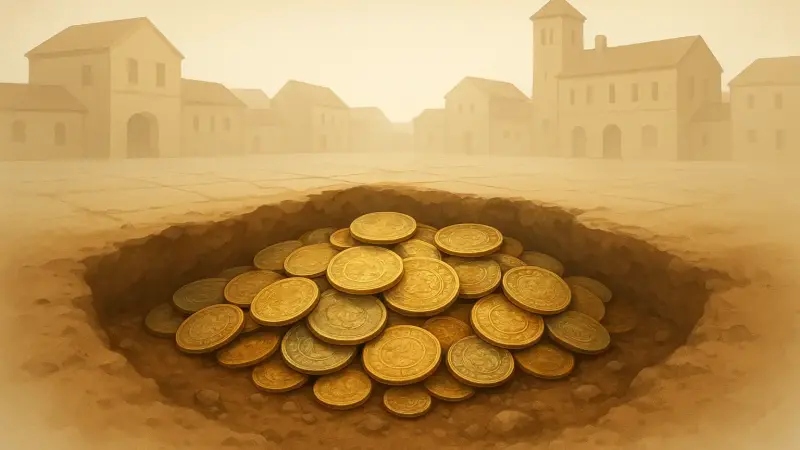
A coin hoard under paving stones is more common than people think
Most town squares feel permanent. Stone, brick, a fountain that looks like it has always been there. But those surfaces get lifted and relaid more often than people realize, and that is when the past sometimes shows up. In Britain alone, a well-known example is the Frome Hoard, uncovered in 2010 in Somerset, and other finds have turned up during roadworks and utility repairs. A “century old” hoard under a square is usually not one dramatic act. It is often a container that stayed dry enough, deep enough, and undisturbed long enough while the square above it changed around it.
What gets overlooked is how thin the safe zone can be. A difference of a few inches can decide whether a jar survives decades of freeze-thaw cycles, tree roots, and trenching for pipes. The coins aren’t waiting in a tidy layer. They’re usually where the container ended up after settling, cracking, or being nudged by later digging that stopped just short of it.
Why people buried coins where everyone walks
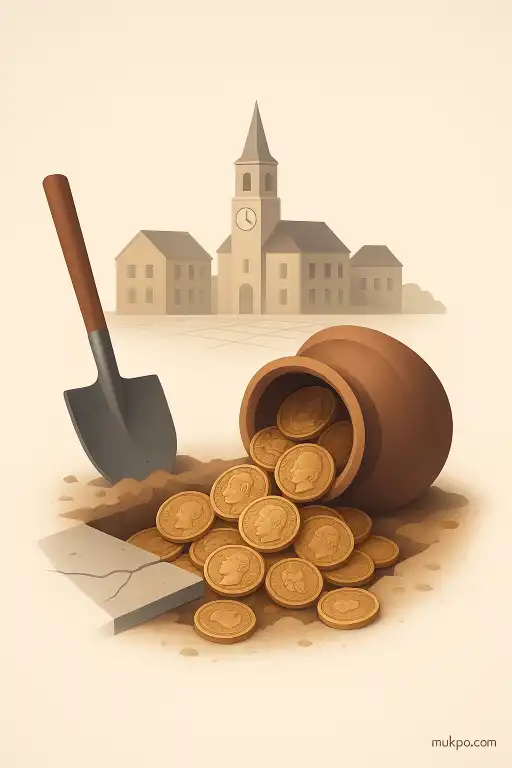
A square sounds like the last place to hide valuables. But “town square” is a modern label. The same patch of ground may have been a market edge, a churchyard boundary, a private garden, or a yard behind shops when the coins went in. Public space can drift over time as buildings are demolished, streets are widened, and property lines get redrawn. A person hiding money tends to pick a spot they can relocate without attracting attention, and a familiar central place can feel safer than a remote one.
The motive also varies, even at the “about 100 years old” range. Some hoards look like emergency hiding during a crisis, and others look like savings that were never retrieved because the owner died, moved, or forgot the exact spot. Sometimes the “hoard” is more like a personal cache: a mix of small change and a few higher-value pieces, buried quickly in whatever container was at hand.
What the coins and container can reveal
Dating a hoard is less about the oldest coin than the newest one. Archaeologists look for the most recent issue in the group, because you can’t bury coins before they exist. Even then, the burial could be years later. Wear matters. So does the mix. A hoard heavy on low denominations can hint at everyday transactions, wages, or a shop’s till. A hoard dominated by high-value coins suggests a different kind of saving, or a deliberate attempt to store wealth compactly.
The container often tells a quieter story than the coins. A ceramic jar, a glass bottle, a cloth pouch, a tin, or a box each decays differently and affects what survives. People tend to imagine a sealed pot, but many finds come out as a stain in the soil with coins scattered through it because the organic parts vanished. Small details like a corroded lid, a nail pattern, or a surviving textile fragment can show whether it was meant to be reopened or simply hidden fast.
How a town square ends up disturbing, then preserving, a hoard
Squares are worked on constantly, but not always deeply. Crews replace paving, install lighting, run cables, repair drains, plant trees, and patch utility trenches. Those jobs slice the ground in narrow corridors. That creates a strange effect: a hoard can be missed repeatedly because every trench passes beside it. Then a later project finally hits the exact spot, often with a mechanical digger that cracks the container and spreads the coins into the surrounding fill.
There’s also the way squares get built up. Layers of resurfacing can raise ground level over decades, burying older surfaces and any small pit beneath them. That can protect a cache from casual disturbance, even while the area is “busy” above. The modern look of a square can be misleading, because what’s under it may be earlier paving, demolition rubble, and compacted soils that effectively seal a small deposit in place.
What happens after the coins come up
Once coins are exposed, context becomes fragile. The exact location, depth, soil layer, and how the coins were clustered can matter as much as the objects themselves. Archaeological teams will often record the findspot quickly and try to recover everything, including fragments of the container. Cleaning is usually cautious, because aggressive scrubbing can remove surfaces that carry information like mint marks, plating, or traces of burial chemistry.
Then comes the slower work: identification, counting, and figuring out whether the group is a single deposit or several disturbed together. A “century old” label can shift once the newest coin is read properly, or once a handful of later pieces are recognized as intrusion from disturbed soil. If the square is still being repaired, the timing matters too, because construction schedules can push the investigation into a tight window where recording has to happen before the ground is closed again.
Related reads
- The Ottoman edict that closed coffeehouses and criminalized gossip
- How mental shortcuts steer snap judgments
- How mangrove roots act like natural filters for microplastics
- How Saturn’s polar winds carve a hexagon
- The deep-sea shrimp that carries bacterial gardens on its claws
- Why certain smells unlock exact moments from your past