
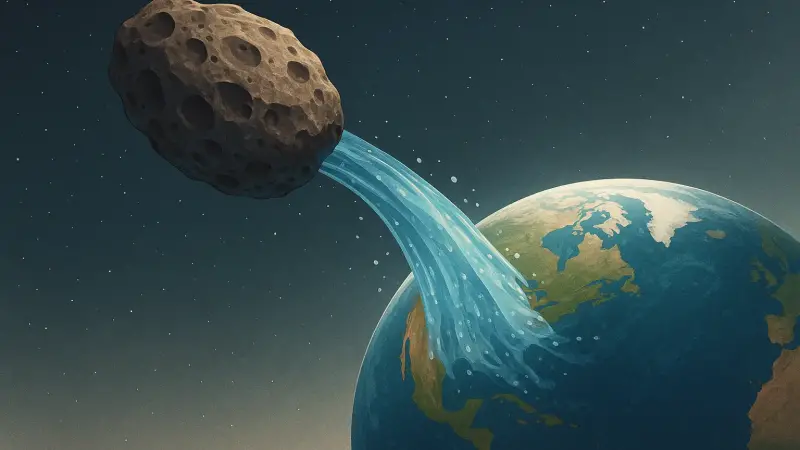
Why there’s water on a rocky planet at all
People rarely ask the plain version of the question: if early Earth was hot, battered, and dry-looking, why does it have oceans now? There isn’t one single “water event,” and the timeline is still debated. Scientists point to several overlapping sources and places in the record, including meteorites found in Antarctica, the Allende meteorite that fell in Mexico in 1969, and the asteroid sample returned by JAXA’s Hayabusa2 mission from Ryugu in 2020. One mechanism is simple enough to picture. Some space rocks carry water locked inside minerals, and that water can be released after the rock lands and reacts with the environment.
Water that isn’t a puddle: how rocks can carry it
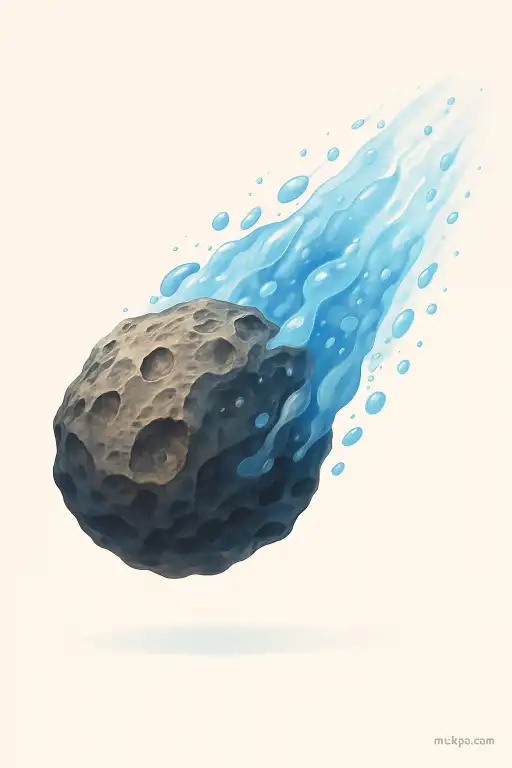
A common mental image is a comet dripping ice. Asteroids and meteorites can work differently. Many carbon-rich meteorites contain hydrated minerals, meaning water is built into their crystal structure as hydroxyl (OH) groups. That water is not sloshing around. It’s part of the rock. Heat, impacts, or chemical reactions can drive it out as water vapor, or it can be freed when minerals alter in contact with other materials.
One overlooked detail is that a “wet” meteorite can still look bone-dry. The water is often invisible unless it’s measured in a lab. Researchers heat tiny samples and watch what gases come off, or they use spectroscopy to detect bonds associated with water. That matters because it changes what “delivery” means. It is not just bringing ice. It can be bringing chemistry that manufactures water during alteration.
What happens when a wet space rock hits a young Earth
Impacts don’t just add material. They also supply energy. On the early Earth, frequent collisions would have smashed incoming bodies, melted local crust, and created hot, reactive zones where minerals, metal, and gases mixed. In those conditions, hydrated minerals can break down and release water. Even if some water is blown off into space during a large impact, not all of it has to be lost. Some can be trapped in cooling rock, dissolve into magma, or later vent out through volcanic activity.
The amount that sticks around depends on things that are still uncertain. Impact angle matters. So does the size of the impactor and whether the planet already has an atmosphere. A thicker atmosphere can slow smaller incoming objects and reduce the most violent heating, which helps retain volatiles like water. A thinner atmosphere does the opposite. That’s why researchers talk in probabilities and ranges rather than one clean number.
The chemical fingerprints scientists look for
When scientists argue about where Earth’s water came from, they often lean on isotopes. The best-known comparison is the ratio of deuterium to hydrogen (D/H) in water. Earth’s oceans have a characteristic D/H value, and different solar system sources don’t all match it. Some comets have D/H values higher than Earth’s ocean water, which makes them less likely as the dominant source. Many carbonaceous chondrite meteorites land closer to Earth’s value, which makes asteroid-like material a strong candidate for supplying a significant fraction.
But the fingerprints don’t come from one dial. Researchers also compare nitrogen and noble gas isotopes, and they look at how water and other volatiles are packaged together. A space rock that fits Earth’s water isotopes but misses on nitrogen, for example, complicates the story. That’s one reason sample-return missions matter. Ryugu and Bennu samples let scientists test the real material with less contamination than many meteorites, which sit on Earth for years absorbing water from air and soil.
How this connects to oceans forming, not just water arriving
Even if a lot of water was delivered early, an ocean still needs the planet to cool and to hold onto an atmosphere. Water can spend a long time as vapor in a thick, hot atmosphere before it ever rains out. It can also cycle through the interior. Water dissolves into magma and can be stored in minerals deep in the mantle, then released later by volcanism. So “kickstarting” can mean feeding a long process, not pouring in a ready-made sea.
A concrete example of the scale difference helps. A single meteorite fall like Allende is scientifically valuable but physically tiny compared with what early Earth experienced. The interest is not that one rock made an ocean. It’s that rocks with similar chemistry were likely common in the inner solar system, and repeated delivery could have stocked Earth with water-bearing minerals and other volatiles while the planet was still settling into the conditions where surface oceans could persist.
Related reads
- Why time feels shorter as decades pile up
- When an Ottoman sultan shut down Constantinople’s cafés and made coffee a crime
- The mannequin that rearranged the shop window every morning
- How fungi can feast on nuclear radiation
- The piano that hid a century of forgotten letters
- What makes a chorus loop in your head long after the song ends