
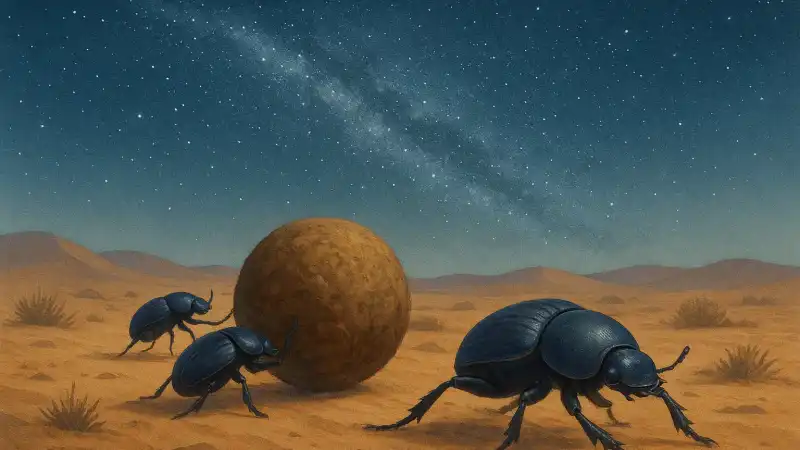
Watching a beetle roll a ball in the dark
Out on a clear night, a dung beetle can look oddly purposeful. It shapes a ball, climbs on top, and then rolls away in a straight line as if it has a map. This isn’t one single place or event. Researchers have tested this in places like South Africa and in controlled planetarium setups. The basic trick is simple: some species use the sky as a compass. When the Milky Way is visible, its bright band gives the beetle a stable direction cue, even when there are no trees, hills, or streetlights to steer by.
Why straight-line travel matters for a dung beetle
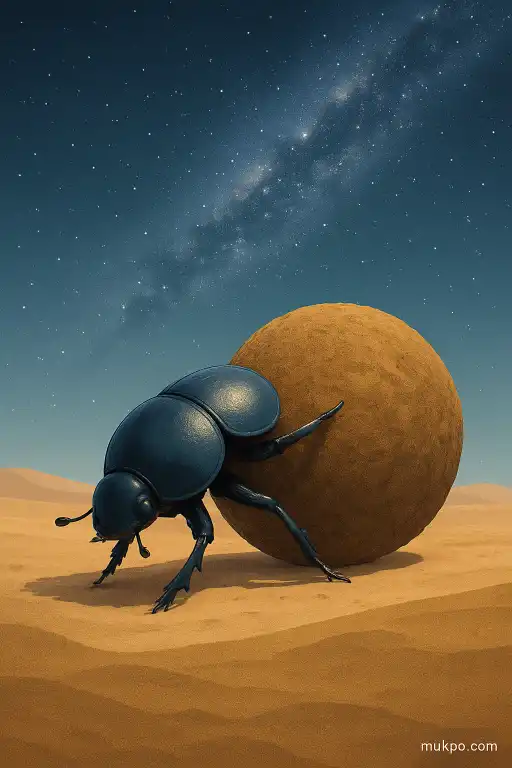
Rolling straight is not just neat behavior. It’s a way to leave the competition fast. Dung is a busy, crowded resource. Other beetles arrive quickly, and theft is common. A beetle that wanders in curves can end up circling back toward rivals or crossing its own track and wasting time. A beetle that picks a direction and commits to it gets distance, buries the ball sooner, and reduces the odds that something larger or faster steals the prize.
There’s a specific detail people tend to overlook: many dung beetles do a brief “dance” on top of the ball before they roll. It can look like hesitation. It’s usually a quick orientation routine. The beetle pauses, turns its body, and samples the sky. Then it climbs down and starts rolling with much less zigzagging than it would manage without that check-in.
How the Milky Way becomes a compass
Dung beetles don’t need to recognize constellations the way people do. The Milky Way is useful because it’s a big, broad pattern. To an insect eye, it can act like a bright stripe across the sky. If you can keep that stripe at a consistent angle relative to your body, you can keep a steady heading. It’s similar in spirit to using a shoreline or a distant mountain to walk straight, except the reference is overhead.
The beetle’s visual system is doing coarse, low-resolution work. That matters because insect eyes aren’t built for sharp, detailed images at night. What they can do well is integrate light across wide areas. A large feature like the Milky Way stands out even when individual stars are dim. The cue is also available in open habitats where there may be almost no landmarks, like sandy flats or sparse scrub.
What changes when the sky isn’t cooperative
When the Milky Way is washed out by clouds, haze, or artificial light, the job gets harder. Beetles can still use other cues, and which ones they rely on varies by species and conditions. The Moon can work as a bright reference point. The overall gradient of brightness across the night sky can help. Some insects also use polarized light patterns, though how much that matters for any given dung beetle can depend on the species and the night.
What tends to show up in experiments is not a total loss of navigation, but a drop in performance. Paths get more wobbly. The beetle stops to re-orient more often. And if a cue changes suddenly—like a cloud bank moving in—straight travel can break down in a way that looks like indecision, even though it’s just the beetle re-checking a compass that keeps shifting.
How researchers test a beetle’s “star compass”
To figure out what the beetle is actually using, scientists set up simple but controlled choices. A common approach is to let a beetle roll under an open sky, then repeat under altered conditions: blocking parts of the sky, adding shade, or using an indoor dome that can display a starry projection. If the beetle stays straight when the Milky Way pattern is present, and gets less consistent when it’s removed, that points to the cue doing real work.
The cleanest demonstrations avoid teaching the beetle anything. The animal isn’t trained to follow a reward. It’s just doing its normal escape-and-bury routine while the sky information changes around it. That’s why the little orientation pause on top of the ball is so informative. It’s a visible moment when the beetle is gathering the sky signal, before the rolling starts again.

Related reads
- How a brief hesitation can tilt us toward risk or caution without conscious thought
- Victorian wallpaper woven with human hair
- A clock tower that runs counterclockwise every afternoon
- Why we reflexively glance where others are looking even in a crowd
- Why comet tails shed sodium and how sunlight sculpts them
- The Christmas truce and the impromptu football match along the 1914 Western Front