

What people mean when they say “hair wallpaper”
Most wallpaper is just paper, ink, and paste. Victorian hair work complicates that. It’s real human hair, arranged into patterns, then fixed down under glue or varnish so it sits flat and survives handling. This wasn’t one single famous incident in one town. It shows up as a craft idea across Britain and the United States, and you can see related hair art traditions in places like Sweden and Germany. The part that surprises people is the mechanism. Hair is treated like thread or filament. It’s sorted, aligned, and used for lines, borders, and shading in a way that looks a lot like fine inlay from a few steps back.
Where the hair came from, and why it mattered
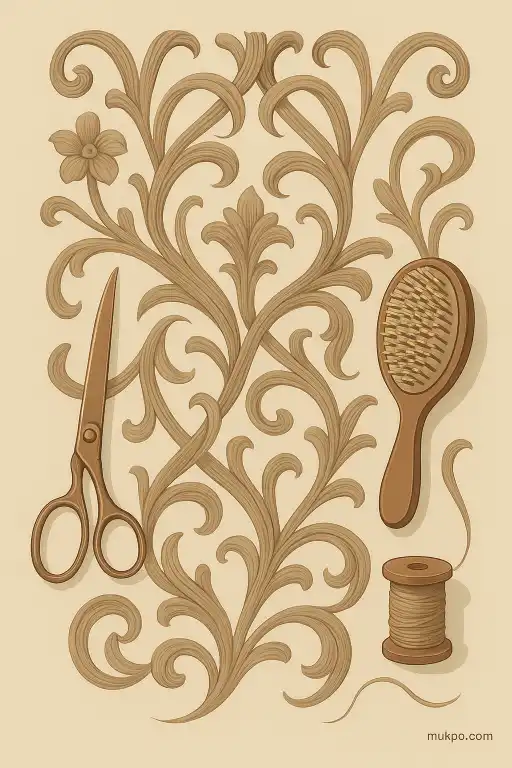
Victorians collected hair the way people later kept photographs. It was intimate, durable, and easy to store. A lock from a child, a spouse, or a friend could be turned into something you lived with every day instead of something kept in a box. That’s why hair shows up in so many domestic objects from the period: jewelry, wreaths, brooches, watch chains, and framed designs. Wallpaper made from hair sits on the same spectrum, just scaled up. Some pieces were mourning-related, but not all. Hair also functioned as a material with a dependable color and sheen, especially in an era when dyes and pigments could fade or discolor.
One detail people overlook is that hair behaves differently depending on humidity and oil. Freshly cut hair still carries natural oils, and older saved hair is often drier and more brittle. That changes how it takes glue and whether it curls back up after being pressed. So the maker had to degrease, wash, or at least comb and “train” it. The goal was to get it to lie in the same direction, because random direction makes it read like lint. Direction makes it read like a deliberate line.
How it was made to sit flat on a wall
Hair has spring. Wallpaper wants to be flat. The trick was binding. Hair could be laid into a sticky ground—paste, gum, or varnish—then pressed under paper or a board until it dried. Some designs used hair as the “ink,” laid along traced outlines, almost like laying thin wire into a groove. Others mixed hair with fibers in a paper pulp so it became part of the sheet itself, closer to a textured paper than a surface collage. Reports vary by maker and surviving example, and it’s not always obvious which method was used once everything is sealed and aged.
Color mattered too. Natural hair offers a tight palette: black, brown, blond, gray, red, and everything in between. That can look subtle and elegant, but it also limits the kinds of patterns that read well from across a room. So hair tends to show up in borders, geometric repeats, or small florals where linework is the main effect. If the surface got a protective coat, it could also pick up a slight gloss that makes the pattern appear and disappear as the light changes.
What it looked like in a real room
It helps to imagine a hallway or a parlor where you stand close to the wall while taking off a coat. From far away, a hair-made pattern can read like a fine dark print or a faint raised texture. Up close, it turns into something else entirely: strands with tapered ends, tiny overlaps, and occasional irregularities where a hair was thicker or kinked. That close-range reveal is part of why people talked about hair work as “curious” even when it wasn’t meant to be shocking. It’s decorative until you recognize the material.
Practicality pushed some choices. A wall covering has to handle soot, coal smoke, and cleaning. Hair itself doesn’t dissolve, but the binders do age. Old adhesives can yellow, crack, or loosen at edges, and that’s when hair becomes more visible in a messy way. That is also why surviving examples can be hard to identify. If the top coat darkens, hair can disappear into it. If it flakes, the hair suddenly stands proud and looks far stranger than it originally would have.
Why it’s hard to pin down today
There isn’t a neat catalog of “hair wallpapers,” partly because the line between wallpaper, panel, and craft display blurs. Some pieces were essentially framed wall panels that functioned like wallpaper visually. Others may have been described loosely in letters or advertisements without technical detail. And even when hair is present, it may not be obvious without magnification, raking light, or careful conservation work, because a sealed strand can look like a printed line.
There’s also a modern bias in what gets saved. Hair jewelry and wreaths fit in drawers and museum cases. A wall covering gets torn out during renovations, especially if later occupants find it unsettling or unhygienic. That makes the record uneven. A few examples get photographed and circulated. Many more probably vanished without anyone realizing what they were removing, because the hair only announces itself when you’re close enough to see individual strands.
Related reads
- A clock tower that runs counterclockwise every afternoon
- Why we reflexively glance where others are looking even in a crowd
- Why comet tails shed sodium and how sunlight sculpts them
- The Christmas truce and the impromptu football match along the 1914 Western Front
- When a 1784 Paris commission exposed Mesmer’s animal magnetism as spectacle rather than science
- The island that vanished from maps and reappeared decades later