
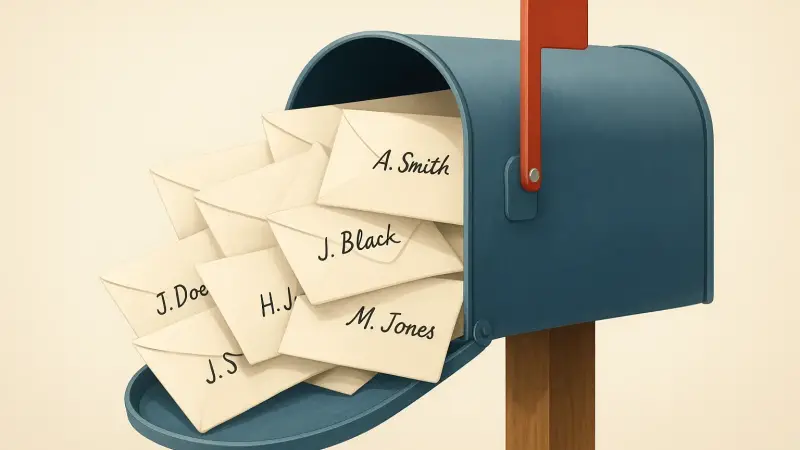
How a made-up person ends up with real mail
People sometimes write letters to someone they know doesn’t exist, and a real mailbox still has to deal with it. There isn’t one single famous mailbox where this happened. It pops up wherever a fictional name gets tied to a real address people can find. The best-known example is 221B Baker Street in London, connected to Sherlock Holmes. Another is “Santa Claus” mail addressed to places like Santa Claus, Indiana, or the Santa Claus Main Post Office in Rovaniemi, Finland. Once an address becomes part of a story that travels, the postal system treats it like any other destination until someone decides what to do with it.
The part the postal system can’t ignore
Mail is processed by matching a destination to routes, postcodes, and known delivery points. If an envelope has enough correct structure—city, postal code, country—sorting equipment and staff can move it surprisingly far even when the recipient is imaginary. A letter to “Sherlock Holmes” with “NW1” and “London” has a better chance of landing near Baker Street than a letter with just a character name and a doodle of a house.
A detail people overlook is how often the return address matters more than the fictional addressee. If the mail can’t be delivered and there is a readable return address, it can be sent back rather than stored, destroyed, or rerouted. When there’s no return address, “undeliverable” stops being a clean outcome. It turns into a local decision made by a depot, a postmaster, or whoever manages that address day to day.
Why the letters keep coming
The letters arrive because fiction gives people a safe target. Some writers are playing along with a story. Some are testing whether the world will answer. Others are using a fictional person as a stand-in for a real one, especially when they want to say something without sending it to a friend, a parent, or an institution. It’s not always fan mail. It can be grief, apology, anger, confession, or a wish that feels too private to put under a real name.
There’s also a mechanics problem: once a specific address gets repeated online, in books, on signs, or in tourist material, it becomes “sticky.” People copy what they saw. Even if the original point was a joke, the copied address looks official in the way printed text often does. That’s enough to keep a stream of envelopes coming long after the first wave should have faded.
What happens when the mailbox starts overflowing
At the receiving end, someone has to decide whether the mail is treated as dead letters, forwarded, or answered. With 221B Baker Street, there have been periods where staff associated with the address responded to some of the letters addressed to Holmes, turning the trickle into an expectation. Santa mail is often handled by organized reply programs, volunteers, or seasonal workflows, depending on the country and the specific post office involved. The behavior of the sender changes when there’s even a rumor of replies.
Overflow is usually a practical issue before it’s a cultural one. Mail takes space. It has to be secured. It can’t block normal deliveries. It also can’t be casually thrown away in many workplaces without someone taking responsibility for it. That’s why these situations often produce ad hoc systems: a separate bin, a separate sorting tag, or a person unofficially tasked with keeping it under control.
The quiet consequences of answering or not answering
Replying creates a relationship that didn’t exist. It turns an imaginary addressee into a real correspondent, even if the reply is obviously part of the fiction. That can be harmless fun, but it also changes what people send. The tone can shift from playful to urgent once someone believes there’s a listening ear behind the name. Not replying has its own effect. Some people keep writing anyway, and some stop the moment their letter disappears into silence.
Either way, the strange part is how little “magic” is needed. It’s mostly infrastructure doing what it was designed to do: accept messages, move them along, and deliver them somewhere. Fiction just supplies a name that feels safe to write on the front of an envelope, and a real address gives the system something solid to grab onto.
Related reads
- Why strong emotions can sharpen some memories and erase others
- How dung beetles steer by the Milky Way across desert nights
- How a brief hesitation can tilt us toward risk or caution without conscious thought
- Victorian wallpaper woven with human hair
- A clock tower that runs counterclockwise every afternoon
- Why we reflexively glance where others are looking even in a crowd