
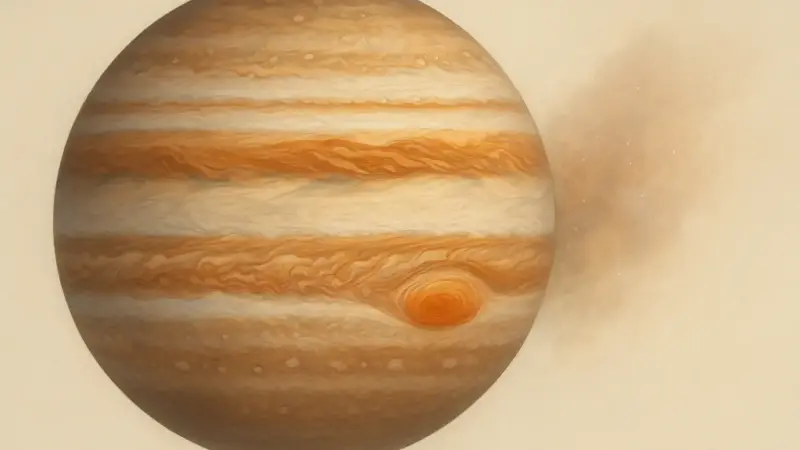
A storm that should have disappeared by now
It’s a simple question people rarely ask: why hasn’t Jupiter’s Great Red Spot faded away like most storms do? We’ve been watching it for a long time. Astronomers like Giovanni Cassini reported it in the 1600s, and spacecraft such as Voyager in 1979 and NASA’s Juno since 2016 have kept an even closer eye on it. This isn’t one single “event” with one agreed start date, though. Records vary, and it isn’t always clear whether early observers saw the exact same feature. The basic answer is that Jupiter keeps feeding the spot energy while also keeping it fenced in.
The Great Red Spot is a pressure system, not a cloud stain
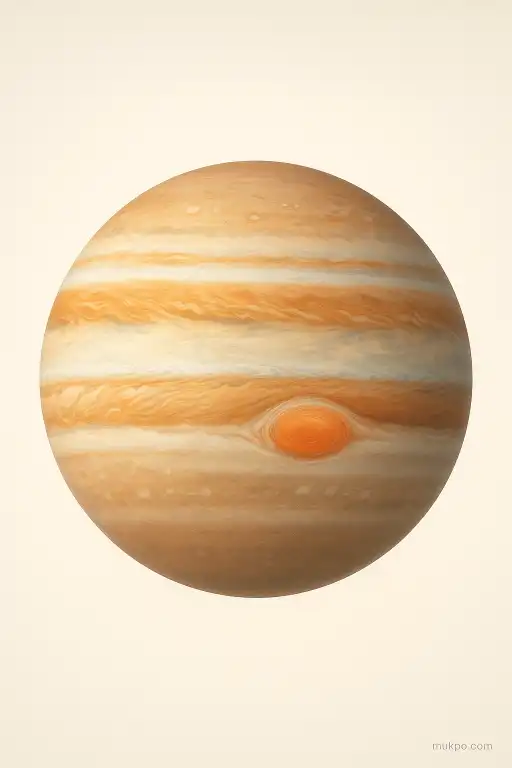
The spot isn’t a painted mark on Jupiter’s surface. Jupiter doesn’t have a solid surface in the usual sense. It’s a huge anticyclone: a rotating high-pressure system sitting in the planet’s upper atmosphere. The visible “red” is a set of hazes and clouds riding along in that circulation. That matters because fading isn’t mainly about the color wearing off. It’s about the vortex losing its organized rotation and breaking apart into smaller swirls.
One overlooked detail is how tall the system is. Juno’s instruments indicate the circulation extends far below the cloud tops, down into deeper layers than many people expect. A deeper vortex has more stored momentum and is less easily shredded by surface-level turbulence. It’s like the difference between a shallow whirl in a puddle and a deeper one that reaches into moving water underneath.
Jupiter’s jet streams keep it stable and keep it trapped
Jupiter’s atmosphere is organized into fast east–west jet streams. The Great Red Spot sits between two of them that move in opposite directions. That setup does two helpful things. It creates strong shear that can help maintain a tight, spinning structure, and it also pins the storm in place so it doesn’t simply wander into regions where the flow would tear it apart. The spot’s latitude isn’t an accident. It’s where the surrounding winds allow a long-lived vortex to exist.
The jets also act like boundaries. They limit how easily the spot can mix with surrounding air. Mixing is one of the main ways a vortex “leaks” energy and fades. When the edges stay relatively sharp, the storm keeps its identity. Observations show the spot’s perimeter can be a very active ring, but it still functions as a barrier that reduces full-blown dilution of the core.
It stays alive by eating smaller storms
A long-lived vortex still needs a way to replace energy it loses to friction, turbulence, and wave-like disturbances. One supply line is merging. Jupiter’s atmosphere produces lots of smaller vortices and storm cells. When some of them drift near, the Great Red Spot can absorb them. That transfer can strengthen the main circulation or at least refill some of what was lost. Telescopic observers have watched nearby smaller ovals interact with it, and spacecraft have seen the surrounding region constantly generating eddies.
This isn’t a calm, sealed system. It’s more like a busy intersection of flows. The spot survives because the neighborhood keeps delivering spinning features and kinetic energy. The exact balance varies over time, which is one reason the spot’s size and shape change. It can look more compact in some eras and more stretched in others, depending on what it has recently absorbed and what the surrounding jets are doing.
The color is chemistry riding on sunlight and altitude
The “red” is not a stable dye. It’s thought to come from complex molecules created when sunlight and energetic particles alter simpler gases lifted upward from deeper layers. Candidates include modified ammonia and hydrocarbons, but the exact recipe is still debated. What’s clear is that altitude matters. The spot’s circulation can loft material higher than nearby clouds, exposing it to different radiation conditions. That can keep the upper haze chemically refreshed, even if the underlying vortex is the more important thing for longevity.
Sometimes the spot does look paler, and its outline changes. That doesn’t necessarily mean the storm is dying. It can mean the high-altitude haze thinned, or that different cloud layers became visible. The persistence comes from the dynamics first: a deep, rotating anticyclone trapped between jet streams, repeatedly topped up by interactions with smaller storms, with chemistry and lighting deciding how dramatic the red looks at any given time.
Related reads
- Why your stomach growls louder at the worst possible moments
- A mailbox that filled up with letters addressed to fictional people
- Why strong emotions can sharpen some memories and erase others
- How dung beetles steer by the Milky Way across desert nights
- How a brief hesitation can tilt us toward risk or caution without conscious thought
- Victorian wallpaper woven with human hair