
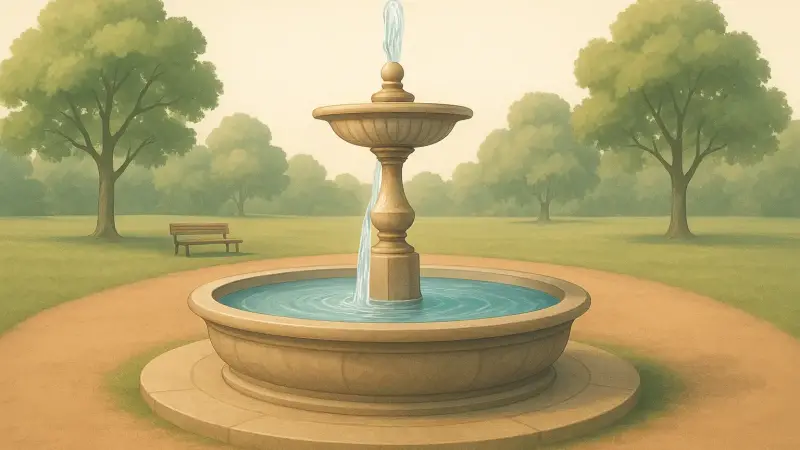
You’ve probably seen it: the lawns are brown, the city puts up drought signs, and yet the park fountain is still running. Sometimes it even looks like it “refilled itself” overnight. There isn’t one single famous fountain story that fits every retelling. It’s a pattern that pops up in different places, like California parks during drought restrictions, Cape Town’s dry-year water limits, or Australian cities that keep some water features going. The core mechanism is usually boring but effective. The fountain isn’t tapping the same shrinking supply people are worried about. It’s recirculating, running on a separate line, or drawing from a hidden source on-site.
Most fountains aren’t “using up” water the way people assume
A typical decorative fountain is a closed loop. A pump pushes water up, gravity brings it back down, and the basin feeds the pump again. If the fountain looks full after days of heat, that doesn’t automatically mean someone added fresh water every day. It can mean the basin is larger than it looks, or the plumbing includes an underground holding tank that evens out the level.
The overlooked detail is evaporation. It’s real, but it’s not always dramatic from one afternoon to the next. Wind matters more than temperature in how fast a fountain drops. Shade matters, too. A fountain tucked under trees can lose far less water than the same fountain in open sun, even when everything else nearby is drying out.
“Freshwater” can mean a separate, less-visible supply
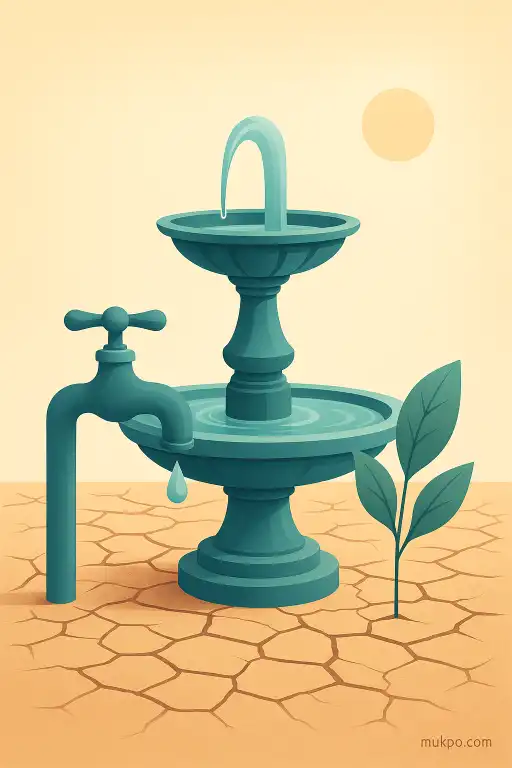
When people say a fountain “refilled itself with freshwater,” they’re often describing what it looks like after the water level rises back to a normal line. Many systems have an automatic makeup-water valve, like a toilet tank float, tied to some dedicated feed. That feed might be municipal water, but it might also be non-potable water that’s still allowed during restrictions, depending on local rules.
Parks and campuses sometimes have purple-pipe systems for reclaimed water (treated wastewater used for irrigation and certain features). In drought periods, that network can keep running even when drinking-water use is restricted. To an observer, the water looks “fresh” because it’s clear and circulating, and because the refill happens quietly through a valve you never see.
Groundwater and springs can make a fountain look like it’s cheating
Some fountains are built where water already wants to come up. Natural springs exist in parks, and older cities sometimes turned spring sites into formal water features. In that setup, the fountain can refill even during a dry spell because it’s connected to a local groundwater discharge point, not the same surface reservoirs that are visibly low.
That doesn’t mean the water supply is unlimited. Springs can weaken in drought, and groundwater levels can drop with heavy pumping. But a spring-fed or well-fed feature can stay steady longer than a shallow pond. The timing can feel uncanny: a hot week passes, the basin looks low, and then after a cooler night the inflow catches up and it’s back at the brim.
Maintenance schedules create the “overnight refill” effect
Fountains are finicky. They get algae, clogged nozzles, and pump strain. Crews often shut them off to clean filters, skim debris, or fix leaks. When the pump stops, the water level can change in ways that fool the eye. Water that was trapped in plumbing lines, a surge tank, or an upper basin drains back down and makes the main basin look like it suddenly “refilled,” even though it’s the same water returning.
There’s also deliberate top-off timing. If a city allows limited makeup water for safety or equipment reasons, crews may add it early in the morning when parks are empty and evaporation is lower. A person walking by at noon sees “it was low yesterday, and today it’s full,” and it reads like a self-filling trick rather than a routine.
Rules, optics, and plumbing labels rarely line up
Drought restrictions often target specific uses, not “all water everywhere.” A city might ban lawn watering but still allow recirculating fountains, or allow them only if they use reclaimed water, or require them to be turned off entirely. That’s why two parks in the same region can look inconsistent. One fountain is dry and covered. Another is running and looks newly topped up.
The final mismatch is informational. The sign that explains “reclaimed water” or “recirculating system” is easy to miss, and sometimes it isn’t posted at all. What people see is motion and shine. What they don’t see is the small hardware that controls everything: a float valve in a locked box, a backflow preventer, a meter labeled “non-potable,” or a buried tank that makes a low basin look magically full again.
Related reads
- A radio frequency that broadcasts the same lullaby across three countries
- Why certain minerals split light into rainbow halos
- A mailbox that returned postcards stamped before anyone living remembered
- Hy-Brasil the phantom island that haunted medieval maps off Ireland
- The lighthouse that slowly sank into the dunes while its light kept burning
- Victorian hairwork the 19th-century craft of weaving mourning into jewelry