
How “old” postcards can arrive out of nowhere
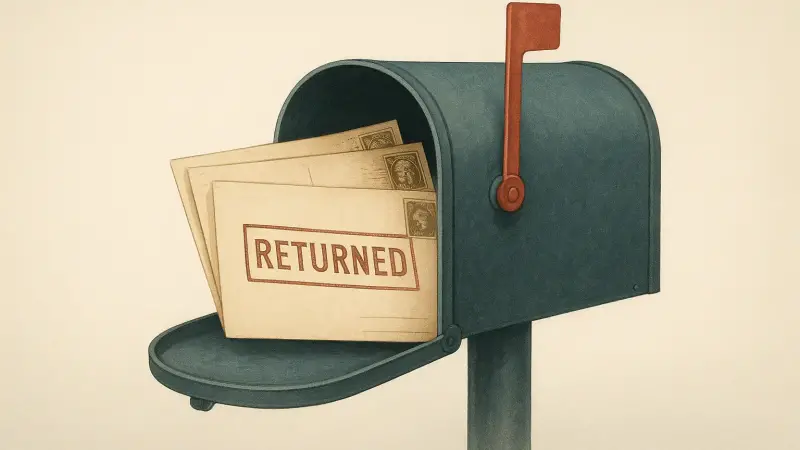
Most people don’t think about the inside of a mailbox. It’s just a metal throat for today’s bills and flyers. But every so often, someone opens one and finds a postcard that looks like it was mailed decades ago, with a stamp and a postmark from before anyone in the house was alive. There isn’t one single famous town where this happens. Reports pop up in different places and are usually hard to verify after the fact. When it does happen, the mechanism is almost always ordinary: a postcard that was genuinely mailed long ago and then got trapped, misrouted, or forgotten until the system (or the building) finally coughed it back up.
The postal system can lose things without “losing” them
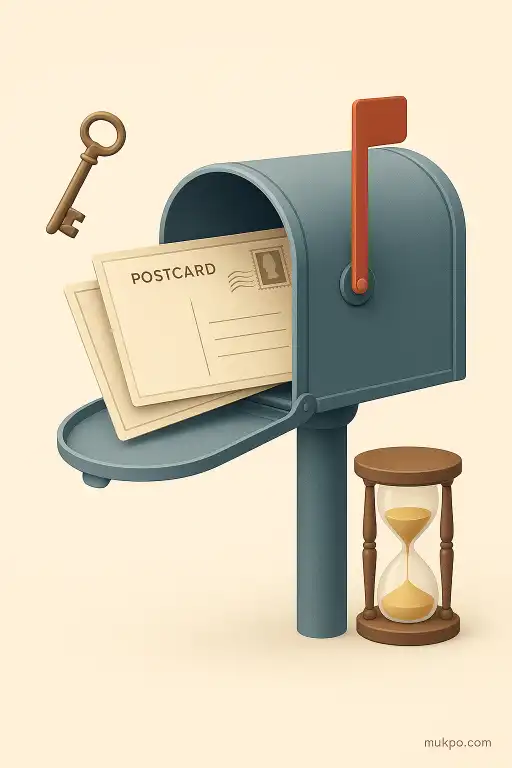
Mail doesn’t travel in a straight line. It rides conveyors, bins, trucks, sacks, sorting machines, and human hands. A postcard is especially vulnerable because it’s thin, stiff, and exposed. It can slip behind a sorting cabinet, wedge between conveyor parts, or get stuck inside a mailbag seam. It can also be mis-delivered into a different route’s tray and end up in a dead-end loop: office to office, return-to-sender attempt, then recirculation if the address is smudged or incomplete.
A detail people usually overlook is how the cancellation mark actually works. Postmarks are applied where the stamp is canceled, not where the card is delivered. So a card can carry a perfectly real-looking old postmark and still show up much later if it was pulled out of a machine jam years afterward, or found during a move, renovation, or equipment replacement and dropped back into the outgoing stream.
Mailboxes and slots are better hiding places than they look
The “returned by the mailbox” part often comes down to architecture. Older buildings sometimes have mail slots cut through doors, with a narrow chute or box inside. In apartments, there may be a wall cavity behind a bank of boxes. Items can fall off the back, slip between studs, or get caught on a nail or a jagged edge of sheet metal. Then a draft, a vibration, or a repair knocks the piece free and it suddenly appears where it never should have been.
This is easiest to picture with a front door slot: the postcard drops in, hits the interior, and slides into a gap between the trim and the floor. If the house later gets new flooring, the gap changes. A card that’s been pinned under baseboard for decades can re-enter the open space and end up in a basket, behind a radiator, or—if there’s a chute—back inside the box area. It feels like the mailbox “produced” it, but it’s the building finally releasing something it swallowed.
Why postcards are the ones that show up like this
People report postcards more than letters for a few practical reasons. They have dates printed on them, either on the stamp design, the postmark, or the photo caption, so “old” is obvious at a glance. They also feel personal. A stranger’s handwriting, a vacation note, a joke that didn’t land, a signature—those details make the time gap feel bigger than it is. A delayed utility bill doesn’t create the same reaction.
Postcards also survive storage accidents surprisingly well. They’re often thicker stock than envelopes, so they don’t crumble as fast in a dusty corner. If they land face-up, the message can stay legible. If they land face-down, the stamp and cancellation can stay crisp. That combination can make a decades-late delivery look “fresh,” even though it’s just been protected from sunlight and handling the whole time.
How a “time-stamped” delivery can still be misleading
Sometimes the date isn’t what it seems. A postcard can be written long before it’s mailed. It can sit in a drawer, get packed into a box during a move, and later be dropped into a mailbox by someone clearing clutter. The stamp can also mislead casual readers. Many stamps show a year as part of a commemorative design, which people mistake for the mailing date. The only hard date is a clear postmark, and even those can be partial or smeared.
There’s also the human memory factor. When someone says “before anyone living remembered,” they’re usually comparing it to their own lifetime in that house, not the actual history of the address. Neighborhoods change fast. A card might have been correctly delivered to a previous resident, slipped behind a hall table, and only resurfaced after a renovation years later. It still lands in the current mailbox because that’s where people place found mail when they don’t know what else to do with it.
Related reads
- Hy-Brasil the phantom island that haunted medieval maps off Ireland
- The lighthouse that slowly sank into the dunes while its light kept burning
- Victorian hairwork the 19th-century craft of weaving mourning into jewelry
- The apartment building where each elevator responds only to a specific melody
- Why some leaves hold beads of dew while others stay dry
- Why pretending calm can sometimes actually soothe your panic