
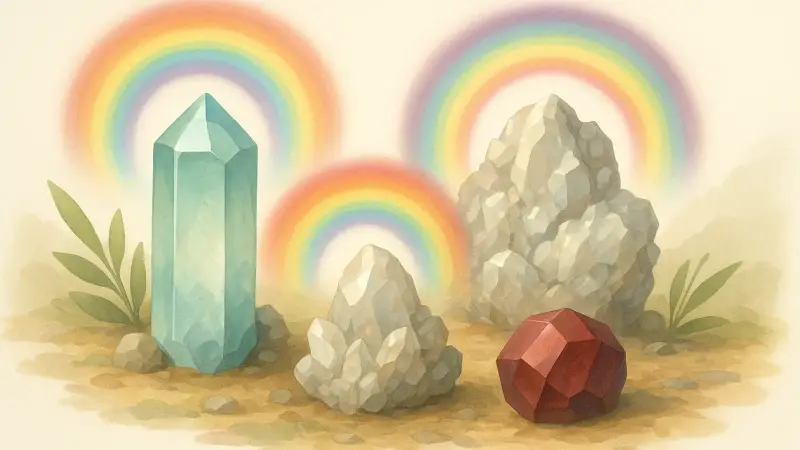
Seeing the halo in the first place
If you’ve ever turned a clear piece of Iceland spar (a transparent calcite) in your hand, you may have noticed something odd: edges double, and thin bands of color can appear near bright highlights. This isn’t one single famous event or place. It shows up wherever certain crystals are found and handled, from calcite in Iceland to tourmaline from Brazil and Sri Lanka. The core mechanism is simple but picky. The mineral makes light split into two rays that take slightly different paths, then those rays separate by wavelength just enough to look like a faint rainbow at the right angles.
The split: one beam becomes two
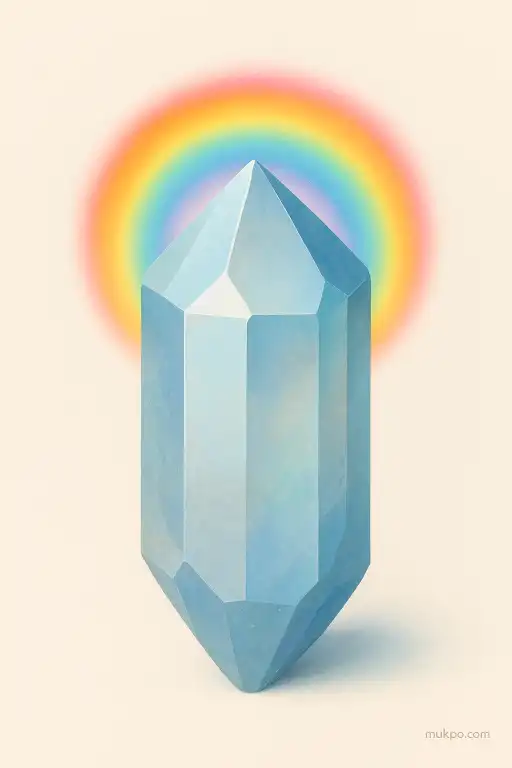
Some minerals are birefringent. That means their internal structure gives light two different refractive indices depending on direction and polarization. Instead of one refracted beam, you get an “ordinary” ray and an “extraordinary” ray. They exit the crystal separated, so a line under a clear calcite crystal looks doubled.
The overlooked detail is that the split is tied to polarization, not just “two images.” If the incoming light is already polarized, one of the rays can weaken a lot, or nearly vanish at certain orientations. That’s why the effect can look strong one moment and then seem to fade as the crystal rotates, even though the mineral hasn’t changed.
Why color shows up at the edges
Rainbow halos need dispersion: different wavelengths bend by different amounts. Birefringent minerals can disperse each ray differently, and the extraordinary ray in particular changes direction with crystal orientation. Near sharp boundaries—an edge, a fracture, the rim of a polished face—tiny differences in exit angle spread the colors spatially. White light that stays stacked together looks white. White light that gets fanned out becomes a thin spectrum.
That’s why the color often hugs edges or bright reflections instead of filling the whole crystal. In the middle of a face, the two rays may be separated but still overlap enough that the eye blends them back toward white. At an edge, the geometry forces separation. A small shift in angle becomes visible as a colored fringe.
The crystal has preferred directions
The strength and look of the halo depends on how the light travels relative to the mineral’s optical axis. Calcite is strongly birefringent, so the two rays can diverge noticeably even in a small crystal. Quartz is birefringent too, but much weaker, so it rarely gives dramatic rainbow splitting in hand samples. Tourmaline and some other minerals add another twist: they can be pleochroic, absorbing some colors more along one direction than another, which changes the balance of the two rays and makes the fringes look uneven.
Orientation also controls whether the extraordinary ray “walks off” to the side a lot or only a little. That’s why two pieces of the same mineral can behave differently. A crystal cut differently, or one viewed along a different face, can go from obvious rainbows to almost none without any change in clarity.
Imperfections can make the halo easier to notice
Perfect crystals are not always the most colorful. Fine internal stress, microscopic twinning, or thin cleavage steps can act like built-in boundaries that separate the rays more cleanly. Calcite’s cleavage is a common culprit. Those flat cleavage planes can create a stack of slightly offset exits, so the color bands repeat as you move your viewpoint. The halo can also be sharper in bright, point-like light because the spectrum has a clean starting point. Diffuse light tends to wash it out.
A concrete scene where this shows up is a clear calcite rhomb on a printed page under a desk lamp. The text doubles, but the most noticeable color often appears where black letters meet white paper, or where the lamp reflects off an edge. The mineral isn’t “making” color from nothing. It’s sorting the colors already present in white light and giving them slightly different exits, and the eye only sees it when the geometry forces those exits to separate.
Related reads
- A mailbox that returned postcards stamped before anyone living remembered
- Hy-Brasil the phantom island that haunted medieval maps off Ireland
- The lighthouse that slowly sank into the dunes while its light kept burning
- Victorian hairwork the 19th-century craft of weaving mourning into jewelry
- The apartment building where each elevator responds only to a specific melody
- Why some leaves hold beads of dew while others stay dry