
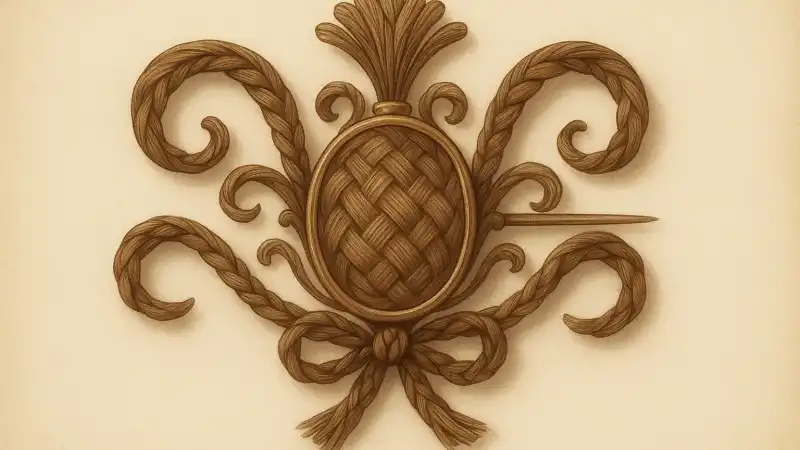
People sometimes assume mourning jewelry was just black enamel and a name. Then you see a Victorian brooch where the “stone” is a tight braid of human hair under glass, arranged like rope or lace. That’s hairwork. It wasn’t one single local custom. It shows up across Britain and the United States, and it appears in museum collections in places like London and New York. The mechanism is simple but surprising: a lock of hair, saved from someone living or dead, gets cleaned, sorted, and woven into a pattern that can be worn close to the body. It turns something ordinary and physical into a portable keepsake.
Why hair became a material for grief
Hair is one of the few parts of the body that doesn’t decay quickly. That mattered in a century when photography was becoming common but still not universal, and when deaths at home were frequent. A curl could be kept without the smell, the mess, or the practical problems of other relics. It also felt intimate without being graphic. For Victorians, that combination made hair suitable for memory, especially in cultures where wearing signs of mourning was expected.
It also worked for living relationships. Hairwork shows up as friendship tokens, hair bracelets exchanged between sweethearts, and pieces that include multiple family members’ hair. That’s one reason it can be hard to tell from the object alone whether it marks a death. Inscriptions help, but not every piece has one, and some were altered later when they changed hands.
How hairwork was actually made
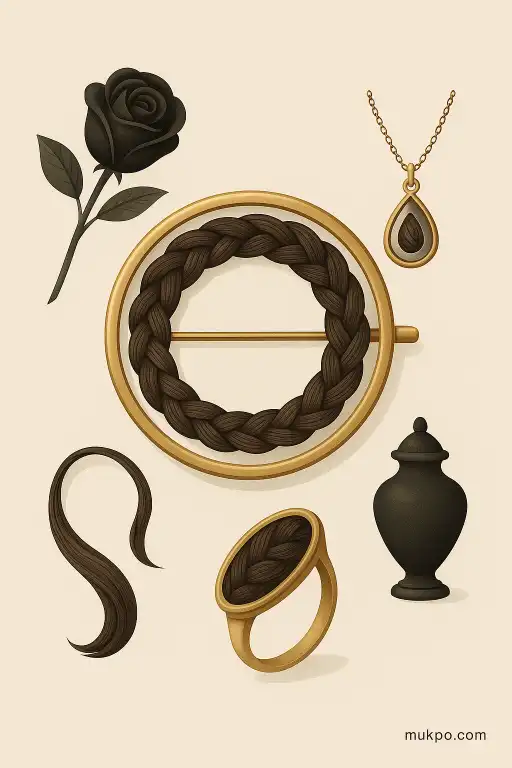
The craft split into two broad approaches. One used hair as a kind of fiber, woven or braided into cords and then shaped into bracelets, watch chains, or necklaces. The other used hair like paint, laid under glass into scenes or initials, sometimes with tiny seed pearls. Either way, it took more than a saved lock. Hair had to be strong enough, long enough, and reasonably consistent in thickness, or the pattern wouldn’t sit evenly.
A detail people often overlook is the infrastructure. Makers used specialized tools: braiding tables, weights to keep tension, and fine wires or frames hidden inside the braid so the piece would hold its curve. Some designs were so tight that the hair functioned almost like a textile. If you look closely at surviving bracelets, you can sometimes see where strands were spliced in, because one person’s hair was not enough to finish the width or length.
Home craft, professional workshops, and catalogs
Hairwork had a domestic reputation, and there were instruction books and patterns aimed at middle-class households. But a lot of it was professional. Urban workshops offered hairwork alongside jewelry repair, and some businesses accepted hair by post. Families could send a labeled lock, choose a pattern, and receive a finished bracelet mounted with a clasp and fittings. That mattered because the most intricate weaves are hard to do without practice and equipment.
Mass manufacturing also changed the look. Settings, clasps, and glass covers could be bought ready-made, which meant the hair component was slotted into standardized jewelry forms. That’s why you can find nearly identical lockets where the only unique part is the hair arrangement inside. It also explains why some pieces feel personal but slightly formal, like they were designed to fit a catalog description.
What the designs signaled to other people
Victorian hairwork communicated in public without saying much out loud. A black-enamel ring with a name and date was direct. A hair bracelet was subtler. It could pass as decorative to strangers while still being loaded with meaning to the wearer. Some pieces included obvious mourning cues—urns, weeping willows, or the word “In Memory Of”—but plenty did not. The ambiguity was useful in social settings where grief was present but conversation had rules.
There were also practical constraints that shaped style. Hair color affected what could be made. Dark hair shows pattern sharply, while very light hair can disappear under glass unless it’s densely packed or backed with a contrasting ground. Gray hair could be prized for its visual texture, but it is often more fragile. These material facts helped determine why some motifs were common and others rarely attempted.
How pieces survived, and why they feel unsettling now
Many pieces survived because they were stored like documents. Families kept them in boxes, tucked into letters, or pinned inside albums. They also survived because they were sturdy. Hair doesn’t tarnish the way metal does, so the woven part can look oddly fresh even when the clasp is worn. At the same time, hair is sensitive to moisture and oils. Pieces kept in damp conditions can develop clouded glass, loosened weaves, or corrosion that stains the hair.
Modern discomfort often comes from the closeness of the material, not from the design. People are used to seeing hair as waste once it’s cut. Victorian hairwork treats it as a stable substance with identity attached. When you hold a braided bracelet and notice the ends tucked under a cap, you’re seeing the maker’s attempt to hide the messiest part of the process: the fact that it’s made strand by strand, from someone’s body, meant to be worn against skin.
Related reads
- The apartment building where each elevator responds only to a specific melody
- Why some leaves hold beads of dew while others stay dry
- Why pretending calm can sometimes actually soothe your panic
- Why compliments can feel uncomfortable to receive
- How emotional moods spread through a group without a word being said
- How bombardier beetles fire boiling chemicals as defense