
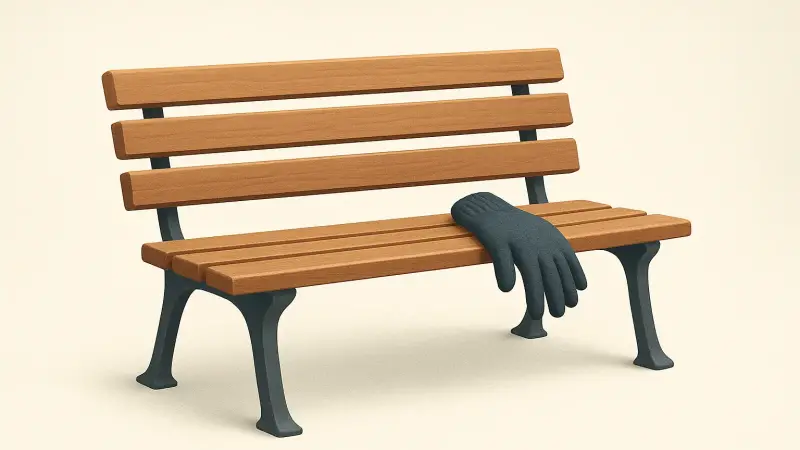
A small thing you notice too late
This isn’t one single bench in one single town. It’s a pattern people report in lots of ordinary places where strangers pass through. A park bench in London, a bus-stop bench in Toronto, a bench outside a supermarket in Melbourne. The detail shifts, but the shape stays the same: one glove shows up, then another, but it somehow feels like it belongs to the same absent owner. It sits there for days. It gets moved to the same corner or tucked under the slat. And you start to notice the overlooked part—how often it’s the left glove, and how rarely it’s two together.
Why it’s almost always just one
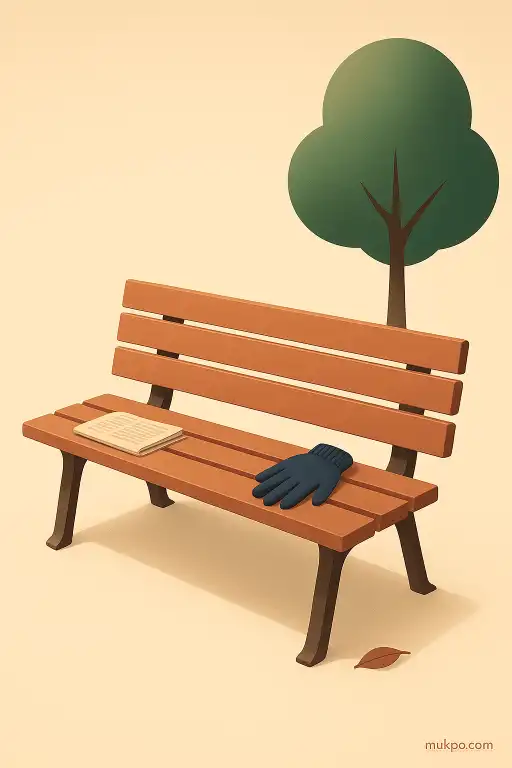
Gloves get separated in very specific ways. People pull one off to check a phone, handle a ticket, dig for keys, or carry a hot drink. The free glove goes onto the nearest flat surface without thinking. A bench is perfect because it’s at hand height and already “public.” The other glove stays on because the hand is still cold, or because it’s holding something. That’s how you get one left behind instead of a pair.
Pairs also don’t survive the next few minutes. If someone notices immediately, they go back for it. If they don’t, the chance that both gloves are lost in the same place at the same time is low. Even when two gloves are dropped, they often land in different spots because one falls from a pocket earlier and the other later. The bench ends up as the last resting place for a single straggler.
How a bench becomes the “holding spot”
Once a glove is on a bench, other people handle it in a predictable way. Most don’t throw it away. They move it a little, usually onto the backrest or the end of the seat, like they’re making space without erasing it. That small relocation matters. It keeps the glove visible enough to be “found,” but not so much in the way that someone feels forced to deal with it.
Benches also have repeat traffic. The same dog walkers, commuters, smokers, and lunch-break regulars pass by at similar times. That repetition creates a tiny shared routine: the glove becomes a known object in a known place. If it blows off and lands underneath, someone tends to put it back on top. Not out of kindness exactly. More because it’s become part of what the bench “looks like.”
Why it feels like it belongs to the same person
Most gloves you notice are dark, plain, and mid-range. Black knit. Brown leather. Grey fleece. They’re common enough to be interchangeable, which is why the brain stitches separate sightings into one continuing story. You remember “the glove” more than you remember the specific glove. Then a second one appears a week later—also dark, also single, also in roughly the same area—and it feels like the same missing owner is haunting that bench.
There’s also selection bias. The weird ones get picked up. Bright ski gloves, kids’ cartoon mittens, neon cycling gloves. Someone takes them to a lost-and-found or posts a photo. The boring lone glove is what survives. It’s easier to ignore and easier to leave. That’s why the bench “always” seems to have the same kind of glove. The other kinds don’t stay long enough to become a fixture.
What keeps it there for days
People assume someone else will handle it. If there’s no obvious lost-and-found—no station desk, no café counter, no office reception—the glove falls into a gap in responsibility. It’s not trash, but it’s not valuable enough to trigger action. Rain doesn’t always remove it, either. A knit glove can soak and still cling to wood or rough paint. Leather can get heavy and stay put. Wind tends to move it under the bench instead of away from the area, which is why it often reappears in the same small radius.
Eventually it disappears for ordinary reasons. A cleaner clears the bench. A curious kid pockets it. A dog grabs it and drops it nearby. Or the owner actually returns on the same route, scanning the ground instead of the seat, and only spots it because someone moved it onto the backrest where it’s at eye level. Until then, it can sit in that one corner, looking oddly intentional, like it was placed there on purpose.
Related reads
- Why ordinary noises seem louder and creepier at night
- The mushroom that smells like rotting meat to lure flies
- A street mural that rearranges its bricks to spell new names at dawn
- How a single antibiotic reshapes your gut microbiome
- The park fountain that refilled itself with freshwater during a drought
- A radio frequency that broadcasts the same lullaby across three countries