
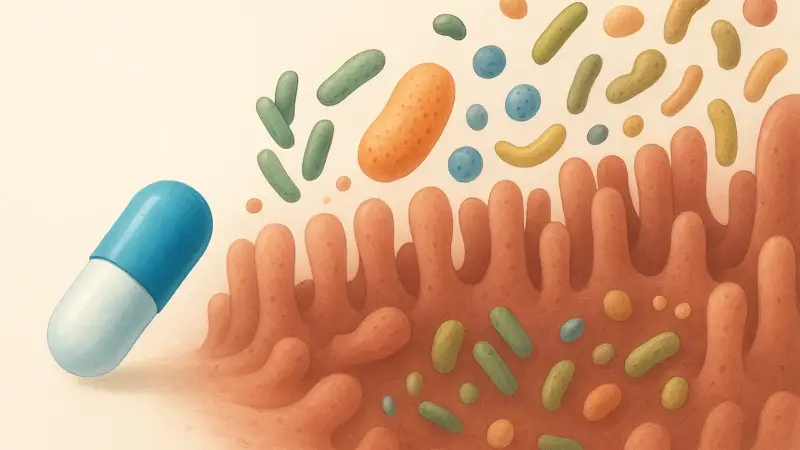
You take amoxicillin for strep throat, or ciprofloxacin for a stubborn UTI, and the sore throat fades before you’ve even finished the bottle. What’s less obvious is that the same pills are also traveling through the gut, where they collide with a crowded ecosystem of bacteria, fungi, and viruses that normally spend their days breaking down food and signaling to the immune system. There isn’t one single “antibiotic event” here; the effects vary by drug and person, and have been tracked in places as different as the U.S., the U.K., and Japan. The core mechanism is blunt: an antibiotic blocks key bacterial functions, so some gut microbes crash, others slip through, and the whole network has to rebuild.
Antibiotics don’t aim for your gut, but they hit it
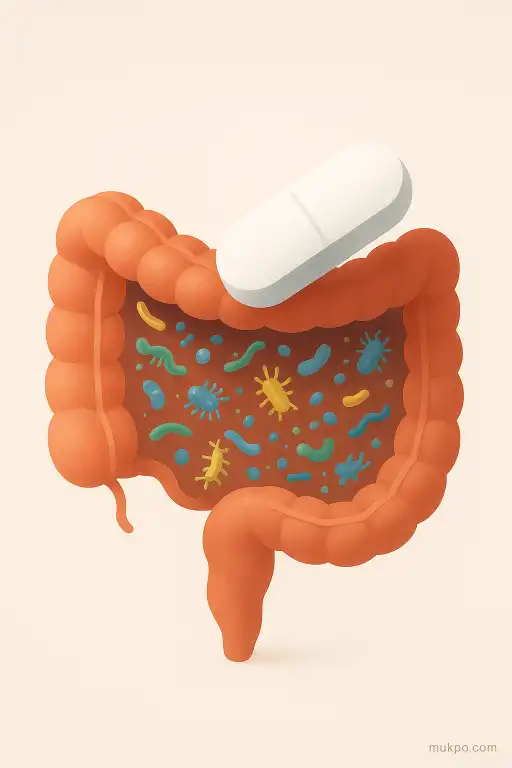
Even when an antibiotic is prescribed for a throat, skin, or bladder infection, a portion often reaches the intestines. Some drugs are not fully absorbed in the small intestine. Others are processed by the liver and released into bile, which empties into the gut. Either way, the colon ends up exposed to active drug, sometimes for days, sometimes longer.
That exposure is uneven. Concentrations can spike after a dose and then drop. They also vary along the digestive tract, because the small intestine and colon are different habitats. That’s one reason the same antibiotic can produce different microbiome changes in different people, even with the same dose.
The first shift is usually loss of diversity and a reshuffle
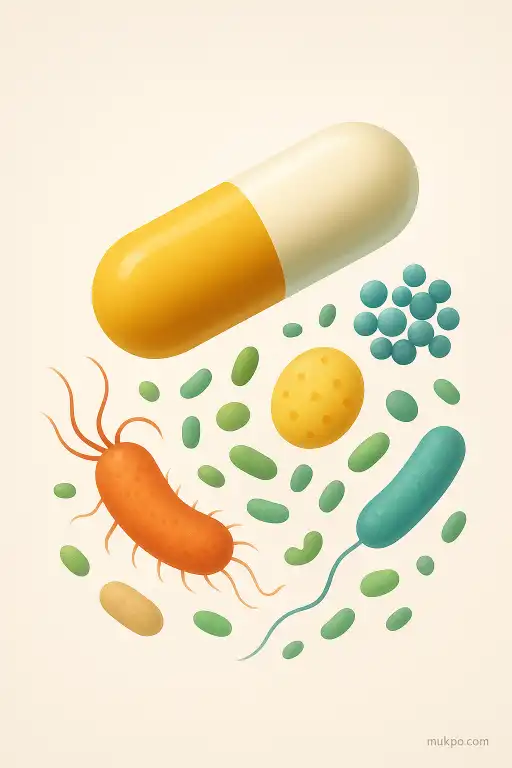
Gut microbiomes tend to be resilient, but they are not indifferent. After a single antibiotic course, many people show a drop in richness and evenness: fewer kinds of bacteria detected, and a heavier tilt toward whatever survived best. Some groups are simply more sensitive to the specific drug, while others are protected by where they live, how fast they grow, or whether they can inactivate the antibiotic.
An overlooked detail is that “who survives” isn’t just about the antibiotic’s target. The gut is full of microbes that swap genes. If antibiotic-resistance genes are already present at low levels, treatment can raise their frequency quickly by removing competitors. That doesn’t mean a person becomes permanently “full of resistant bacteria,” but it can change the balance of the resistome—the pool of resistance genes—for a while.
Some species bounce back fast, others don’t return the same way
After the drug stops, regrowth starts immediately, but recovery is not a simple reset. Fast-growing, oxygen-tolerant bacteria often expand early because the gut environment shifts during treatment. That early bloom can shape what comes next, because the first microbes to reoccupy space change pH, available nutrients, and the chemical signals that other microbes respond to.
Some taxa can rebound to near-baseline within weeks, while others may stay reduced for months, and in some people longer. It’s unclear which changes matter most for health in every case, because two people can “recover” different-looking microbiomes and still feel fine. But the ecosystem can settle into a slightly different steady state, especially if the antibiotic course coincides with other disruptions like a stomach virus, major diet change, or travel.
Collateral effects show up as chemistry changes, not just “missing bacteria”
Microbes are chemical factories. When the community shifts, the gut’s chemistry shifts with it. A common example is bile acids: the liver makes primary bile acids, and gut bacteria convert them into secondary bile acids. Antibiotics can reduce those converters, changing the mix of bile acids that help regulate gut motility, inflammation signals, and which microbes can thrive.
Short-chain fatty acids like butyrate can also dip if fiber-fermenting bacteria are hit hard. That matters because butyrate is a major fuel for colon cells and helps maintain the gut barrier. People often focus on side effects like diarrhea, but the overlooked part is that diarrhea itself changes the habitat by speeding transit time, which can further disadvantage slow-growing anaerobes and favor opportunists.
A concrete example: why C. difficile can appear after a routine prescription
Hospitals in the U.S. and Europe have long tracked Clostridioides difficile infections after antibiotic exposure. The bacteria (or its spores) can be present without causing symptoms when the surrounding microbiome keeps it in check through competition and bile-acid chemistry. When an antibiotic knocks down key competitors, C. difficile can gain a foothold, produce toxins, and trigger severe colitis in some patients.
That doesn’t mean every antibiotic course leads there. Risk varies by drug class, dose, duration, a person’s age, recent hospitalization, and prior exposures, and it’s sometimes unclear which factor dominates in a given case. But it’s a clear, situational illustration of the same basic pattern: remove enough of the ecosystem’s “crowd control,” and a microbe that was previously background noise can become the loudest signal in the gut.
Related reads
- The park fountain that refilled itself with freshwater during a drought
- A radio frequency that broadcasts the same lullaby across three countries
- Why certain minerals split light into rainbow halos
- A mailbox that returned postcards stamped before anyone living remembered
- Hy-Brasil the phantom island that haunted medieval maps off Ireland
- The lighthouse that slowly sank into the dunes while its light kept burning