
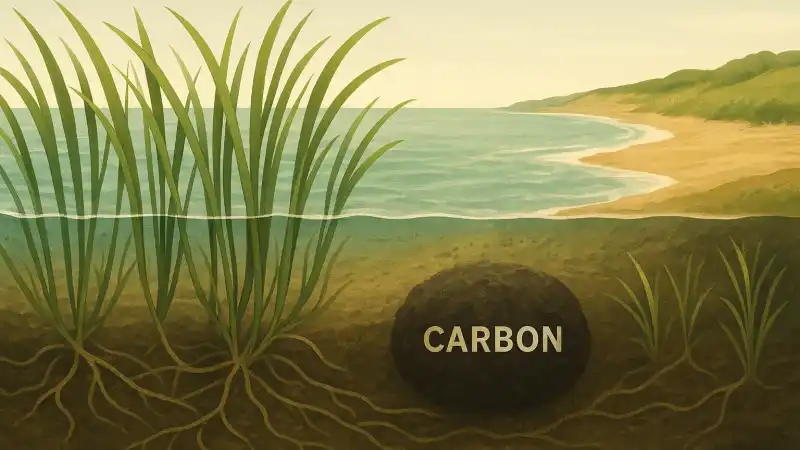
People often notice seagrass when it tangles a propeller or brushes their ankles in shallow water. What’s easier to miss is that these underwater plants are also building a kind of quiet archive. This isn’t about one single bay or one famous project. It shows up in places as far apart as Florida Bay in the United States, Shark Bay in Western Australia, and the Wadden Sea along the Netherlands and Germany. Seagrass pulls carbon from the water as it grows, then helps trap fine sediment. Over time, that sediment becomes an oxygen-poor layer where bits of plant material can sit for years to centuries instead of quickly rotting away.
How carbon gets locked into the seabed
Seagrass stores some carbon in its leaves and roots, but the bigger story is what ends up under it. The plants slow currents near the bottom. That makes suspended particles settle out: silt, clay, and tiny organic fragments. The seabed becomes a mix of mineral grains and carbon-rich material, packed into layers.
A specific detail people often overlook is oxygen. When sediment is trapped tightly and stays waterlogged, oxygen can’t move through it very well. That changes the chemistry. Microbes have a harder time breaking organic matter down fast, so more of that carbon stays buried. How long it lasts varies by site, because storms, burrowing animals, and water quality can all disturb those layers.
Why seagrass meadows are good at catching sediment
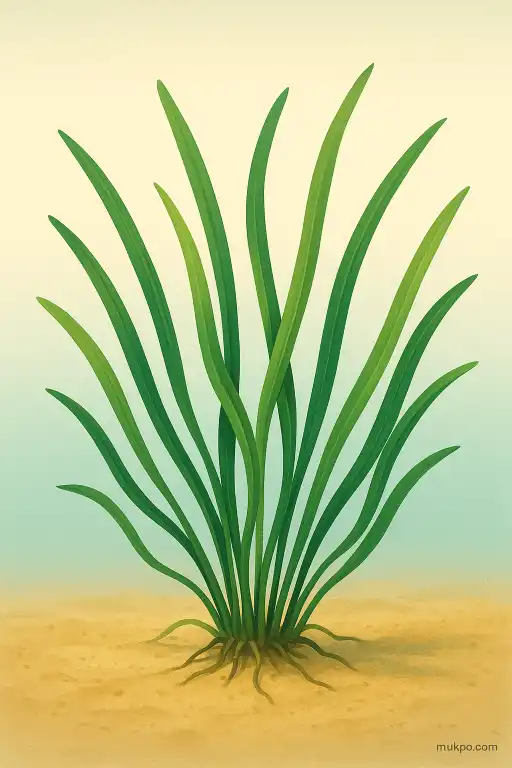
The leaves act like a dense filter. They make water flow more slowly through the meadow than over bare sand. With less turbulence, fine particles that would normally stay suspended drop to the bottom. The roots and rhizomes also hold the seabed together, which reduces how easily waves and currents can lift sediment back up.
This is one reason the water inside a meadow can look clearer than water just outside it, even on the same day. It isn’t always dramatic, and it depends on conditions, but the pattern is common. The meadow changes the local “budget” of sediment: less gets resuspended, and more ends up stored in place.
What “blue carbon” includes, and what it doesn’t
When people talk about seagrass as “blue carbon,” they often mean the carbon held in sediments, not just living plant tissue. That buried portion can be large because it represents accumulation over long time spans. It can also include carbon that didn’t originate in the seagrass itself. Organic matter can drift in from algae, nearby wetlands, rivers, or plankton in the water column, then get caught and stored under the meadow.
That mix is why measurements can be tricky. Different meadows sit on different kinds of sediment, and they receive different inputs from land and sea. Even within a single region, the carbon stock can vary over short distances because the seabed isn’t uniform, and because some patches are older or denser than others.
How meadows reshape coastlines without looking like they do
Coastlines don’t only change where sand is visibly piling up. They also change where the seabed slowly rises or stabilizes. By trapping sediment, a meadow can create a shallower platform behind it, which can alter how waves lose energy before reaching shore. In sheltered areas, that can support more deposition. In more exposed areas, it can be a tug-of-war between trapping and being ripped up.
These changes can show up as subtle shifts in channels and sandbars over time. Seagrass doesn’t build a rigid structure the way a seawall does. It nudges the physics: friction in the water, the timing of sediment settling, and the ease with which the seabed gets stirred up again.
What happens when seagrass is lost
When a meadow thins or disappears, the system can flip. Faster water movement over the bottom means more resuspension of fine particles. The water gets cloudier, which can reduce the light that seagrass needs to grow, making recovery harder. If the seabed becomes more oxygenated, the buried organic material can break down more quickly than it did when it was sealed under dense vegetation.
How much carbon is released, and how fast, is not fixed. It depends on how deep the carbon-rich layers are, whether they get physically eroded, and how local chemistry changes. In places with heavy boat traffic, dredging, or strong storm seasons, the disturbance can be more direct. In calmer settings, the shift can be slower, showing up first as a gradual loss of the fine, dark sediment that had been quietly accumulating under the grass.
Related reads
- The Antarctic brine pocket where microbes breathe metal instead of oxygen
- How a cold rewires your sense of taste and flavor
- The mushroom that glows to attract spring beetles
- Why bread sometimes grows mold in perfect circular patches
- An elevator that refuses to open on floors with odd birthdays
- How volcanic ash shapes global weather patterns