
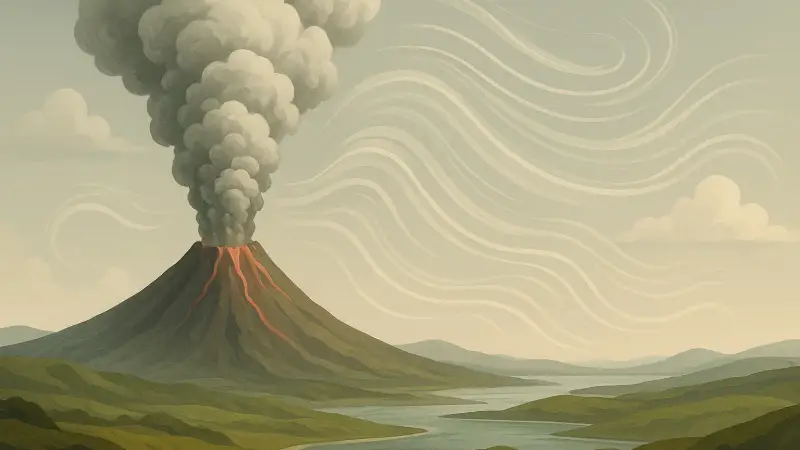
It doesn’t take much ash to reach the weather
A weird detail about volcanoes is that the ash people sweep off cars is not the part that matters most for weather. The big shifts start when fine particles and sulfur gases get injected high into the atmosphere. That happened after Mount Pinatubo in the Philippines in 1991, and it also happened with Eyjafjallajökull in Iceland in 2010 and the 1783–1784 Laki eruption. This isn’t one single “volcanic weather event.” It varies by eruption size, latitude, season, and how high the plume goes. The basic mechanism is simple: tiny particles change how sunlight and heat move through the air, and that can nudge winds and rain patterns far from the volcano.
Ash falls out fast, but aerosols linger
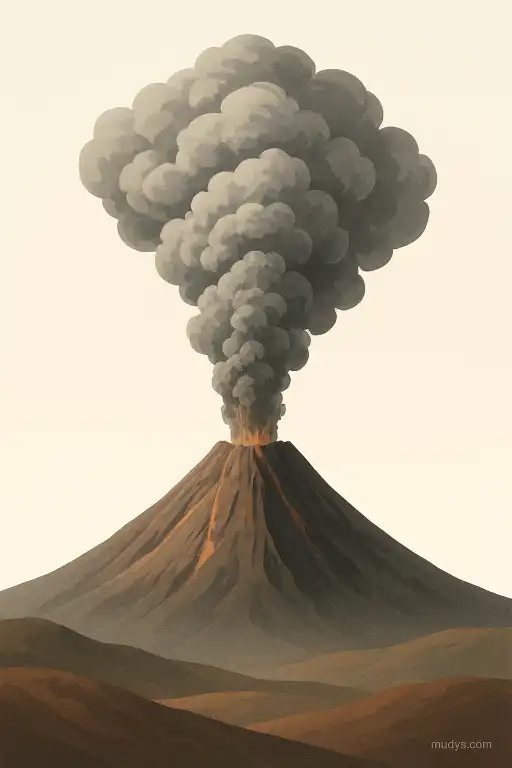
Volcanic ash is mostly broken rock and glass. The heavier grains drop out quickly, sometimes within hours to days, and usually close to the eruption. The stuff that sticks around is often sulfate aerosol, formed when volcanic sulfur dioxide reacts with water vapor and oxygen. Those droplets are tiny, and if they reach the stratosphere they can stay there for a year or two because there’s little rain up that high to wash them out.
One overlooked detail is that the stratosphere is a different transport system. It has its own circulation, and it mixes differently than the lower atmosphere where day-to-day weather happens. So an eruption that only reaches the troposphere can be dramatic locally but fade quickly in global terms. An eruption that crosses into the stratosphere can keep affecting sunlight long after the headlines stop.
The first global effect is usually cooling, not darkness
The main global lever is sunlight. Sulfate aerosols scatter incoming solar radiation back to space, which cools the surface on average. After Pinatubo, global average temperatures dropped by roughly a few tenths of a degree Celsius for a short period. The sky didn’t go “dark” everywhere. The change is more like turning down the dial slightly, but across the whole planet that’s enough to shift gradients that weather depends on.
Cooling is not evenly spread. The aerosol layer is often concentrated in one hemisphere at first, and the oceans respond more slowly than land. That unevenness matters because winds follow temperature contrasts. Even a small change in the contrast between tropics and poles, or between ocean and continent, can alter storm tracks and the timing of monsoons.
Winds and rain respond to shifted temperature gradients
Weather patterns are partly the atmosphere trying to move heat around. When volcanic aerosols cool the surface, they can weaken evaporation and slightly reduce global precipitation for a while. The changes people notice are often regional: a storm track nudges north or south, a monsoon arrives weaker, or a rainy season shifts. The exact pattern depends on where the aerosol ends up and how the ocean-atmosphere system is already set up that year.
Latitude is a quiet deciding factor. Tropical eruptions have a better chance of spreading aerosols widely because stratospheric circulation can carry them into both hemispheres. High-latitude eruptions can have strong local effects but sometimes stay more confined. That’s one reason two eruptions with similar headlines can lead to very different weather stories.
Volcanoes can warm the stratosphere while cooling the ground
There’s a contradiction that trips people up: the same aerosol layer that cools the surface can warm the stratosphere. Those particles absorb some infrared radiation and change stratospheric temperatures. That can influence the strength and structure of the polar vortex and other high-altitude wind systems. When those winds shift, the effects can trickle down into the patterns that steer winter storms.
A second overlooked detail is that ash and aerosols don’t just interact with sunlight. They also act as surfaces for chemical reactions that can affect ozone, especially in the stratosphere. Ozone changes can further tweak how the stratosphere heats and cools, which matters because weather is sensitive to how the atmosphere is layered. The result is rarely a single, clean outcome, and it’s often clearer in hindsight than in the weeks right after an eruption.
Related reads
- How a tiny meteorite impact changes local soil chemistry
- The bench that always held a single lost glove belonging to the same person
- Why ordinary noises seem louder and creepier at night
- The mushroom that smells like rotting meat to lure flies
- A street mural that rearranges its bricks to spell new names at dawn
- How a single antibiotic reshapes your gut microbiome