

Some mornings, a statue looks slightly wrong. The coat is the same. The pose is the same. But there’s a new hat on its head, and nobody saw it happen. It isn’t one single place with one settled explanation. It pops up as a local story in different towns, and the details vary. People point to pranks, quiet tradition, or someone with keys and insomnia. A well-known example of the broader “dressed statue” habit is the bronze bull on Wall Street in New York City, which has repeatedly been accessorized overnight with props and costumes. The hat version is just cleaner. One small change, reset every dawn.
How a hat can appear without being “seen”
Most statues that get “updated” are in places with a blind spot. A hedge blocks the base from the street. A lamppost throws glare at night. A camera points toward traffic, not upward toward a head. If you stand where passersby naturally stand, you often can’t see the shoulders clearly, which means you also can’t tell if someone is climbing. The result is simple: the town experiences the change, but not the act. People remember the surprise, not the empty hours when it could have happened.
The overlooked detail is weight and shape. A wool beanie or floppy sunhat can be carried under a jacket, placed quickly, and it won’t clatter. A stiff brimmed hat is louder and harder to balance. The hats in these stories are usually the quiet kind, the kind that can be pressed down and made to “stick” with friction or a hidden loop.
Access is usually the whole story
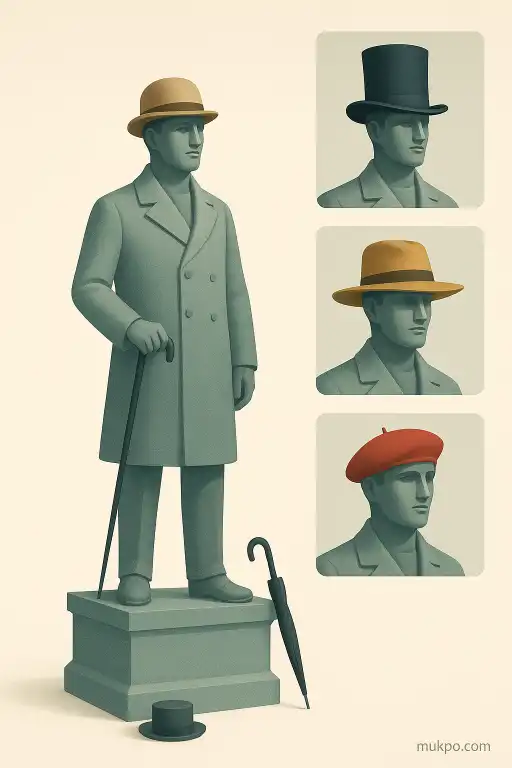
There are only a few practical ways to reach a statue’s head. Some have a low plinth and nearby railings. Some sit beside a bench that acts like a step. Others are next to a signpost or a tree with a convenient branch. If a statue is near a building, a maintenance ladder can do the job in seconds, and it won’t look unusual at night. Even without a ladder, two people can do it if one can brace the other. That’s why these accounts often involve a hat that changes but nothing else. It’s the easiest accessory to place high up without leaving a mess.
Another mundane factor is the surface. Bronze develops smooth patches where people touch it, and smooth metal is hard for a hat to grip. So the “successful” hat changes tend to happen on statues with rougher hair, sharp edges, or a crown-like shape that catches elastic. A small strip of double-sided tape can also do it, but tape leaves residue, and residue is the kind of evidence towns notice once they start looking.
Why it keeps happening once it starts
A repeating hat swap is different from a one-off prank because it becomes a ritual without anyone needing to announce it. A first hat makes the statue “available.” After that, people begin to scan it each morning the way they check a shop window. Once the town expects a change, someone feels invited to continue it, even if it’s a different person each time. It can become a relay. One person does it once, another person tries to top it, and soon the story is bigger than the original actor.
Local calendars feed it too. Hats map neatly onto holidays and events. A Santa hat in December is obvious. A graduation cap appears when the school year ends. A sports cap shows up after a win. Nobody has to explain the message. The hat does it. That’s part of why the hat version spreads as a town tale. It’s low effort, readable from across the street, and easy to photograph.
The quiet roles of staff, cleaners, and weather
Not every “mysterious” hat is placed by a stranger. Statues sit in maintained spaces. Someone unlocks gates early. Someone empties bins before commuters arrive. Someone checks lighting, landscaping, or storefront shutters. If a hat is removed by staff in the morning and replaced by someone else the next night, it creates the feeling of a nightly transformation even if it’s just two predictable routines colliding. Towns rarely connect those routines unless someone asks the boring question of who is onsite before dawn.
Weather can also rewrite the story. A hat that looks firmly placed at midnight can shift in wind and settle into a new angle by morning, which makes it feel “deliberate.” Rain makes fabric cling. Frost can stiffen a cap so it sits higher, almost posed. And if the statue is under a tree, branches can nudge a hat into a different position overnight. That doesn’t explain a totally new hat, but it does explain why witnesses disagree about how “neatly” it was worn.
Why proof is hard even when people add cameras
Once a town starts watching, you’d think the mystery ends. Often it doesn’t, because the watching is imperfect. A camera aimed at the statue’s face may not capture the approach route. A motion light may only trigger for movement at ground level, not for someone already on the plinth. Phones come out in the morning, after the fact. Even security footage can be inconclusive if the statue is backlit or if the hat swap happens during the exact few minutes when streetlights cycle or a sprinkler mist blows through the frame.
There’s also a social reason it stays unproven. People who know more than they say sometimes prefer it that way. The moment a name is attached, the act becomes vandalism or trespassing instead of “our statue’s little tradition.” So the hat keeps changing, the photos keep getting posted, and the details stay fuzzy on purpose, especially in smaller places where everyone recognizes everyone else’s jacket.
Related reads
- A phone line that delivers hold music recorded during the 1970s
- The word at the edge of your tongue: why retrieval slips away
- Salt chemistry in Enceladus plumes and what it reveals about hidden oceans
- Why the word you need vanishes in the middle of a sentence
- The mirror in a thrift shop that reflects rooms nobody recognizes
- How seagrass meadows bury carbon and reshape coastlines