
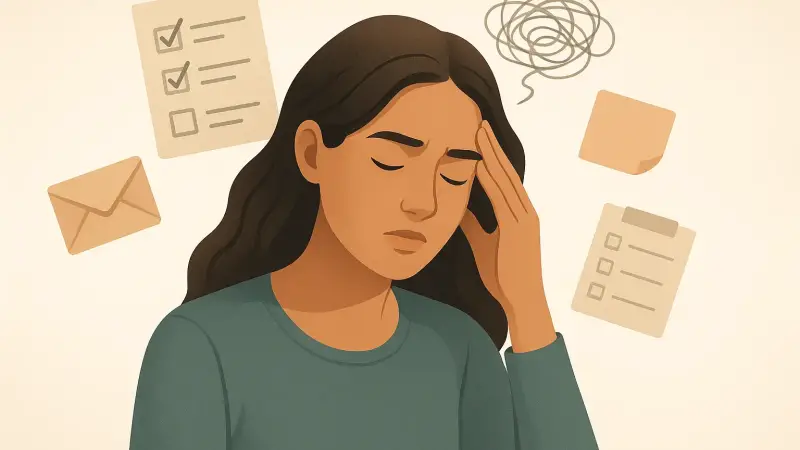
You can be halfway through a movie and still get tugged back to an email you didn’t send. Or you’re in the shower and suddenly remember the one item you didn’t buy. This isn’t one single event or place. It shows up everywhere, from cramming in the U.S. to exam weeks in South Korea to late-night shift work in the U.K. Psychologists often point to the Zeigarnik effect, named after Bluma Zeigarnik, as part of the explanation: unfinished tasks stay “active” in the mind. The brain seems to treat them like open loops that might still matter, so they keep bubbling up at odd times.
An unfinished task is a special kind of memory
Finished tasks tend to get filed away. Unfinished ones hang around because the mind doesn’t only store what happened. It also stores what still needs to happen. That “needs to happen” part is not a feeling. It’s closer to a status flag. It’s why a half-written message can feel louder than ten messages you already answered.
Researchers describe this as a difference between completed and uncompleted goal states. When a goal is active, attention becomes biased toward anything that might help close it. You notice related cues more. You recall the task faster. It’s not that the task is more important than everything else. It’s that it’s still marked as unresolved.
Why it pops up at the worst times
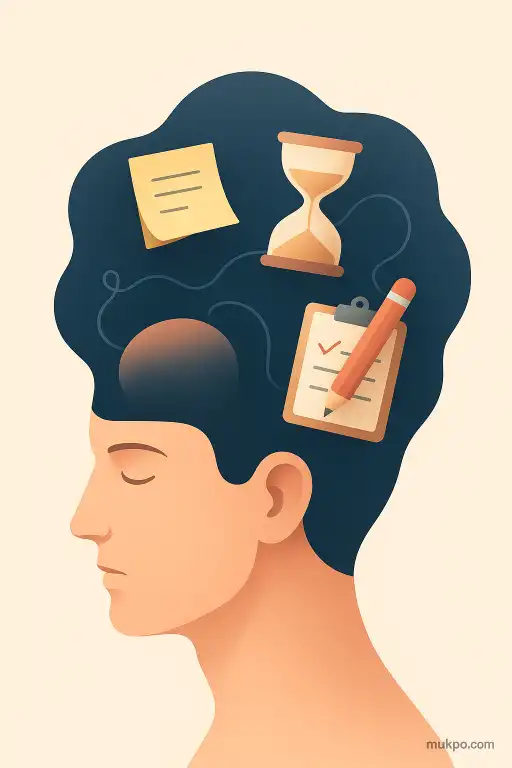
The intrusions often arrive when the mind has spare capacity. Waiting in line. Walking to the car. Lying down at night. When the external world demands less, internal monitoring has room to run. A small gap in attention can trigger a scan: what’s pending, what’s risky, what’s unfinished.
A concrete example is leaving a work request half-done because a meeting starts. Later, while listening to someone talk, the mind keeps flashing the incomplete step: “attach the file,” “confirm the date,” “hit send.” The overlooked detail is that the trigger is often not the task itself but a tiny cue linked to it. Seeing a calendar time, hearing the person’s name, noticing your phone battery—small reminders that the loop is still open.
Tension comes from uncertainty, not effort
Unfinished tasks feel sticky when the next step is unclear. A task that is hard but well-defined can be mentally quieter than a task that is easy but ambiguous. “Write the report” can nag more than “format the spreadsheet” because it contains more unknowns: what angle, what length, what standard counts as done.
That’s why the mind can obsess over things that take two minutes. It’s not the workload. It’s the unresolved decision point. If a task has multiple possible endings, the mind can’t confidently close the file. It keeps it active in case new information arrives, or in case you suddenly decide which version is “correct.”
The mind keeps a queue, and it’s not fair
People often assume the most important tasks will dominate attention. But the mental queue isn’t ranked purely by importance. It’s shaped by immediacy, emotion, and the chance of causing trouble if forgotten. A low-stakes chore can stay on top if it’s easy to imagine the consequence of missing it, like forgetting to pay for parking or not replying to a time-sensitive text.
There’s also a social edge to it. Tasks tied to other people can cling harder because they involve reputation and uncertainty about how someone will react. An unfinished message to a manager can feel heavier than an unfinished personal note, even if the personal note matters more to you, because the outcome is less controllable.
Stopping points matter more than people think
Where you pause a task changes how much it nags. If you stop at a clean boundary, the mind has something to label: “done for now.” If you stop mid-step, it’s harder to represent what’s left. That’s one reason interruptions are so mentally expensive. They often cut in the middle of a sequence, before the next action is clearly stored.
One small detail people overlook is that physical context can act like a bookmark. Leaving a document open, keeping items on a counter, or seeing a browser tab can keep the goal active without any conscious choice. The environment keeps re-issuing the reminder. Even when you’re trying to focus on something else, the unfinished task is still being reintroduced as if it just happened.
Related reads
- The town statue that mysteriously appears wearing a different hat every morning
- A phone line that delivers hold music recorded during the 1970s
- The word at the edge of your tongue: why retrieval slips away
- Salt chemistry in Enceladus plumes and what it reveals about hidden oceans
- Why the word you need vanishes in the middle of a sentence
- The mirror in a thrift shop that reflects rooms nobody recognizes