
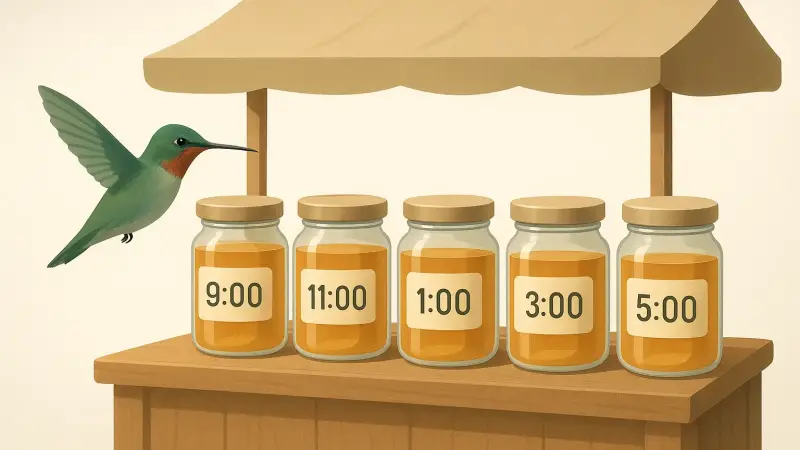
What a “time-stamped jar” means at the stall
You pick up a jar of pickles and the label doesn’t say “spicy” or “dill.” It says “Opened 14:07.” The idea isn’t tied to one famous market or one documented tradition, and details vary when people tell the story. You’ll hear versions set in London street markets, Tokyo side streets, or weekend flea markets in the U.S., but there isn’t a single verified location everybody can point to. The mechanism is consistent, though: the seller opens jars at specific times and sells them as objects with a recorded moment attached, almost like a receipt that became the product.
A concrete example is how it’s usually described: a customer watches a vendor crack a seal, write the exact hour on masking tape, and move the jar to a “just opened” section. Another jar might have been opened at 09:12 and has been sitting there for hours, even if it’s the same brand and batch. The label is the point.
How the hour becomes the product
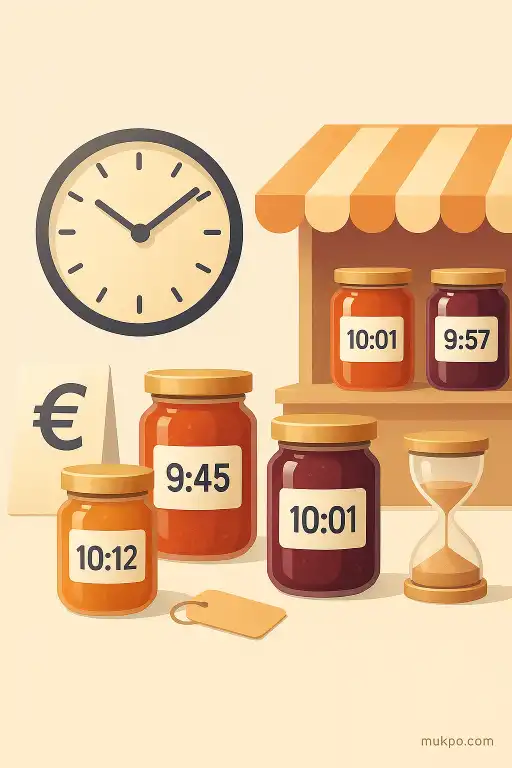
For this to work, the jars can’t be treated like normal inventory. The vendor needs a rule about what “opened” counts as, and that rule tends to be stricter than people expect. Some versions require the lid to come off and go back on, not just loosening it. Some require a new seal, or they refuse to reseal at all so the jar’s state stays honest. The label has to be applied immediately, because the whole pitch depends on the customer believing the time is not “close enough.”
The overlooked detail is the clock. If the stall’s time runs fast, the whole system gets weird fast. Vendors who take it seriously have to pick a reference time and stick to it. That can be a phone set to network time, a radio-controlled clock, or simply “the market’s clock” everyone can see. Even then, it’s still a human system. People notice when the handwriting changes or when the ink looks too dry for a label that claims it was written three minutes ago.
What people think they’re buying
Most buyers aren’t paying for freshness in the usual sense. If it were only about that, the label would be “opened today.” The exact hour does something else. It pins the jar to a narrow slice of time, which makes it feel less interchangeable. Two identical jars stop being identical once one says 10:03 and the other says 16:41. People start choosing based on their own day. Someone who arrived late buys the late jar because it matches their schedule. Someone who wants the earliest one treats it like the first print of a book.
It also invites small social rituals. Buyers ask what was happening at that moment. Vendors answer with whatever the market gave them: a sudden rain, a busker starting a set, the espresso machine breaking. The time stamp becomes a hook for conversation, which is a real form of value at a stall. The jar becomes a souvenir of an interaction that has a clear coordinate: 14:07.
The practical problems sellers have to solve
Once you attach a time to an opened container, you also attach all the boring parts of food handling, storage, and spoilage. Even if the jars are non-food—buttons, sand, paper scraps—the public assumption is that “opened” changes the object. That means the seller needs a plan for what happens when jars sit too long. Some versions of the story include a cutoff, where anything opened before noon moves to a discount crate. Others treat older times as more desirable, like aging, which flips normal expectations and can confuse people walking up cold.
There’s also a quiet logistics issue: the act of opening has to be visible or verifiable, or customers start suspecting the labels are being batch-written. If the market is crowded, a vendor may have to repeat the opening gesture again and again just so new people can witness it. That can turn the stall into a little performance. It also slows down sales, which is fine if the point is the ritual, but it’s a real cost if the vendor is trying to run a normal food business.
Why the idea sticks around in stories
The reason this gets repeated as a market oddity is that it takes a familiar container and makes it behave like a timekeeping device. A jar normally promises stability. Sealed, shelf-stable, the same tomorrow. Marking the exact hour it was opened flips that. It says the jar now lives on a timeline, and you’re buying a specific point on it. That’s easy to understand quickly, which is why it spreads as an anecdote even when the origin is unclear.
When people describe seeing it, the details that stay consistent are small: tape instead of printed labels, handwritten times instead of dates, and the way customers compare hours the way they’d compare prices. The stall doesn’t need a big sign. It just needs one jar that says “Opened 08:19” sitting in plain view, close enough that someone can lean in and read it.
Related reads
- Methane-eating microbes that slow greenhouse emissions in thawing Arctic ponds
- Why deep-sea squid flash lopsided bioluminescence to disappear from predators
- How bristlecone pines archive millennia of drought in rings and resin
- How Joshua Norton declared himself Emperor on 1859 San Francisco streets
- An elevator that skips floors if you say a secret word
- Why unfinished tasks cling to your mind