
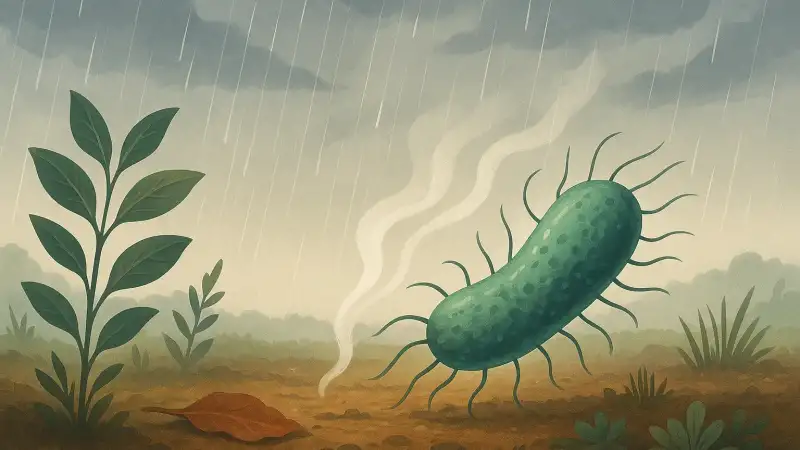
A smell that shows up before the rain is even over
After a dry spell, the first minutes of rain can smell like damp soil and old stone. It isn’t tied to one specific place or event. It happens in lots of settings, from London parks to the Australian outback to sidewalks in Mumbai. The core mechanism is simple: raindrops hit surfaces and kick tiny bits of material into the air. Some of that material is a molecule called geosmin, made by soil bacteria. Some of it is plant oils that have been sitting on rocks and pavement. Your nose is unusually good at noticing those compounds, even when there isn’t much of them.
Geosmin: the bacterial molecule your nose can’t ignore

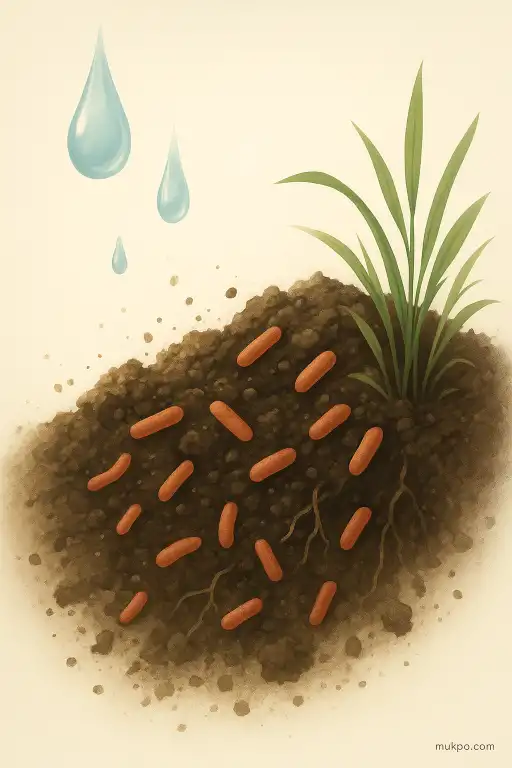
Geosmin is produced by microbes that live in soil, especially bacteria in the group called Streptomyces. These are common decomposers. They feed on dead plant material and help recycle nutrients. Geosmin isn’t “for” humans, but it’s a byproduct your brain treats as meaningful. People can detect it at extremely low concentrations, down in parts per trillion, which is why the smell seems to bloom out of nowhere.
A detail people overlook is that the smell is not only about wet dirt. It’s also about disturbance. Geosmin tends to be trapped in soil pores and on particles. When the ground is dry and then gets hit suddenly, more of it becomes airborne at once. That’s why a gentle drizzle after days of rain can smell like almost nothing, while a first shower after weeks of heat can smell strong.
How raindrops turn soil into airborne scent
When a raindrop strikes a porous surface, it can form tiny bubbles that rise and burst. That bursting sprays microscopic droplets upward, like a small aerosol. Those droplets carry dissolved compounds and small particles. In 2015, researchers described this “aerosolization” effect in experiments with raindrops and different surfaces, which helped explain why the smell can travel quickly through air instead of staying in the ground.
Conditions matter. Impact speed, wind, and surface texture all change the amount of aerosol produced. Compacted clay behaves differently than loose garden soil. So does asphalt. Even the size distribution of raindrops shifts during a storm, and that changes how much material gets lifted. The variability is why the scent can be intense on one street and faint a few blocks away, even under the same clouds.
Not just bacteria: plant oils and ozone also get involved
The earthy note is only one part of what people lump together as “rain smell.” During dry weather, plants release oils that can collect on rocks, dust, and pavement. When rain arrives, those oils can be released along with geosmin. That’s one reason the smell near shrubs, dry grass, or leaf litter can differ from the smell near a concrete parking lot.
Another contributor can be ozone, which has a sharper, cleaner edge. Ozone near storms can form when electrical activity or strong atmospheric chemistry splits oxygen molecules and they recombine into O3. How noticeable that is varies a lot. Some storms have plenty of lightning and gust fronts that move air around, and some don’t. So sometimes the “rain smell” is mostly geosmin and wet mineral dust, and sometimes it includes that faint electrical note.
Why it hits hardest after drought and around certain surfaces
Dry periods set up the conditions for a strong burst. Microbial life in soil shifts when water is scarce, and organic material can accumulate. When moisture returns, activity ramps up and compounds are more likely to be released and carried upward. The first rain also knocks loose fine dust that has been sitting undisturbed. That dust is a vehicle for smell, not just a background nuisance.
There’s also a simple situational example people recognize: the scent is often strongest right where rain first hits hot pavement. Pavement has pores and grime, and it sheds aerosols efficiently when drops strike. But it doesn’t smell the same as a forest floor because the chemistry isn’t the same. The “earthy” part still tends to come from soil bacteria nearby, carried on moving air, mixed with whatever the surface itself throws up in that first noisy minute of rainfall.
Related reads
- Traffic lights that flash seemingly random colors but predict storms
- The confident memory that never happened: how false memories form
- Why yawns spread: what contagious yawning says about empathy
- A library that loans bottled rain collected during historic festivals
- A diner that serves one dish only on nights without moonlight
- How tiny pauses in speech reveal honesty and bluffing