
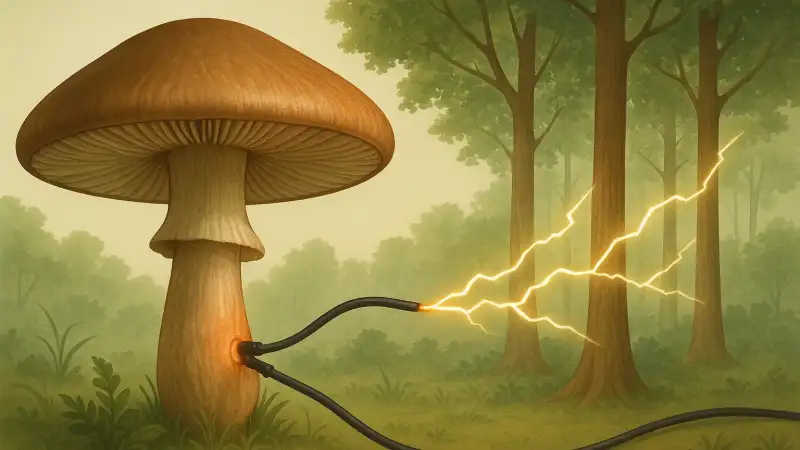
If you’ve ever walked through a damp forest and seen mushrooms pushing up after rain, it’s easy to forget they’re only the visible tip of something much larger. Under your boots is a web of fungal threads called mycelium, and some of those threads can move electrical signals. This isn’t one single place or one famous incident. It’s been reported in different fungi and different forests, including studies on Armillaria in Europe, work on Schizophyllum commune, and lab experiments on oyster mushrooms (Pleurotus). The core mechanism is simple: ions shift through wet, living tissue, and the mycelium’s thin tubes can carry that change as a measurable voltage pulse.
What “electric” means in a fungus
When people hear “electricity,” they often imagine metal wires and flowing electrons. Fungal tissue is different. Most measurements in fungi look like electrical potential changes across the mycelium, driven mainly by ions moving through watery cells and across membranes. It’s closer to the kind of signaling seen in nerves or plant tissue than it is to a copper cable.
The numbers are usually small. Researchers typically record millivolt-level changes with electrodes placed on the mycelium or fruiting body. What’s easy to miss is that a mycelial network can be electrically active even when you can’t see any mushrooms. The fruiting bodies are temporary. The signaling substrate is the persistent underground network.
The “wires” are living tubes and wet surfaces
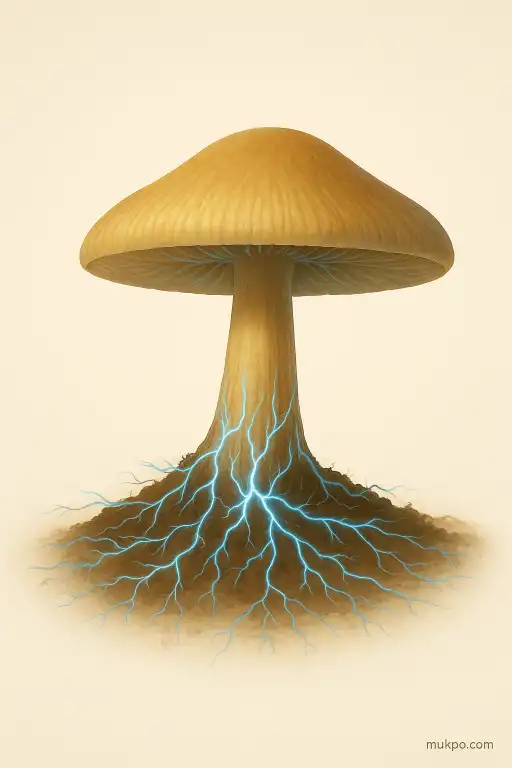
Mycelium is made of hyphae, microscopic tubes that grow through soil, leaf litter, and wood. Those tubes have membranes that maintain ion gradients, and they share cytoplasm through pores and junction-like structures. When conditions change, channels open and close, ions shift, and the voltage across parts of the network changes.
A specific detail people usually overlook is how much the surrounding moisture matters. Soil water, surface films on hyphae, and damp wood all change conductivity. A network measured after rain can behave very differently than the same network in a dry spell, even if the fungus is alive in both cases. That makes field measurements tricky, because “signal” and “environmental conductivity” can blur together.
What tends to trigger the pulses
Electrical activity in fungi often appears as spikes or pulses rather than a steady current. In lab settings, pulses have been observed after changes in light, temperature, humidity, mechanical disturbance, or the arrival of nutrients. Some experiments also report changes when the fungus encounters obstacles or when a food source is added at one edge of a growing colony.
It’s still unclear how standardized these patterns are across species, or how much they vary with setup. Electrode placement matters. So does what the fungus is growing on. A colony growing through agar in a dish is not the same electrical environment as mycelium threading through rotting logs and mineral soil, where salts, microbes, and water channels all add their own effects.
A concrete example: the honey fungus network
One of the easiest situations to picture is a fungus spreading through wood. Honey fungus (Armillaria) forms long, dark “shoelace” structures called rhizomorphs that can travel between tree roots and stumps. In places like Switzerland, Armillaria has been studied for how it colonizes forests and moves resources through connected tissues. Those rhizomorphs are thick compared to single hyphae, and they provide a more defined pathway for measuring potential differences along a strand.
What tends to happen is that resource transport and electrical changes show up together, but they aren’t the same thing. Sugars and water move physically. The electrical signal is a pattern of ion changes riding on living tissue. In a real forest patch, the rhizomorph might also be touching wet bark, soil water, and other organisms, which can create alternate conductive routes that look like “wiring” if you only focus on the voltage trace.
What the forest “network” can and can’t be
Fungi are famous for connecting plants through mycorrhizal partnerships, and forests do have networks that move carbon, nutrients, and chemical signals. Electrical activity adds another layer, but it doesn’t automatically mean there’s a forest-wide messaging system that works like an engineered grid. A mycelial web is patchy. It breaks. It competes with other fungi. It gets eaten. Even in healthy soil, networks are more like overlapping territories than one continuous cable map.
The most grounded interpretation is that electrical signals are part of how fungal cells coordinate growth and transport across their own bodies, and that those signals can be measured because the body is spread out through the environment. In the field, a single step, a drip of water, or a shifting root can change contact points in ways that matter electrically, even though nothing about the fungus itself has “decided” to send a message.
Related reads
- Why rain smells earthy: the bacteria behind petrichor
- Traffic lights that flash seemingly random colors but predict storms
- The confident memory that never happened: how false memories form
- Why yawns spread: what contagious yawning says about empathy
- A library that loans bottled rain collected during historic festivals
- A diner that serves one dish only on nights without moonlight