
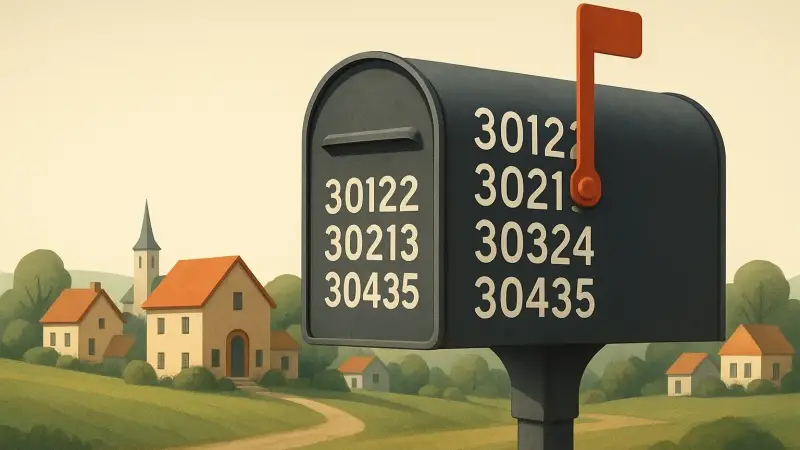
A superstition that lives in the address
People don’t usually think of a postal code as something you can “fix.” It feels like a neutral label that just points mail in the right direction. But there are places where residents have pushed to change it anyway, because the numbers look wrong, sound wrong, or seem unlucky. Hong Kong is a clear example of how this can work: most of the city doesn’t use postal codes at all, partly because the format was associated with colonial-era administration and later politics. Elsewhere, the belief is more intimate. A cluster of houses might lobby for a different code because one digit keeps showing up in a funeral notice, or because a sequence resembles a death-related word in the local language.
How a postal code can “change” without the mail collapsing
Postal codes are designed for sorting, not for storytelling. They get assigned by a postal authority, and changing them usually means changing routing tables, databases, and labels that other systems rely on. That’s why the “village that changes its postal codes” is often less like a whole community flipping a switch, and more like a boundary being redrawn, a new code being introduced, or an old one being retired. Sometimes the change is official and public. Sometimes it’s informal, with people writing an alternate code that still reaches the same post office because human sorters and local carriers recognize it.
A specific detail people overlook is how many non-mail systems treat a postal code as an identity tag. Banks use it for verification. Insurers use it for risk models. Online retailers use it for fraud checks and delivery promises. Even if a post office can handle a swap, everything else has to be updated too. That’s why “changing a code” can take months of quiet paperwork even when the superstition itself is simple and old.
What makes a number feel unlucky
The superstition usually attaches to language. In parts of East Asia, certain digits are avoided because they sound like words tied to death or suffering, depending on the language and the exact pronunciation. A postal code is a neat bundle of digits that gets repeated constantly: on envelopes, receipts, school forms, clinic registrations, and delivery labels. If one of those digits is culturally “heavy,” the code can start to feel like a daily invitation to bad luck. The belief doesn’t have to be universal to create pressure. It just has to be common enough that people begin to hesitate when giving their address out loud.
It can also be about patterns, not single digits. A sequence that looks like a bad year, an emergency number, or a local slang phrase can become a talking point. Once a few residents start linking a number to misfortune, confirmation bias does the rest. One storm, one illness, one business closure, and suddenly the code is part of the explanation people repeat to each other.
The practical triggers that turn belief into a request
Postal authorities rarely change codes just because someone feels uneasy. The requests that succeed tend to piggyback on practical changes: a new delivery route, a municipal merger, new housing developments, or a decision to split a large code area to reduce sorting errors. That’s when residents can argue that a new code is already needed, and the exact digits are still up for discussion. If a “bad” digit can be avoided at the design stage, it’s cheaper than changing it later. This is why the superstition often shows up right after a development boom or an administrative reorganization.
Another overlooked trigger is emergency services and navigation. If an area’s addresses are confusing, officials may push for a standardized scheme that includes a new postal code or a different set of boundaries. Residents who care about lucky numbers sometimes get their chance in that moment, because the system is being touched anyway. The superstition doesn’t have to be written into any policy. It just rides along with a broader fix that everyone agrees is necessary.
What daily life looks like during a code change
When a code changes, the messy part is the overlap period. Old and new codes often work side by side for a while, because mail can’t be allowed to bounce. Some postal services formally accept both for a set time. Others do it informally because carriers know the neighborhood. The real friction shows up elsewhere: school records, medical charts, utility accounts, shipping profiles, and government IDs that were validated against the old code. A village can feel like it’s “changing its code” repeatedly when, in practice, it’s chasing down every place that stored the old digits and refuses to accept the new ones.
And then there’s the social side. People correct each other. Shopkeepers reprint flyers. Someone’s grandmother keeps writing the old code on letters because it’s the one she memorized decades ago. The superstition is supposed to make life calmer, but during the transition it can do the opposite. It’s not dramatic. It’s just a lot of small moments where a number, of all things, becomes something the community has to negotiate out loud.
Related reads
- An office building whose plants only thrive when given live music
- How the 1755 Lisbon earthquake sent Enlightenment salons into philosophical panic
- How the 1778 Potato War over Bavarian fields turned Europe’s armies into crop thieves
- How tiny mineral magnets make sand dunes align
- How a distant volcano dimmed sunlight and chilled entire harvests
- A street where every doorstep displays a broken clock set to the same minute