
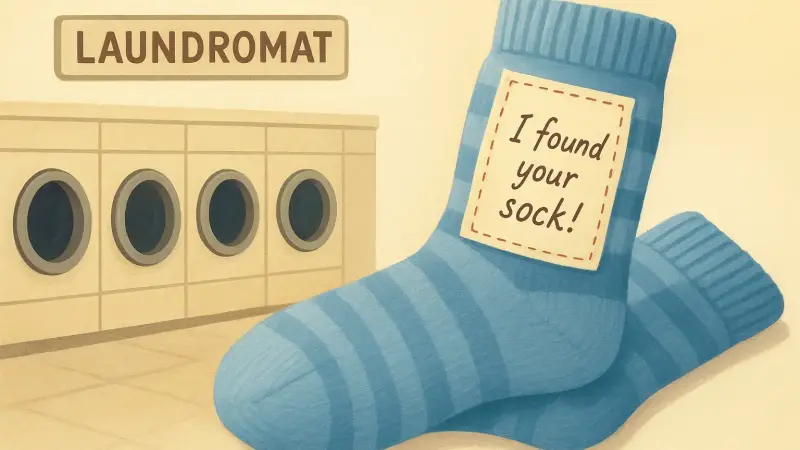
People drop off laundry and expect to lose a sock or two. The odd thing here is the opposite: socks come back matched, and sometimes there’s a sentence sewn inside them. This isn’t one documented, single laundromat with a verified address. It shows up as a modern rumor and a repeatable idea people claim to have seen in different cities, including stories passed around in places like New York and London. The mechanism is always the same. A “missing” sock returns later. The inside cuff has been opened and closed again with a neat line of stitches, hiding a small note in the seam allowance where most people never look.
How the note can even be there
A sock has a few places where a message can be hidden without changing how it feels on your foot. The easiest is the cuff. Knit cuffs are doubled over, which creates a natural pocket of fabric. If someone unpicks a short section of seam, slides in a thin strip of paper, and stitches it back with matching thread, you won’t see it from the outside. You might not even feel it, because the paper sits between layers.
The overlooked detail is that most socks already have non-obvious seams and reinforcements. The toe is often closed with a flat seam that hides in the knit. The heel has extra yarn density. If a laundromat (or any person handling laundry) wanted to conceal a repair, they’d choose a spot that already looks “busy.” That’s why stories about notes usually mention the inside edge of the cuff, right where people assume it’s just a normal join.
Why socks are the perfect container

Socks are small, easy to separate, and easy to “accidentally” swap. Anyone who has used a wash-and-fold service knows how often single socks end up in the wrong bundle, especially when lots of customers own the same black crew socks. A laundromat can plausibly return a sock a day later with no one thinking it’s a big deal. That makes socks useful in stories about secret messages, because the delivery can be framed as routine error correction.
They also survive the process better than most hiding places. A note in a pants pocket gets shredded, soaked, or found immediately. A note taped to a waistband is obvious and leaves residue. But a note protected by knit fabric can go through heat and tumbling and still come out readable, especially if it’s folded tightly and placed where water doesn’t circulate as aggressively as it does on exposed surfaces.
What people say the notes are like
When people tell this story, the message is almost never long. It’s usually a single line, like a reminder, a riddle, a phone number, or a tiny confession. That matters because a sock can’t hide much without becoming noticeable. A thick wad changes the shape. A larger paper corner can poke through the knit after drying. The “credible” versions of the tale keep the note small enough to stay invisible.
A common situational example goes like this: someone gets a familiar pair back with a slightly stiffer cuff. Later, folding laundry, they notice a few stitches that look newer than the rest, as if the thread is less fuzzy. They tug, the seam opens, and a folded slip drops out. The detail people fixate on isn’t the handwriting. It’s the craftsmanship. The stitches look like someone who does repairs all day, not like someone improvising in a rush.
How a laundromat ends up linked to “secret notes”
Most of the time, a laundromat becomes “that place” because of repetition and ambiguity. One customer claims it happened. Another customer hears the story and starts checking their own socks. A third person finds a loose thread and decides it must be the same thing. Socks invite that kind of pattern-seeking because they already go missing so often that any unusual return feels meaningful.
The business side adds to it. Wash-and-fold operations often do small repairs without fanfare, especially if a seam has popped and it’s quicker to fix it than to explain it. A repaired cuff can look like it was opened on purpose. A stray scrap of paper from a sorting table can get trapped in a fold and travel home inside a bundle. Once someone believes the note was placed intentionally, every mundane explanation starts to sound like a cover story.
Why it keeps working as a story
It’s an appealing contradiction. Laundromats are bright, practical places. They’re also full of unattended time, anonymous bags, and staff who handle intimate items without knowing the owner. That mix makes them feel like a plausible stage for quiet, one-way communication. The note isn’t taped to a door. It’s hidden in something you wear, which makes it feel personal even when it’s random.
And the discovery happens late. People don’t inspect the inside of a sock cuff. They don’t expect a seam to be a pocket. So the moment comes when everything is calm—sorting a clean pile, pairing socks, noticing a line of thread that doesn’t match the wear around it. If a message is going to feel uncanny, it helps that it arrives in the one garment everyone treats as disposable and never really looks at.
Related reads
- A museum statue that sprouts crystals after humid nights
- Microscopic glass spherules hidden in Antarctic snow
- Mondegreen mechanics: why your brain insists on wrong song words
- The conman who sold the Eiffel Tower to scrap dealers in 1925 Paris
- The beach where footsteps sound like xylophone notes
- Stalin’s Lysenko campaign that turned Soviet genetics into political theater and reshaped farms