
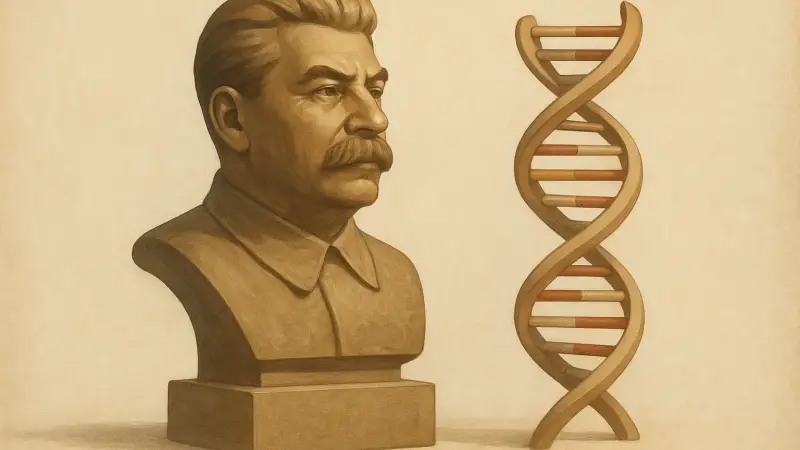
It’s easy to assume crop science is boring and slow. In the Soviet Union under Joseph Stalin, it became loud and urgent. By 1948, at a session of the Lenin Academy of Agricultural Sciences (VASKhNIL) in Moscow, Trofim Lysenko was presented as the voice of “correct” biology, and genetics was treated like a political enemy. The mechanism was blunt: if an idea matched the Party line and promised quick harvests, it was promoted; if it didn’t, it could be punished. Farms, labs, and classrooms all felt it. This wasn’t one single local incident. It spread across Soviet republics, from Ukrainian grain regions to Siberian test fields.
How genetics became a loyalty test
Lysenko rejected Mendelian genetics and the chromosome-based view of heredity that most biologists were using. He claimed plants could be “retrained” by their environment and pass on those acquired changes. That sounded politically comfortable. It echoed the idea that nature, like society, could be reshaped fast by will and correct guidance. In Stalin’s system, scientific disputes weren’t settled by experiments alone. They were settled by who could frame their claims as ideologically safe.
The label “Weismannism-Morganism” was used to tar geneticists as enemies, not just colleagues who disagreed. Once a field is defined as politically suspect, normal debate becomes dangerous. Researchers start writing to signal loyalty. People avoid certain words. Even careful, modest claims can look like sabotage if the wrong person decides they do.
What Lysenko promised farmers and officials
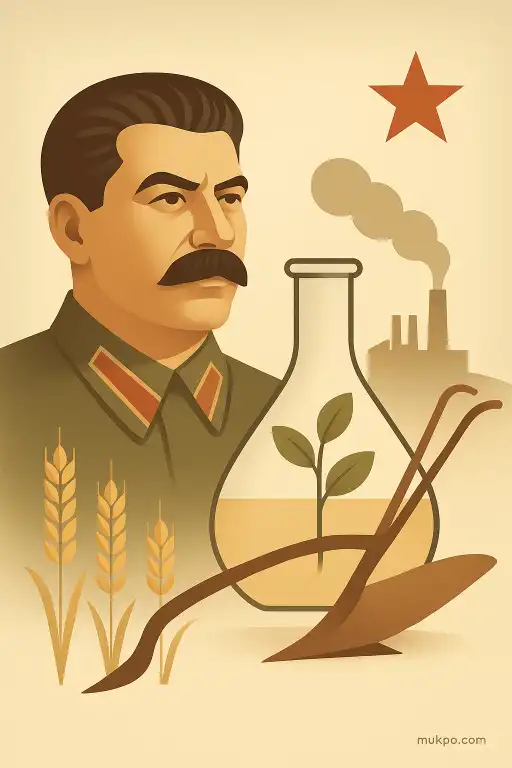
Lysenko’s best-known practical pitch was vernalization: treating seeds with cold and moisture to push crops through developmental stages. There was a real phenomenon behind the term. Some plants do respond to cold periods. But the campaign sold it as a broadly reliable lever that could boost yields quickly and widely, even where conditions and crop varieties differed. That kind of promise plays well when planners need numbers and deadlines, not cautious probabilities.
He also attacked the idea of fixed “varieties” and genetic limits. The implication was that anyone insisting on limits was making excuses. On collective farms, that turns into pressure. If a method is declared correct from above, local managers may feel they have to report success. Failures can be blamed on poor execution or bad attitudes rather than on the method itself, which keeps the cycle going.
Theater in the academy, consequences in the lab
The 1948 VASKhNIL meeting is often described as a turning point because it formalized the purge of genetics inside official Soviet biology. It wasn’t only a ban on certain conclusions. It was a redefinition of what counted as proper scientific behavior. Public sessions, denunciations, and set-piece speeches mattered as much as data. A biologist could be forced to recant not because their experiments were disproven, but because their framework was branded “bourgeois.”
A detail people often overlook is how quickly this changes the daily texture of work. It’s not just who gets arrested or fired, though that did happen. It’s that grant access, lab space, journal publication, and even permission to teach become political decisions. The safest career move becomes repeating official language. Over time, whole technical skills fade because fewer students are trained in them, and fewer papers can even mention them.
What it did to fields and harvest planning
When genetics is sidelined, plant breeding loses a key toolkit. Breeders still select plants, but they do it with a foggier model of why traits appear and persist. That matters for long projects like improving disease resistance or stabilizing yields across variable weather. Soviet agriculture already faced huge stresses—climate extremes, soil challenges, disruptions from collectivization, and war losses. A campaign that insists on quick transformations can push planning toward showy interventions instead of slow, cumulative improvements.
There were also logistical ripple effects. If a technique is declared universal, seed distribution and planting schedules may be reorganized to match the theory, even when local agronomists have doubts. The reporting chain then rewards good news. That can distort what central planners think is happening on the ground, because bad outcomes are risky to document and hard to attribute to “approved” ideas.
How it lasted, and how it unwound
The campaign held on not only through Stalin’s lifetime but into the post-Stalin years, because institutions had been rebuilt around it. Once departments are staffed with loyalists and textbooks are rewritten, reversal isn’t instant. It requires admitting that whole systems of training and evaluation were misdirected. That is difficult in any bureaucracy, and especially in one where yesterday’s orthodoxy was enforced with fear.
Over time, Soviet biology re-absorbed genetics, but the timeline and the degree of rehabilitation varied by institution and specialty. Some researchers had kept quiet lines of work going where they could. Others had left the field or been pushed out entirely. The result wasn’t just a wrong idea that got corrected. It was a reshaped scientific landscape, where what could be safely said had dictated what could be learned.
Related reads
- The fungus that carpets rainforest floors in blue light
- An elevator that stops for no passengers and opens to reveal a single folded note on the floor
- The microbes living on commuter shoes
- A shoemaker who found a child’s drawing hand-stitched inside a pair of century old boots
- How micrometeorites alter planetary atmospheres
- How quantum coherence helps plants harvest light