

A familiar corner, a strange after-rain pattern
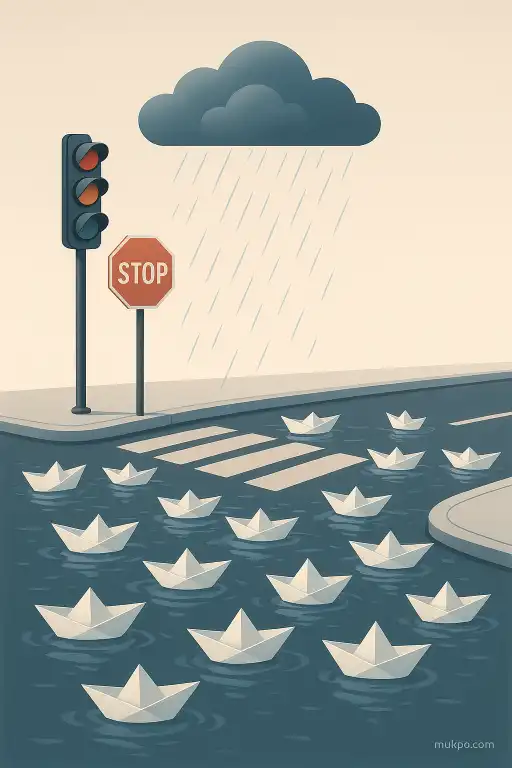
After a hard rain, some intersections don’t just shine and steam. They collect things. In a few cities, people have noticed the same odd scene: the crosswalk fills with hundreds of little folded paper boats, all nudged into the same shallow pool like they arrived on purpose. This isn’t one famous, single location with a plaque. It’s more of a repeatable setup that can happen anywhere, and versions have been spotted around storm-drain-heavy neighborhoods in places like London and New York City. The mechanism is usually ordinary. A rush of runoff, a choke point at the curb, and a lot of small paper shapes that were already nearby.
Where the boats come from

Most of the time, they start as something else. A kid folds one boat at a bus stop. Someone leaves a stack of flyers that gets soaked. A school project gets carried out in a sudden gust. The “boat” part matters because a folded hull is stiff enough to survive a brief trip and buoyant enough to float instead of collapsing into pulp right away.
There’s also a less charming source: drainage litter. Receipts, takeout bags, and paper packaging break down into panels and triangles as they snag, tear, and re-fold themselves against fences and curb grates. If the paper is coated or glossy, it resists water a little longer, long enough to behave like a boat for a few minutes. That’s why the boats can look surprisingly intact even when they clearly weren’t all made by hand.
How one intersection “collects” them
The street does the sorting. During a downpour, runoff forms narrow streams along the curb line. Anything light and flat gets pulled into that flow. At an intersection, several of those streams merge, and the water slows where the road crown changes or where the curb dips for a ramp. That slowdown is the whole trick. The boats stop traveling and start stacking.
A common overlooked detail is the tiny ridge of thermoplastic paint used for crosswalk stripes and lane markings. It sits a few millimeters proud of the asphalt. In shallow flooding, that ridge becomes a miniature dam. Floating paper hits it, pivots, and then gets pinned in place by the next piece arriving. From the sidewalk, it reads like a deliberate installation, but it’s often just a micro-topography problem repeated hundreds of times.
Why it happens after every big rain, not every day
To get “hundreds,” the water has to hit a narrow window. Too little rain and nothing moves far; the boats stay scattered in gutters or stuck in tree pits. Too much rain and the flow turns fast and deep enough to carry everything right past the intersection and into the nearest catch basin. The sweet spot is heavy enough to mobilize litter, but not so heavy that the intersection becomes a full-on channel.
Wind matters too. A gust in the first minutes of a storm can sweep paper off sidewalks and storefront ledges, adding fresh material right when curb streams are forming. The timing makes it look like the boats “arrive” all at once. They’re usually arriving over ten or twenty minutes, just quickly enough that a person who steps inside for coffee and comes back out thinks the street changed instantly.
Why the boats gather in one spot instead of spreading out
Paper boats don’t behave like leaves. Leaves waterlog and sink or stick to pavement. Folded paper traps a bit of air. It skims. When lots of skimming objects share the same shallow flow, they start to “raft” together. One catches on a rough patch of asphalt, another wedges against it, and soon there’s a floating mat that’s wider than the curb stream. After that, the mat becomes the obstacle that catches everything else.
If the intersection has a partially clogged storm drain, the effect amplifies. Water ponds higher, the crosswalk stripes become better dams, and the raft has time to grow before the drain clears. When the rain eases and the water finally drops, the boats can be left behind in a neat outline of where the puddle was, like a tide mark made of folded paper.
Related reads
- How a Victorian inventor smuggled a steam carriage into a London fair
- The Victorian surgeon whose public anatomy demonstration ignited a London street riot
- A supermarket aisle that keeps smelling like citrus, year after year
- How a Florentine guild in the 14th century outlawed laughter on market days
- The speeding years illusion: how perception compresses with age
- When a solar storm painted auroras across low latitudes