
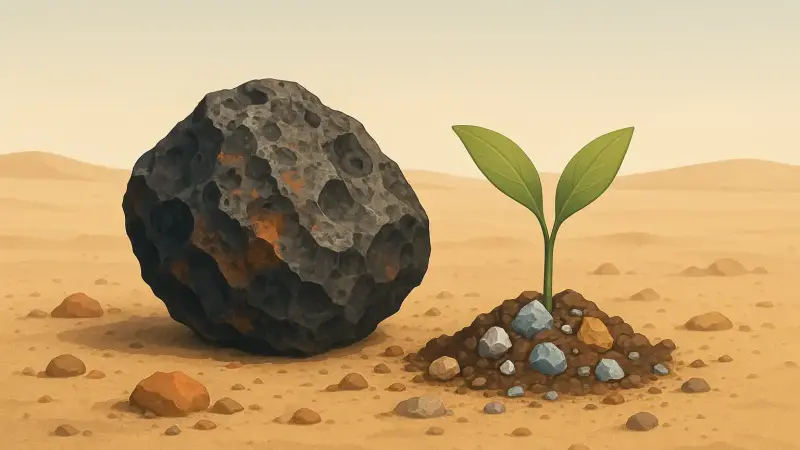
What people mean by “seeding” minerals
How can a single dark rock sitting on pale sand change the ground under it? It isn’t one single place or event. It can happen anywhere meteorites land and soils stay dry and exposed for a long time. Think of places like the Atacama Desert in Chile, the Sahara, or the deserts of Oman where meteorites are regularly recovered. The basic mechanism is simple: a meteorite brings in fresh, reactive material, then desert weathering and occasional moisture turn that material into new minerals right where it rests, and sometimes in a halo around it.
“Seed” doesn’t mean the soil suddenly makes gemstones. It means the meteorite acts like a starter kit. It supplies unusual elements and minerals, and it creates tiny chemical zones where new solids can precipitate. Desert soils are often slow to change, so even small inputs can leave a clear mineral fingerprint.
Why deserts make the effect easier to see
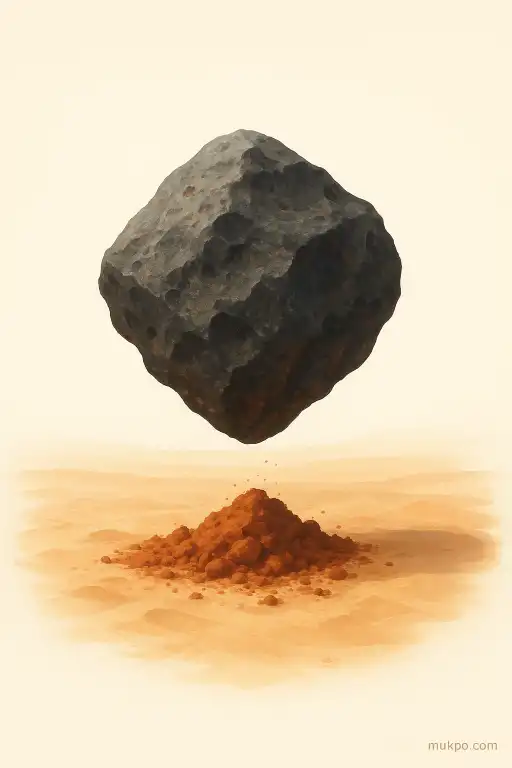
Deserts don’t have much flowing water, but they do have moisture. Dew, rare rain, fog, and brief runoff events still happen. That stop-and-go wetting is important. Water dissolves a little bit of metal and rock from the meteorite, then evaporation concentrates the dissolved ions until minerals fall out of solution.
Low biological activity also matters. In wetter soils, roots and microbes mix and recycle material fast, which can blur the chemical trail. In very dry ground, the chemistry can stay localized. A detail people often overlook is how shallow the action can be. The most distinctive new minerals may form right at the soil surface or within just a few centimeters, because that’s where evaporation is strongest and salts accumulate.
The meteorite starts corroding as soon as water shows up
Many meteorites contain metal-rich phases, especially iron-nickel metal and iron sulfides. Those are not stable for long at Earth’s surface. When a desert soil gets briefly wet, oxygenated water attacks those phases first. Iron oxidizes into rust-like minerals. Sulfides can produce sulfate. Nickel can be mobilized too, even if it ends up trapped again nearby.
That corrosion changes the local pH and redox conditions. It can make a small pocket of soil more acidic for a while, or create sharp chemical gradients between the meteorite surface and the surrounding sand. Those gradients matter because mineral formation is picky. A slight shift in pH can decide whether iron stays dissolved, sticks as an oxide, or combines with sulfate, chloride, or carbonate to make an entirely different solid.
New minerals can grow in a thin “halo” around the rock
Once ions are released, they don’t usually travel far in desert soils. Water films are thin and short-lived. That’s why researchers sometimes find a visible stain or a cemented crust around meteorites: iron oxides tint the soil red-brown, and salts can glue grains together. Under a microscope, that halo can include tiny nodules and coatings that were not present in the original sand.
The exact mineral list varies with the meteorite type and the local soil chemistry, so it can be unclear ahead of time what will form at a given site. But common outcomes are iron oxides and hydroxides, and sulfate or chloride salts if the environment supplies those anions. In some deserts, evaporite minerals are already part of the soil, and the meteorite just provides extra metal ions that get incorporated into those existing salt systems.
What scientists look for in real samples
A concrete example is meteorites recovered from the Atacama Desert, where long exposure can preserve a strong weathering signature. Teams compare the meteorite’s outer rind, the immediately adjacent soil, and soil a short distance away. They look for enrichment in iron, nickel, cobalt, and sometimes chromium, along with mineral changes that match those element spikes. The pattern can be surprisingly tight: a strong signal right next to the rock and a quick fade with distance.
They also pay attention to textures, not just chemistry. Thin coatings on individual sand grains, tiny crack-fillings, and cement that binds grains into a crust can all mark where solutions moved and then dried. Those features can persist long after the meteorite itself breaks apart, which is why a vanished meteorite can still “leave behind” a mineralized patch of desert soil that looks normal until it’s examined closely.
Related reads
- An island where cats outnumber people by the dozens
- The Italian town that banned high heels to stop tourists chipping its ancient stones
- How short routines calm decision anxiety
- The 1814 London brewery disaster that flooded streets with porter
- The town that resurfaces from a reservoir when waters fall
- How octopus suckers taste to choose prey