
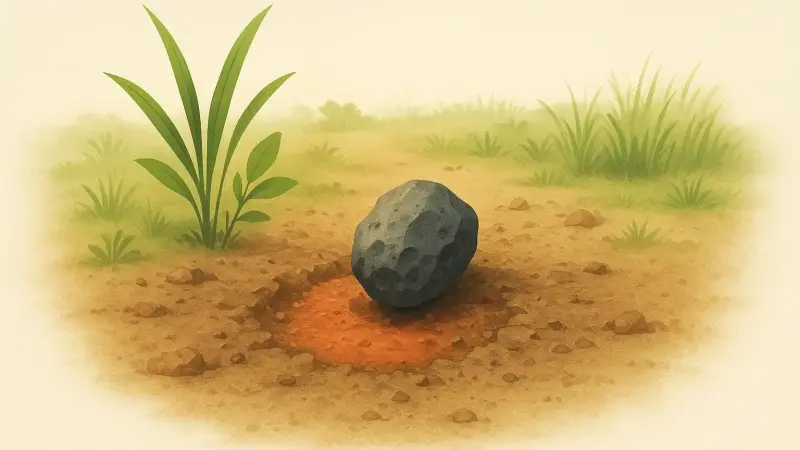
What would change if a pebble from space hit the ground and vanished from sight? Not one single place is “the” example here, because these tiny impacts happen across deserts, ice, and ordinary fields. Scientists have tracked the chemistry around small craters and fall sites in places like Meteor Crater in Arizona, the Sikhote-Alin meteorite fall area in Russia, and the Atacama Desert in Chile. The basic mechanism is simple: a fast impact shocks and heats a small patch of ground, mixes in a little extraterrestrial material, and then leaves behind fresh surfaces that react differently with air and water. The soil can end up measurably different from the soil a few meters away.
Shock, heat, and a brief moment of melting
Even a “tiny” meteorite arrives at speeds that are hard to picture. The impact doesn’t just make a dent. It briefly spikes pressure and temperature in the first centimeters to meters of ground. Mineral grains fracture, and some can partially melt or fuse into glassy droplets if conditions are right. That matters because intact crystals and shock-broken crystals weather differently. A cracked grain has more surface area and more reactive edges, so the same rainwater can pull out ions faster than it would from an unshocked grain.
A specific detail people often overlook is that the chemistry can change even without a big, obvious crater. A small burst of heat can “reset” the outer skins of grains. Those outer skins are where most reactions happen. So a very thin zone—sometimes just a few millimeters of altered material—can drive measurements that look like a much larger chemical change when soil is sampled and mixed in a lab bag.
A sprinkle of foreign metals changes the trace-element story
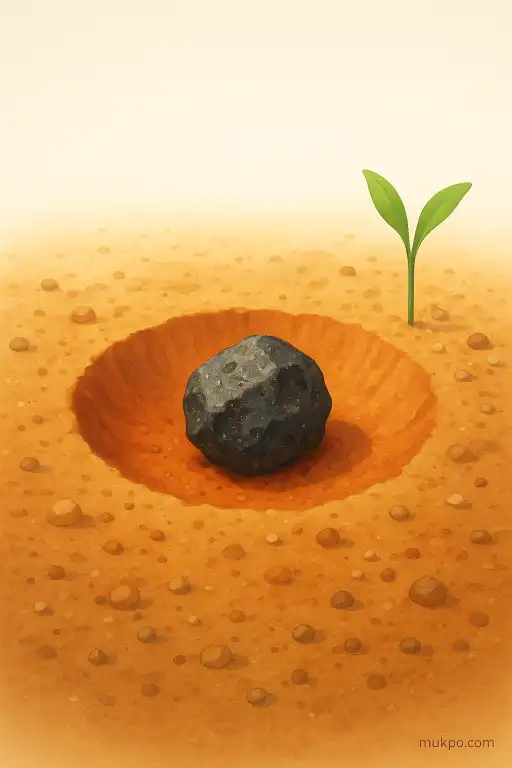
Meteorites are not just generic rocks. Many carry elevated nickel, cobalt, and iron compared with typical surface soils. Even a small mass can shift the trace-element pattern in the immediate area, especially if the meteorite breaks up and spreads fragments. At the Sikhote-Alin fall, for example, thousands of iron meteorite fragments were scattered over a broad zone. In a smaller fall with fewer fragments, the effect is patchier, and it can be hard to tell whether an unusual nickel spike is from the meteorite or from local geology without careful comparisons.
Those metals don’t stay in the same form. Once exposed, iron-bearing fragments begin to oxidize. They can form iron oxyhydroxides that act like sticky surfaces for other elements. Phosphorus, arsenic, and some rare earth elements can adsorb onto these new iron-rich coatings. The soil’s “available” chemistry can shift even if the total amount of the element in the ground hasn’t changed much.
Glass, ash-like fines, and brand-new minerals
If the impact is energetic enough to melt a little target material, it can create glassy bits and very fine dust. That fine fraction matters because soil chemistry is often dominated by the smallest particles. They hold more water films, exchange ions more readily, and move with wind or runoff. A patch of soil can end up enriched in certain elements simply because the impact made more “fines” that then settled nearby.
Sometimes new minerals appear as the melt cools or as hot material reacts with air. Tiny magnetite grains can form from iron-rich droplets. Sulfides can oxidize into sulfate minerals. These are small-scale changes, but they can show up in pH and conductivity measurements, and in how strongly the soil binds nutrients and contaminants. Exactly which minerals form varies a lot with local conditions, and it’s not always clear from field observations alone without lab work.
Water is the slow editor after the impact
After the flash of impact, the long chemistry is mostly about water. Rain, dew, and groundwater move soluble ions through the disturbed zone. If the new material includes reactive iron phases, they can acidify tiny microenvironments as they oxidize, even if the bulk soil pH barely shifts. That can increase the mobility of elements like manganese and nickel. It can also change which elements get locked onto clays and oxides versus which ones keep moving.
Climate controls how long these signals last. In very dry places like parts of the Atacama, weathering is slow and unusual trace-element patterns can persist longer. In humid soils, leaching can blur the chemical fingerprint faster. Bioturbation also matters. Worms, roots, and soil mixing can dilute a distinct layer into the surrounding profile over time, leaving a subtle gradient instead of a sharp boundary.
Why the chemistry looks patchy when people sample it
Field sampling tends to average over space, but impact effects are often lumpy. A few centimeters can separate a soil pocket full of oxidized meteoritic grains from soil that never saw a fragment. That’s why researchers often take paired samples—upwind and downwind, inside and outside an ejecta patch, or at set distances from a small crater rim. Without those comparisons, an odd nickel or cobalt value can look like noise instead of a real, local signal.
The other reason it looks inconsistent is that “soil” isn’t one thing. It’s a mix of mineral grains, organics, salts, and coatings on surfaces. A tiny impact can change the coatings more than the grains themselves. If a lab test dissolves coatings easily, it will report a big change. If it targets only the stable mineral core, it might report almost nothing. So two studies can both be right, just measuring different pieces of the same disturbed patch of ground.
Related reads
- The bench that always held a single lost glove belonging to the same person
- Why ordinary noises seem louder and creepier at night
- The mushroom that smells like rotting meat to lure flies
- A street mural that rearranges its bricks to spell new names at dawn
- How a single antibiotic reshapes your gut microbiome
- The park fountain that refilled itself with freshwater during a drought