
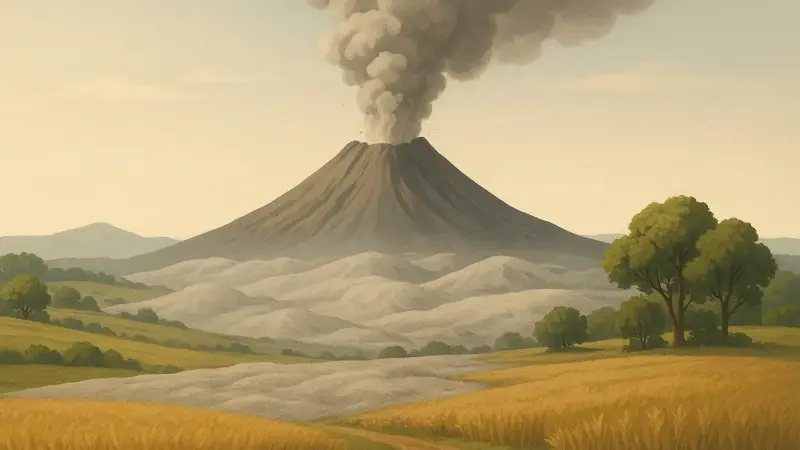
Why a volcano can change the weather far away
People tend to picture volcanic ash as a local problem, like gritty air and dark skies near the mountain. But big eruptions can also cool regions that never see a single ash flake. This isn’t one single event, and the details vary each time. It’s happened after Mount Pinatubo in 1991, after Tambora in 1815, and after Laki in Iceland in 1783–1784. The basic mechanism is simple: material blasted high into the atmosphere changes how sunlight moves through it. Less sunlight reaches the ground, and growing seasons get harder. That can show up later as smaller harvests and higher food prices.
Ash on the ground isn’t the main cooling agent
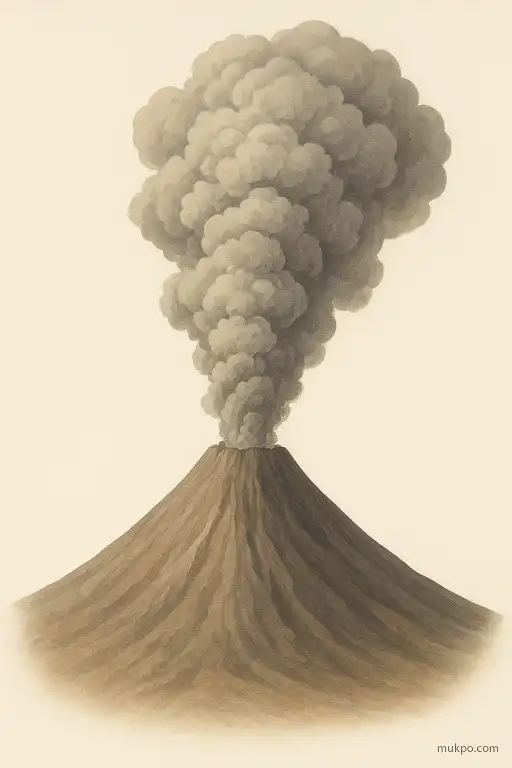
One easy detail to miss is that “volcanic ash” isn’t usually the main reason climates cool for a year or two. The strongest cooling tends to come from sulfur gases, especially sulfur dioxide, that rise into the stratosphere and turn into sulfate aerosols. Those tiny droplets are good at reflecting incoming sunlight. Ash particles are heavier. They fall out faster, often in days to weeks, and mostly near the eruption. Sulfate aerosols can linger longer up high, where there’s little rain to wash them out.
That difference in how long particles stick around changes everything. An eruption that injects a lot of sulfur into the stratosphere can cool the planet measurably, even if the ash fallout on the ground is limited to a region. Pinatubo is the classic example. Global average temperatures dipped for a short period after the eruption. The cooling wasn’t uniform, and local weather still wandered around year to year, but the signal was there in the global data.
Cooling isn’t just “less heat” for plants
For crops, cooler air is only part of the story. Plants respond to sunlight directly, and aerosols change the character of light, not just the amount. Skies can become hazier, which reduces total sunlight but can increase the fraction of diffuse light. That sounds subtle, but it affects how light penetrates a crop canopy. Some plants can use diffuse light efficiently, yet the overall reduction in energy can still slow growth, especially in already marginal seasons.
The overlooked piece is timing. A small temperature drop averaged over a whole year can hide sharper effects during planting, flowering, or grain fill. A few colder nights or a late frost can do more damage than a slightly cooler summer average. Volcanic aerosols can also shift rainfall patterns by nudging atmospheric circulation. That can mean drought in one place and unusual wetness in another, which matters as much as temperature for harvest size.
How a distant eruption shows up in food
After Tambora’s 1815 eruption, 1816 became known in parts of Europe and North America as the “Year Without a Summer.” The exact experience depended on where you were, but there were well-documented reports of unseasonable cold and crop trouble in several regions. It wasn’t that every day was freezing. It was that the warm months became unreliable. When that happens, farmers can end up with grain that ripens late, hay that doesn’t dry well, and harvest windows that close early.
Laki in 1783–1784 is another kind of case. It was a fissure eruption in Iceland that produced vast amounts of sulfur-rich haze. Conditions close to Iceland were extreme, but the broader atmospheric effects reached into Europe. Historical accounts describe a “dry fog” and respiratory problems in some places. Food impacts can come from both directions at once: reduced yields and higher stress on animals from poor pasture. When supplies tighten, the consequences ripple through markets and diets, even for people who never connect it to a volcano.
Why the same eruption doesn’t hurt every harvest
The atmosphere isn’t a simple mixing bowl. Where aerosols spread depends on how high the eruption column goes and where it occurs on the globe. Tropical eruptions that reach the stratosphere can spread aerosols into both hemispheres more easily than many high-latitude eruptions, but there are exceptions. Wind patterns at the time matter. So does the season of the eruption, because the stratosphere’s circulation changes over the year.
Even with the same amount of cooling, vulnerability differs. A region that already farms near temperature limits can see big yield changes from a small shift. Another region might mainly notice cloudier skies and a modest hit to certain crops. And the social side matters too. If reserves are low, transport is disrupted, or prices jump, a moderate yield drop can feel like a crisis. If storage is good and trade routes are open, the same physical shock can land more softly.
Related reads
- The fungus that turns tree leaves into luminous carpets
- Why volcanoes sometimes explode with blue flames
- A jar of honey unearthed with a perfectly preserved fly from a species thought extinct locally
- A museum label describing a missing painting that should have been in the next room
- A community garden where seedlings sprout in perfect geometric rings overnight
- How glow worms build living lanterns in caves