

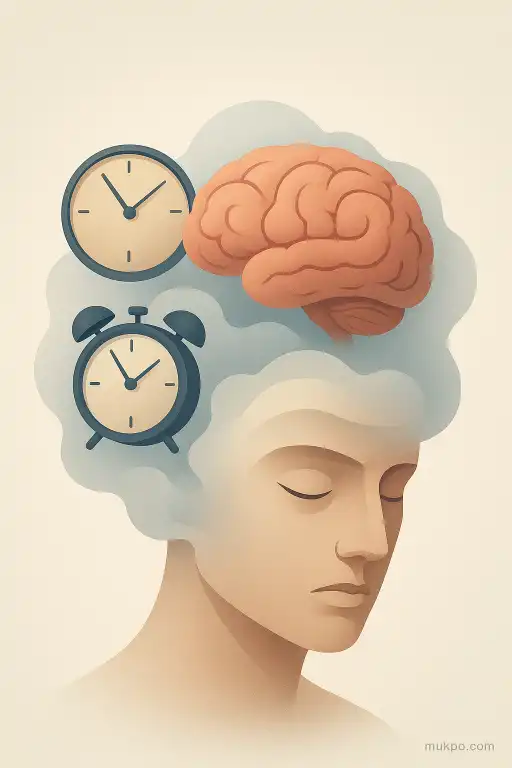
Those first minutes after waking can feel like trying to think through thick air. It isn’t tied to one place or one incident. People describe it in New York subway stations, in Tokyo apartments, and on rural commutes in Australia. The basic reason is straightforward: parts of the brain don’t “come online” at the same speed. Sleep doesn’t switch off like a light. It unwinds in stages, and waking does too. While the eyes are open and the body is upright, key networks for attention, working memory, and self-control may still be running on sleep chemistry, slow blood-flow patterns, and leftover sleep pressure.
Waking is a process, not a moment
Sleep is built from repeating cycles, and the timing of waking matters. If someone wakes out of deep non-REM sleep, the “sleep inertia” feeling tends to be stronger than if they wake near the lighter edge of a cycle. That’s why a person can pop up alert at 6:58 one morning and feel heavy and confused at 7:02 the next, even with similar hours of sleep. The brain state at the instant of waking varies, and it changes how fast mental speed returns.
A specific detail people often overlook is that the confusion can show up even when a person feels physically fine. Standing, walking, even holding a short conversation can happen while attention and reaction time are still dulled. It’s not just “still sleepy.” It’s a temporary mismatch between basic arousal and higher-level cognition.
Sleep inertia: the brain runs on leftover settings

Sleep inertia is the name researchers use for that groggy carryover. During sleep, neuromodulators shift. Adenosine, which builds with time awake, contributes to sleep pressure. As waking begins, adenosine doesn’t instantly clear. Cortisol, which follows a daily rhythm and usually rises toward morning, may help push the body toward alertness, but it doesn’t snap the mind into top gear on command. Melatonin can also still be present, especially if waking happens before the body clock expects it.
This overlap creates a brain that is awake enough to move, but not awake enough to do fast mental switching. Tasks that require holding a plan in mind, tracking time, or resisting distractions are often the slowest to recover, because they lean on networks that are sensitive to those chemical and rhythmic transitions.
Not all brain regions wake at the same speed
Different parts of the brain show different “restart” timelines. Frontal regions involved in executive control and working memory are commonly implicated in that early fog. They’re the ones needed for composing an email, doing mental math, or remembering why you walked into the kitchen. Meanwhile, more basic sensory and motor systems can be relatively functional. That uneven return is one reason people can read words on a screen yet fail to absorb meaning, or open an app and forget what they meant to do.
There’s also a sluggishness in coordination between networks. Attention relies on communication between arousal systems in the brainstem and cortex-wide networks that select what matters. Early after waking, that coordination can lag. The result is a mind that drifts, misorders steps, or takes longer to “lock on” to a single task.
The body clock can fight the alarm
Circadian timing changes the feel of the first minutes. Waking at a time the internal clock tags as “biological night” tends to produce heavier inertia than waking at the clock’s natural morning. This is why the same person may feel sharper after five hours of sleep during a late vacation wake-up than after seven hours when forced up earlier for a flight. The brain isn’t only tracking sleep duration. It’s tracking time-of-day biology.
A concrete example shows up in night-shift work. A nurse finishing a hospital shift at dawn may be wide awake driving home, then feel strikingly foggy after sleeping through the morning and waking mid-afternoon. The schedule can flip the circadian signals, so the body pushes sleepiness at times when social clocks expect performance.
Why simple things feel oddly hard
Early grogginess is often most obvious in “small” cognitive tasks: finding the right word, tracking a short list, noticing an error. That’s because these depend on working memory and rapid updating. The mind may also have reduced error-monitoring at first, so mistakes don’t feel noticeable until a few minutes later. People might pour coffee twice, answer a message without reading it fully, or walk into a room and stand there, waiting for the intention to reappear.
Another overlooked detail is that the environment can mask the fog. Bright light, movement, and conversation can make someone seem awake, while reaction time and judgment are still dulled. That gap is part of why the early minutes can feel confusing in hindsight: the body looks functional, but the brain’s “fast lanes” are still opening.
Related reads
- How volcanic ash once cooled climates and shrank harvests
- The fungus that turns tree leaves into luminous carpets
- Why volcanoes sometimes explode with blue flames
- A jar of honey unearthed with a perfectly preserved fly from a species thought extinct locally
- A museum label describing a missing painting that should have been in the next room
- A community garden where seedlings sprout in perfect geometric rings overnight