
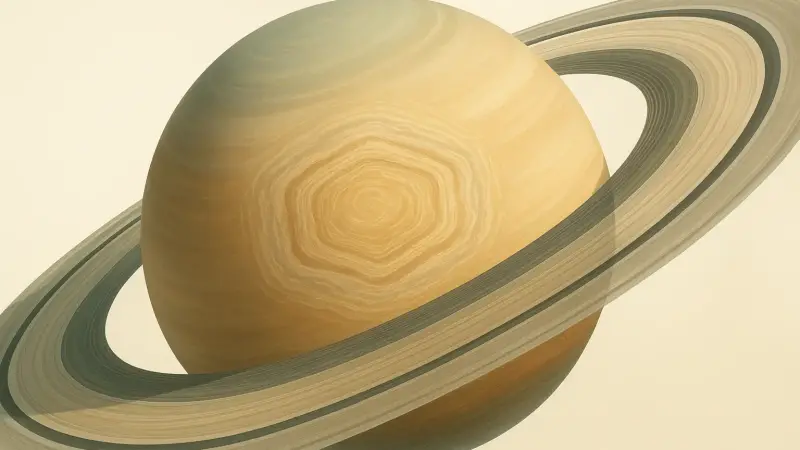
Why a storm would make a six-sided shape
Most storms make circles. So Saturn’s north pole is a quiet contradiction: a giant jet stream that settles into a neat hexagon. It isn’t one single event with one date. It’s a persistent pattern seen over years, especially in images from NASA’s Cassini mission after it arrived at Saturn in 2004. The core mechanism is wind shear inside a fast polar jet. A narrow band of air races around the pole. Adjacent bands at slightly different speeds tug on it. That tugging doesn’t just blur the boundary. Under the right conditions, it organizes it into a standing wave that has six lobes, so the edge looks like straight sides and corners.
The jet stream sits on a boundary
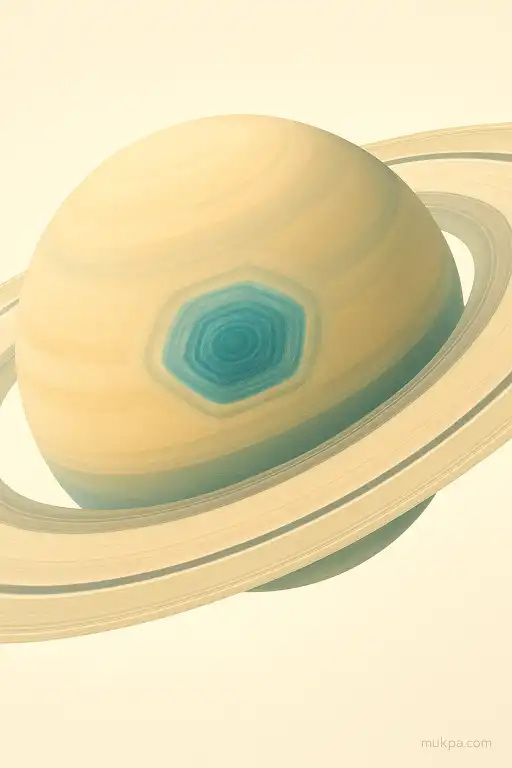
The hexagon isn’t a solid wall of cloud. It’s a shape traced by a sharp contrast in wind speed and cloud appearance. Think of it as a fast river next to slower water. The boundary is where instabilities like to form, because small bends get stretched and sharpened. On Saturn, that boundary wraps all the way around the pole as a jet stream that moves eastward. The hexagon marks where the jet is strongest and where clouds pile up or thin out in a way that makes the edge visible.
One overlooked detail is that the shape is not pinned to individual cloud clumps. The clouds within it can swirl, fade, and reform, but the hexagon outline keeps its position and drift rate. That’s a clue that the geometry is controlled by the flow pattern, not by particular “features” painted on top.
Standing waves can lock into six sides
A fast jet can support waves along its edge, like ripples that run around the ring. On Earth this shows up as large-scale meanders in jet streams, sometimes called Rossby waves, driven by rotation and the way the Coriolis effect changes with latitude. On Saturn’s polar jet, a wave can become “standing,” meaning its peaks and troughs stay in fixed positions around the pole while the air itself keeps flowing through. If the standing pattern has six peaks around the circle, the boundary bulges outward six times and inward six times, and the outline reads as a hexagon.
Why six and not five or eight? The exact number depends on the jet’s speed profile, the width of the jet, and how sharply the wind speed changes across it. Those set which wavelengths are stable. In lab experiments where a rotating fluid tank is driven to create a fast ring-shaped jet, polygon patterns appear with different numbers of sides as you change the rotation rate and the forcing. Saturn seems to sit in a regime where six is a stable mode for that polar jet.
Saturn’s rotation makes the pattern hard to disrupt
Saturn rotates quickly, and its atmosphere is deep. Both matter. Rapid rotation strengthens the organizing role of the Coriolis effect, which favors broad, coherent flows over small, chaotic swirls. It also helps maintain narrow jets that can act like waveguides. The polar jet is not isolated from the rest of the atmosphere, but the rotation makes it easier for the system to hold onto a preferred wave pattern once it forms.
Vertical structure also matters, and it’s easy to miss because the hexagon is usually shown as a flat image. Cassini saw the pattern in different wavelengths that probe different heights, suggesting the winds are not just a skin-deep surface effect. The shape appears to extend upward through a layer of the atmosphere, which helps it resist being erased by short-term weather.
What the hexagon is and isn’t telling us
The hexagon is a boundary pattern, not a literal six-sided cyclone. A cyclone sits inside it at the pole, but the polygon is the jet around that region. It also isn’t a permanent “scar” in the clouds. Its visibility changes with lighting and seasons, and some details vary between observations. Cassini, for example, tracked how the north polar region’s appearance shifted as sunlight returned after winter, even while the basic geometry stayed recognizable.
There is still uncertainty about how the jet is maintained over long timescales, because that depends on how energy moves through Saturn’s atmosphere and how deep the driving flows go. But the carving tool is clear enough to describe: a fast, narrow polar jet with strong shear that supports a stable, six-lobed standing wave, so the edge of the flow keeps drawing straight-looking sides around the pole.
Related reads
- The deep-sea shrimp that carries bacterial gardens on its claws
- Why certain smells unlock exact moments from your past
- A postcard that arrived nearly a century after it was mailed
- How micrometeorite impacts forge glass beads in lunar soil
- Why you freeze during public speaking
- Why glacial flour turns alpine lakes brilliant turquoise