
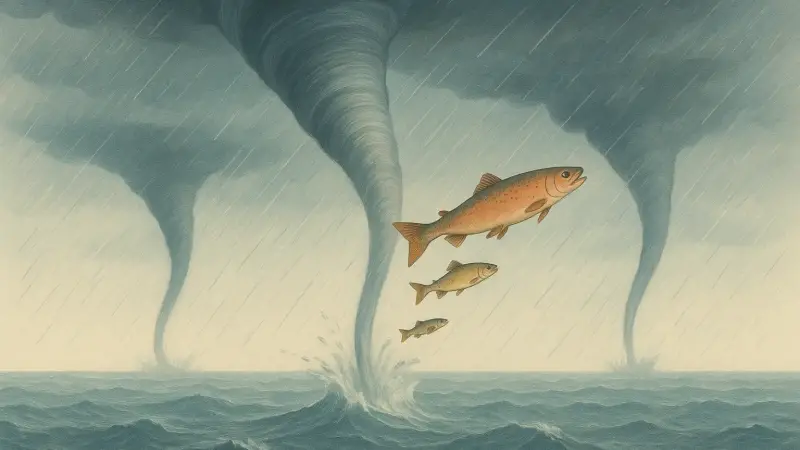
Seeing fish where fish shouldn’t be
People sometimes walk outside after a storm and find fish on the road. It sounds like a prank until you remember waterspouts. They’re tornado-like columns that form over water, and they can briefly connect a choppy surface to the base of a thundercloud. This isn’t one single famous incident. Reports pop up in different places: coastal Florida, the Mediterranean near Italy, and parts of Australia. The basic mechanism is simple. A tight, rotating updraft passes over shallow water. It can yank up spray and lightweight animals. Then the storm carries them and drops them somewhere else when the circulation weakens.
How a waterspout forms over water
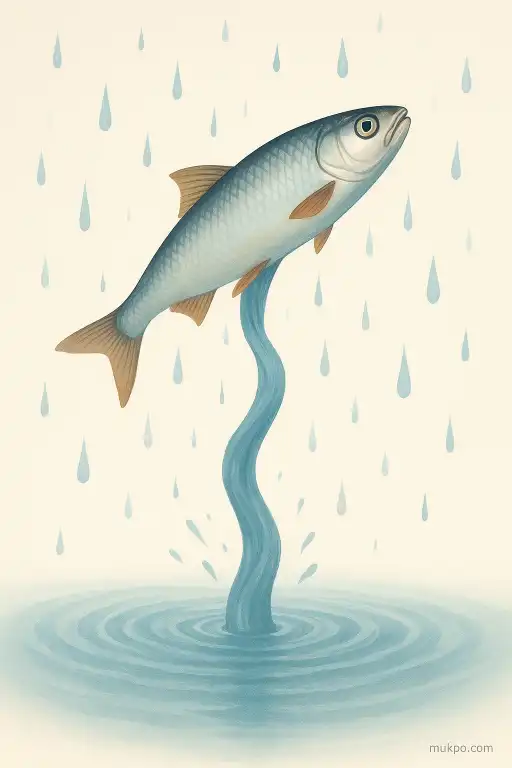
A fair-weather waterspout can grow from a line of developing cumulus clouds. It starts with a dark patch on the water, then a spinning ring of spray, then a thin funnel that may or may not reach the surface. Tornadic waterspouts are different. They’re basically tornadoes over water, tied to stronger thunderstorms and wind shear. Either way, the key ingredient is a narrow zone of low pressure and rising air. Air converges toward it, rotation tightens, and the upward pull gets strong enough to lift water droplets high into the cloud base.
One overlooked detail is that the visible “tube” is mostly condensation and spray, not a solid vacuum hose. The lifting happens because air is moving upward fast inside and near the core. That upward motion is uneven. It pulses. It also tilts and wobbles. So the spout doesn’t need to be perfectly “connected” from cloud to water the whole time to loft things upward.
How fish and frogs actually get pulled up
Waterspouts don’t usually grab big, heavy fish from deep water. The creatures that show up in odd places tend to be small and light. Minnows, small perch, tiny frogs, and sometimes small crabs. They’re often near the surface already, especially in shallow bays, flooded ditches, fish farms, or coastal lagoons where schools cluster at the top. The spout’s winds whip the surface into a froth. That makes it easier for animals to be swept into the rising spray, rather than “vacuumed” out one by one.
You’ll also notice that these falls often involve one type of animal. That’s a clue people miss. A waterspout passing over a school can collect mostly similar-sized fish in a short window. It’s less consistent with a random “storm picked up whatever was around” story. It’s also why some reports describe fish that look freshly caught, while others find battered ones. The trip can be gentle if they’re in a wet, turbulent updraft. Or rough if hail, strong turbulence, or downdrafts get involved.
Where the “rain” of fish comes from
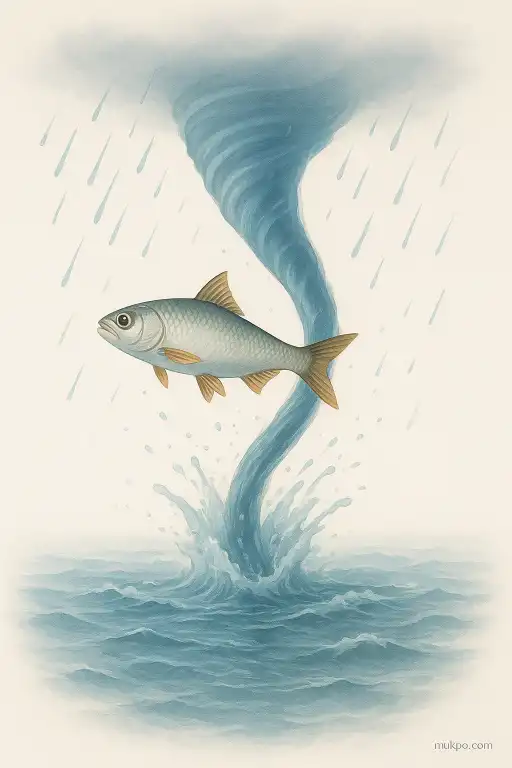
Once fish are inside the storm’s circulation, the problem becomes transport, not lifting. A waterspout can merge into a storm cell or fall apart while the thunderstorm keeps moving. The animals can stay suspended for a while in the cloud’s turbulent updrafts, mixed with heavy rain. Then a downdraft or the collapsing edge of the storm drops them. That drop can happen miles inland if the storm is fast-moving. It can also happen close to the coast if the circulation breaks quickly.
A concrete example people mention is Florida’s Gulf and Atlantic coasts, where summer thunderstorms and waterspouts are common. A spout can form offshore, cross a short stretch of water, then weaken as it reaches land. If the storm is already producing intense rain, the fish fall can look like they “came with the rainfall,” even though the pickup happened earlier and offshore.
What tends to show up on the ground, and why
These events rarely leave a neat blanket of fish across a whole town. The pattern is usually patchy. A few blocks, a parking lot, one stretch of road, a field edge. That’s because downdrafts land in narrow shafts, and the storm’s winds sort falling objects by weight and shape. Small fish can drift farther than you’d expect. Heavier ones drop sooner. If the storm is rotating, different sizes can even fall in different bands.
Another overlooked detail is timing. People often discover the fish after the main rain has moved on, because the fish stand out once puddles start to clear. That delay makes it feel stranger than it is. The storm did the moving earlier, while everyone was indoors listening to thunder and watching the trees bend.
Related reads
- Why you suddenly forget a familiar word mid-sentence
- The village that changes its postal codes as a superstition
- An office building whose plants only thrive when given live music
- How the 1755 Lisbon earthquake sent Enlightenment salons into philosophical panic
- How the 1778 Potato War over Bavarian fields turned Europe’s armies into crop thieves
- How tiny mineral magnets make sand dunes align