
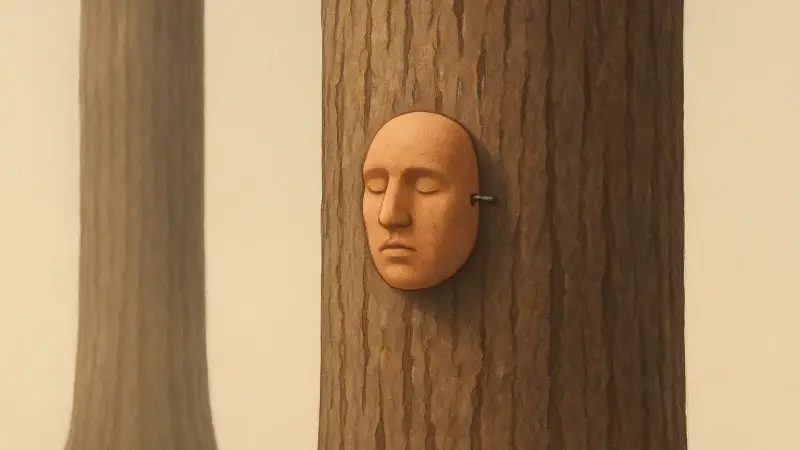
On some streets, people start noticing a strange new “detail” on their daily walk. A thumb-sized clay face. A tiny nail through it. Pressed into the bark of a maple like a little badge. This isn’t one single documented incident with one confirmed street and culprit. It pops up in different places and then gets copied. You can find public examples of miniature faces attached to trees in Vancouver (the “Guy in the Trees” figures), and similar small “tree face” pieces show up in U.S. and U.K. neighborhoods in local photo posts and short news blurbs. The basic mechanism stays the same: small fired or air-dry clay, fastened quickly, and noticed slowly.
How the faces get made and attached
The faces tend to be simple because they have to survive handling. A little slab of clay gets pressed into a mold or shaped by hand, then textured with something sharp for wrinkles, eyelids, and teeth. Some are kiln-fired, but plenty are air-dry clay sealed with varnish. The attachment method is usually a short brad nail, a small finishing nail, or a tack. That choice matters because it’s fast, quiet, and doesn’t require holding the piece in place for glue to cure.
A detail people often overlook is the tree species and bark. On maples, the bark can be tight and relatively smooth when young, then develops shallow furrows as it ages. That gives the nail a predictable bite and makes the face sit flat. It also makes the nail hole less obvious than it would be on very flaky bark. From the sidewalk, the nail head can be invisible unless the light hits it at the right angle.
Why maples and why a single street
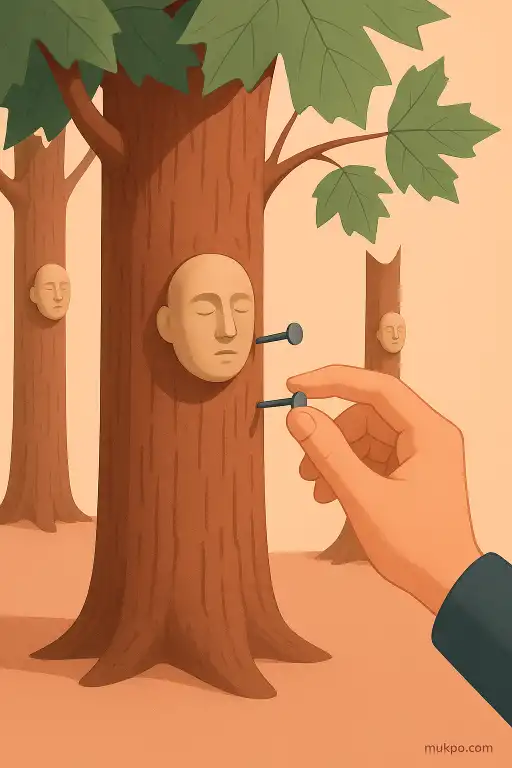
When these appear “on one street,” it’s often because the installer is working within a comfortable walking loop. Street trees are regularly spaced. They’re also consistent in height and trunk diameter, especially in older neighborhoods with planned plantings. That turns the street into a ready-made gallery. Maples are common as street trees in North America and parts of Europe, so they become the default canvas even if the person isn’t seeking them out.
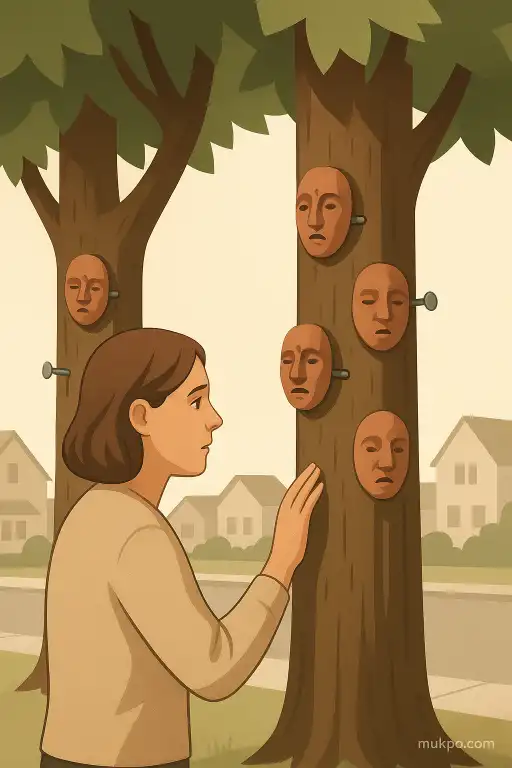
There’s also a visibility trick. A face placed at about adult eye level gets noticed. A face placed lower gets found by kids and dog-walkers who glance down. People often assume “someone must have done them all in one night,” but clusters can build slowly. One or two pieces can sit unnoticed for days, then a neighbor spots the third and suddenly everyone scans every trunk on the block.
What neighbors usually read into it
Reactions split fast. Some people treat it like harmless street art. Others worry about surveillance, marking houses, or a threat. The object is small and human-faced, which pushes the brain toward “someone is watching” even when it’s just clay. The fact that it’s nailed, not tied or taped, adds a sense of intent. It feels like a permanent act, even though the piece can be removed quickly.
What makes it stick in memory is the mismatch between materials and setting. Clay belongs in a studio or a garden. A nail belongs in a fence. Put them together on a living tree and it reads as both careful and slightly wrong. Even people who like it may still feel uneasy, because the face is a familiar human shape in a place where you don’t expect anything to “look back.”
The overlooked impact on the tree
A single small nail usually doesn’t kill a healthy street tree, but it does create a wound. Trees don’t “heal” the way skin does. They compartmentalize damage by growing new tissue around it. The hole can become an entry point for moisture and organisms, especially if the nail rusts or if the piece wiggles in wind and repeatedly abrades the bark. On a maple, repeated small injuries on the same trunk section can leave a scar band that stays visible for years.
The other overlooked part is what happens after removal. If a neighbor pries the face off, the bark can tear, making a larger wound than the original nail made. That’s why these objects can quietly escalate from “odd decoration” to “tree damage” in the way people talk about them, even if the original intent was playful.
How this becomes a repeating local pattern
Tiny additions to public space spread because they’re easy to copy. A person sees a photo, makes a few at home, and tries it on the nearest row of street trees. Once there are several pieces, the street itself does the advertising. Passersby point them out. Someone posts them. Then the neighborhood gets a new micro-story that doesn’t require a big explanation, just a quick “have you seen the faces?”
Sometimes there’s an identifiable local art project, but often it stays anonymous because the action is small and informal. The faces don’t need a signature to work. They just need to be at the right height, on the same kind of trunk, close enough together that the next one feels inevitable when you keep walking.
Related reads
- A sealed plaster cavity containing a century old shopping list with tomorrow’s date circled
- Phantom phone buzzes: how expectation rewires your touch senses
- How the Royal Mint’s Trial of the Pyx exposed coiners in Georgian London
- The piano whose ivory keys rearranged themselves while caretakers slept
- Bronze statue that seems to sweat during heat waves and spooks tourists
- Why the word sits on the tip of your tongue and won’t come out