
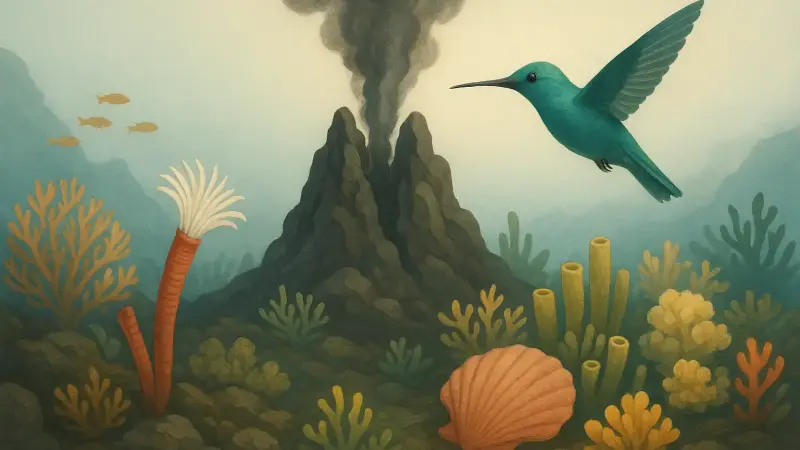
A place that runs on chemicals, not light
Most food chains start with sunlight. Hydrothermal vents don’t. They sit on the seafloor where it’s dark all day, and yet they can be crowded with life. It’s not one single vent system. It varies by ocean and geology. The East Pacific Rise, the Galápagos Rift, and the Mid-Atlantic Ridge’s Lost City field are well-known examples. The basic trick is simple: hot water from inside Earth carries chemicals that microbes can turn into usable energy, and larger animals build their lives around those microbes.
What a vent actually is, physically
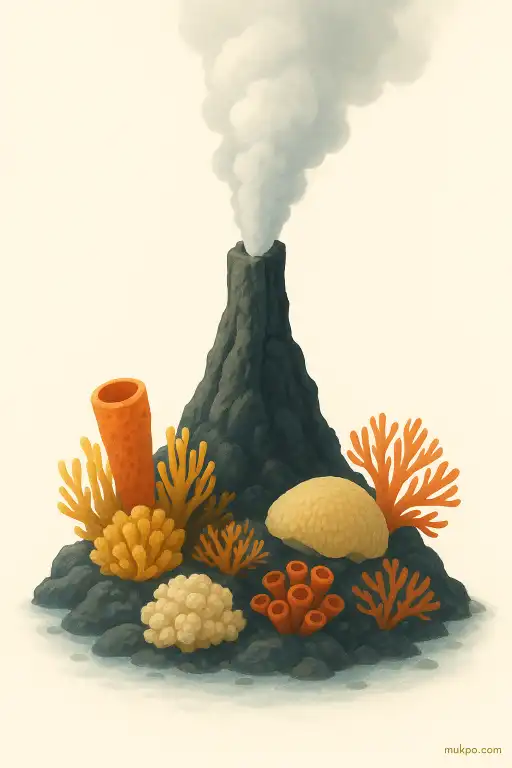
A vent is seawater that has seeped down into cracks, gotten heated by hot rock or magma, reacted with the crust, and then blasted back out. When that fluid hits cold seawater, minerals drop out and can stack into chimneys. Some “black smoker” vents look smoky because they spew tiny mineral particles, often rich in metal sulfides. Other vents are cooler and more alkaline. Lost City, for example, is driven by reactions between seawater and mantle rock rather than a nearby magma chamber.
The overlooked detail is how sharp the boundaries are. The vent fluid and surrounding seawater don’t instantly mix into a mild soup. They form steep gradients over centimeters. Temperature, acidity, and chemicals can shift dramatically across the width of a hand. Those razor-thin transition zones create lots of distinct micro-habitats right next to each other, which helps explain why the same rocky patch can host very different organisms.
Where the “primary production” comes from
At vents, microbes do the job that plants do on land. They make organic matter from carbon dioxide, but they don’t need sunlight. Many use chemosynthesis, often powered by hydrogen sulfide, hydrogen, methane, or reduced iron coming out of the vent. With oxygen from seawater as an electron acceptor, those reactions release energy. The microbes spend that energy building biomass. That biomass becomes food, directly or indirectly, for everything else nearby.
It’s not always one chemical pathway. Some microbes use oxygen, others use nitrate, sulfate, or other compounds when oxygen is scarce. That flexibility matters because the vent environment is patchy. It also changes fast. A chimney can clog, break, or shift flow. Microbial communities can reassemble quickly because they’re small, they reproduce fast, and the chemistry can favor different species from one crack to the next.
How animals turn microbes into a whole community
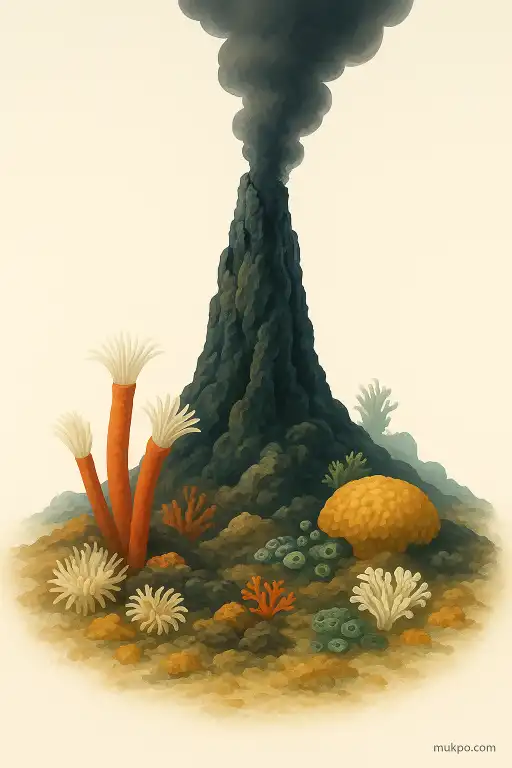
The famous vent animals aren’t famous because they’re great hunters. They’re famous because they partner with microbes. Riftia pachyptila, the giant tubeworm from the East Pacific Rise area, has no mouth or gut as an adult. Instead it houses chemosynthetic bacteria in an organ called a trophosome. The worm supplies the bacteria with hydrogen sulfide, oxygen, and carbon dioxide, and the bacteria supply food back to the worm.
Other animals do similar trades in different ways. Some vent mussels host methane-oxidizing or sulfide-oxidizing bacteria in their gills. Many vent shrimp and crabs graze on microbial films growing on rocks, or even on their own bodies. Predators show up too, because a dense base of microbial production supports worms, clams, and snails, and then larger animals that eat them. The community is “lush” because the energy source is local and concentrated, not because it’s spread evenly like sunlight over a landscape.
Why these ecosystems are productive but fragile
Vents can pump out chemicals for years, decades, or longer, but individual sites can also shut down suddenly. Earthquakes and eruptions can bury or open new vents. When a vent dies, the local food supply collapses because the chemical gradients flatten out. That pushes animals to disperse, if they can. Many vent species release larvae that drift on deep currents, hoping to land on another active site. The distances between active vents can be large, and it’s not always clear how often larvae successfully bridge those gaps.
Even at an active vent, survival is a balancing act. Hydrogen sulfide can be an energy source for microbes and also a poison for animals. Many vent animals rely on specialized blood proteins or other chemistry to transport oxygen and sulfide safely without letting either one shut down basic respiration. That’s part of why the busiest spots are often right at the edge of the flow, where there’s enough vent chemical to feed the microbes and enough seawater mixing to keep oxygen available.
Related reads
- How we make snap moral judgments in a blink
- When the Great Stink halted Victorian Parliament
- The silent chemistry that paints autumn leaves in reds and golds
- What makes lightning behave differently over oceans and mountains
- The desert dunes that sing when you walk on them
- Why songs get stuck in your head