
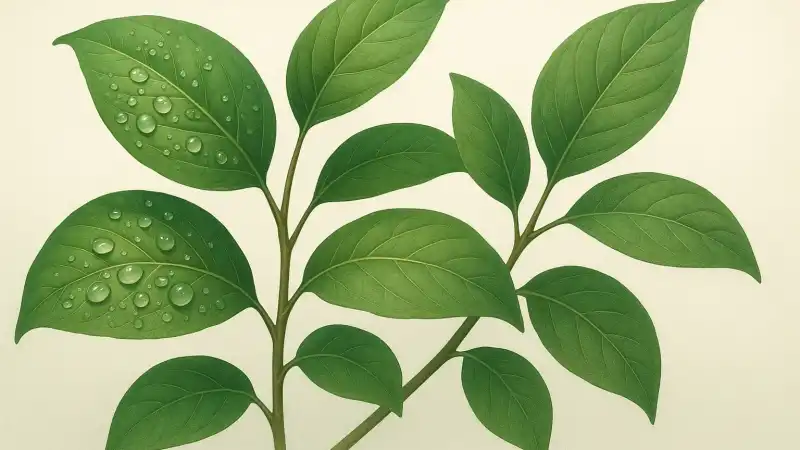
On some mornings, a leaf can look like it’s been sprinkled with tiny glass beads, while the leaf right next to it looks almost untouched. This isn’t one single “place” phenomenon. You can see it in a London park, a rice field in Japan, or a backyard in Florida. The basic reason is simple: dew forms when a surface cools below the dew point, but whether it gathers into visible droplets depends on the leaf’s surface chemistry and texture. Some leaves make water pull into round beads. Others make it spread into a thin film you barely notice, or shed it before it can build up.
Dew needs cooling, not rain
Dew is usually a night-and-early-morning event. Leaves radiate heat to the open sky and cool down, sometimes becoming cooler than the surrounding air. If that leaf surface drops below the dew point, water vapor in the air condenses onto it. Wind, cloud cover, and what the leaf “sees” overhead all matter because they change how fast the leaf can lose heat by radiation.
A concrete example is a clear, calm morning in a city park: grass and low plants often get heavier dew than taller shrubs under a tree canopy. The canopy acts like a blanket. It reduces radiative cooling, so the leaves underneath may never get cold enough for much condensation, even though the air feels equally damp.
Why beads form on some leaves
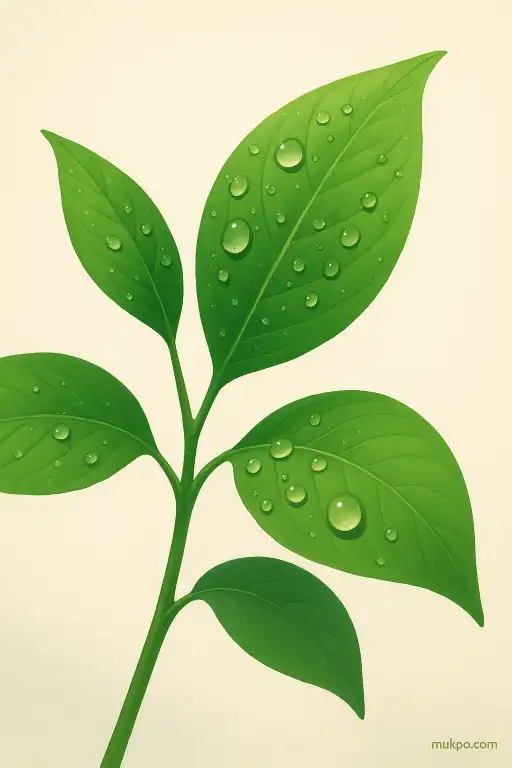
Once water condenses, the next question is what shape it takes. On a waxy, water-repellent surface, droplets pull themselves into rounded beads. That comes from surface tension and a high contact angle: the edge of the droplet doesn’t want to spread across the leaf. Many evergreen leaves, and a lot of young leaves with a fresh wax layer, behave this way. The beads look obvious because they’re thick and catch light.
On a more water-attracting surface, condensation spreads out. It can form a thin, nearly transparent sheet that darkens the leaf but doesn’t sparkle. You can walk past it and think it stayed dry. It didn’t. The water is just distributed differently, and the “dew look” disappears unless the angle and light are right.
Texture, hairs, and tiny valleys
Microscopic structure can matter as much as chemistry. Some leaves have fine hairs (trichomes). Others have ridges, pores, or a rough cuticle. These features change where the first condensation sites appear and how droplets grow. Small bumps can pin the edge of a droplet in place, so lots of small beads stay separate instead of merging into a few larger ones.
A specific detail people usually overlook is that the “beads” often sit on top of air trapped in the texture. That trapped air reduces contact between water and the leaf surface, which encourages beading. If the texture gets clogged with dust or pollen, the effect can weaken. The same plant can show different dew patterns after a windy week or after nearby soil has been disturbed.
Why some leaves look dry even when they’re wet
Sometimes the leaf truly carries less dew because it stays warmer. Leaf angle and position matter. A leaf facing the open sky cools faster than a leaf tilted toward the ground or sheltered by other leaves. Even on the same branch, the outer leaves can condense more water simply because they radiate heat more effectively.
But “looks dry” can also mean “water moved.” If droplets merge and become heavy, they can roll off easily on a waxy surface. That can leave the leaf appearing clean and dry while the water ends up at the tip, on a lower leaf, or on the soil. This is easy to miss because it happens quietly, and the evidence is often a single larger drop hanging from a leaf edge.
Species differences and daily changes
Different species build different cuticles. Some produce thicker waxes, some produce more porous surfaces, and some have coatings that change as the leaf ages. A brand-new leaf can bead strongly, then start wetting more evenly weeks later as the surface chemistry shifts, gets abraded, or accumulates residues. That’s one reason dew behavior can vary even within the same plant over a season.
Even when the species stays the same, the conditions don’t. Humidity, temperature drop overnight, wind, and nearby surfaces all shift the balance between condensation, spreading, and runoff. So two leaves can start the night similar, then end up one covered in visible beads while the other carries its moisture as an invisible film, or loses it in a slow series of tiny slides toward the ground.
Related reads
- Why pretending calm can sometimes actually soothe your panic
- Why compliments can feel uncomfortable to receive
- How emotional moods spread through a group without a word being said
- How bombardier beetles fire boiling chemicals as defense
- Earworms explained: why a fragment of a song repeats in your head
- A cave where bats abruptly changed their songs and left scientists baffled